Mea culpa. Last season got ahead of me, and this blog, unfortunately, fell behind.
Let's see if the 2018 season goes any smoother.
The group has already had a full off-season of demonstrations and recruiting events: the Puyallup Antique Show, Cascade Mountain Man Show, a living history day at the Ft. Lewis museum, and a boy scout outing, among others. We also had the usual pre-season work party, to get the company's tents and gear in order for the summer. As usual, a large quantity of rain also decided to attend.
Coming up soon: the WCWA's School of the Soldier at Union Gap, and the Armed Forces Day living history event at Fort Lewis.
Showing posts with label Information Post. Show all posts
Showing posts with label Information Post. Show all posts
Thursday, April 19, 2018

Tuesday, July 28, 2015
Men's Civilian Attire
 |
| "First Class: The Meeting", 1855, by Abraham Solomon |
The best starting reference I've found is Mrs. Kessinger's wardrobe guide. Several of the on-line discussion spaces named in the ladies' posts also address gents' attire, ie, The Sewing Academy, The Civilian Civil War Closet (you do need to log onto Facebook to view the latter). As always, researching a subject before buying anything is advised.
For purchasing garments, NJ Sekela and Jas. Townshend appear to be the premiere outfitters, though I cannot speak from personal experience (note that Townshend covers a wide range of years, and not all items are suitable for ACW use, or for all impressions therein). Kay Gnagey also has some gentlemen's ready-made items.
To those looking to make their own clothing, Jim Ruley's picture-heavy Tailoring Tutorials can help the novice tailor. Rumor has it that the gentleman himself also drafts custom patterns for hire. Past Patterns has several men's patterns available for the 1850s-1860s, and I've heard good things about their vest pattern #018. Peachtree Merchantile patterns are based on original garments, including trousers and an overcoat. Martha McCain's "Fashion Historian" patterns for Simplicity, though now out of print, included several men's patterns with good shapes. Thoughts on Men's Shirts in America, 1750-1900 by Brown and Chamberlain is apparently the definitive work on the subject, though sadly out of print.
Original patterns/tailoring systems online include Devere's The Tailor's Guide (1855) and these from the 1840s. Most plain-sewing books include instructions for men's shirts, though their usefulness varies: The Workwoman's Guide (1840) is the most extensive; The Sampler (1855) actually includes cutting diagrams, though Plain Needle-Work (1852) has a nice finished illustration.
Friday, June 5, 2015
Research Resources: Period Paintings
Another tool to train the eye: contemporary paintings. These can be a fascinating resource for material culture and clothing in context--as well as activities and attitudes of the time.
For our military men, what fun details can you spot in this 1863 painting?
Children playing, mom in her wrapper with a newspaper and the baby, an apron-wearing servant wiping the dishes. Note the children's headgear as they play soldiers: a folded paper hat, an actual kepi, and I-don't-know-what on the youngest's head. In the background, a draped table and what may be breakfast dishes.
There's all sorts of fun material culture details here. The hand luggage includes a carpet bag with a card on the handle, some red patterned cloth (a shawl?) tied into a bundle, and a stouter cloth pack tied with cords. The young woman has taken off her straw bonnet (unlined, no frill, straw curtain), but still wears her cloak, with the hood off; the mother wears an attached hood drawn over her bonnet, while the third lady has kept her bonnet on. The young man wears no head covering, while the older one in the background seems to have a two-toned hat--a trick of the light? a straw hat with a very broad black hatband? a black hat with some sort of facing on the underside of the brim? a hat with brim and crown of different materials? There's also the characteristics of the train itself--the wooden benches, the open car, advertisements on the wall (contrast to the "First Class", by the same artist, whose occupants enjoy separated, upholstered seats in a private carriage).
So much detail! Blinds and layered curtains on the windows, the identical chandeliers in the two parlors, which are divided by curtains The men have removed their hats, while the women (including the bride!) continue to wear bonnets, save for an old woman in a cap and a young woman bare-headed. Three young girls (bridesmaids?) wear identical striped white dresses with cloaks--on one, you can see a pink waist sash with scalloped edges.
Some Artists to Look Out For
William Powell Frith, British genre painter, 19th century
William Hemsley, British genre painter, 19th century, many paintings of rural children
Winslow Homer, American, 1860s-1900s, slice of life images, include soldiers and leisure activities
Abraham Solomon, a British painter active in the 1840s-1860s; historic and contemporary subjects
Lily Martin Spencer, American genre painter, 1850s-1860s, focused on women and children.
Francis Xavier Winterhalter, German, 1830s-1870s, famous for portraits of royalty.
Other Collections
The Atheneum (you can search by year as well as artist!)
19th Century Genre Paintings on Wikipedia
The Victorian and Albert Museum (use advanced search to find paintings and narrow the year range)
The Metropolitan Museum of Art (ditto)
For our military men, what fun details can you spot in this 1863 painting?
 |
| "Home Sweet Home", c. 1863, Winslow Homer |
 |
| "The War Spirit at Home: Celebrating the Battle of Vicksburg", Lilly Martin Spencer, 1866 |
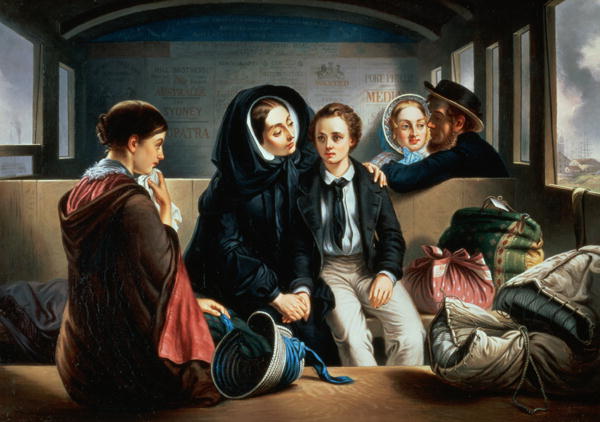 |
| "Second Class: The Parting", revised version 1855, by A. Solomon |
 |
| "Changing Homes" by G. E. Hicks, 1862 (British) |
Some Artists to Look Out For
William Powell Frith, British genre painter, 19th century
William Hemsley, British genre painter, 19th century, many paintings of rural children
Winslow Homer, American, 1860s-1900s, slice of life images, include soldiers and leisure activities
Abraham Solomon, a British painter active in the 1840s-1860s; historic and contemporary subjects
Lily Martin Spencer, American genre painter, 1850s-1860s, focused on women and children.
Francis Xavier Winterhalter, German, 1830s-1870s, famous for portraits of royalty.
Other Collections
The Atheneum (you can search by year as well as artist!)
19th Century Genre Paintings on Wikipedia
The Victorian and Albert Museum (use advanced search to find paintings and narrow the year range)
The Metropolitan Museum of Art (ditto)
Thursday, May 21, 2015
Quick-Start Civilian Reenacting: Secondary Sources

There's a lot to learn about the 19th century, and we don't all have the time or inclination to become experts in every sub-field. Well-researched secondary sources can make interesting, and very readable introductions topics one hasn't previously considered.
For civilian women just starting out, Bonny Blue Historical Help has some straightforward "do's and don't's" for planning your first outfit.
Liz Clark's articles are well-researched and amusing. In addition to the free patterns, her compendium has a lot of advice for progressive reenacting at all levels, especially with children (beginners, check out "Assembling Your Best-Bet Wardrobe" and "The True Cost of Accuracy"). A subject search or inquiry posted at the Sewing Academy will usually get you some friendly advice and links.
Virginia's Veranda & the archive: Mrs. Mescher has a host of fascinating articles on topics near the civilian ACW reenactor's heart. Whether you're looking for resources for your laundress impression, trying to find an accurate basket, or want a succinct history of calling cards, there's a lot to read (and extensive bibliographies if you want to find more).
The Atlantic Guard Soldiers' Aid Society has a wide range of articles on reenacting, as well as period clothing & material culture, farming, crafts, society, and most other topics under the sun.
Anna Worden Bauersmith has several helpful "101 Articles" on civilian reenacting. She also does lovely advanced research on straw bonnets, sewing accessories, shawls, and hair nets. (If you're having trouble with a fashion bonnet sliding around, see her blog post on bonnet stays).
Scroll through The Victorian Needle to learn about 19th century jewelry design and materials.
The Pragmatic Costumer explains corsets, for those still ambivalent about wearing them.
Time Traveling in Costume has a basic run-down of women's watches and watch chains. The authentic campaigner (a great military reenactor forum) also has a watch primer, as does Old Sacramento Living History.
A detailed guide to period glasses and spectacles from the Historic Eyewear Company.
An introduction to period parasols from Marta Vincent.
A fabric-choosing flow chart for women's dresses, courtesy of Heather Sheen.
The Citizen's Companion and Homefront Herald also regularly publish articles on civilian history and re-enactment.
[For the military side of things, The Authentic Campaigner is a good place to ask questions.]
Wednesday, April 1, 2015
Rounding Out Your Impression: Primary Sources
 |
| Glamour: 1865 (from Peterson's Magazine, January) |
Here are some of the resources I've found useful for tracking down written primary sources from the 1850s-1860s.
The Library of Congress: It's not always the easiest to navigate when looking for a particular title, but they have tons of resources which are fun to browse.
Google Books (Advanced Search): One of the easiest ways to search for a particular topic is using this advanced search. Enter your subject or title in the "all the words" bar ("leather work", "etiquette", "Godey's", "agriculture", "housework", etc.), check "full view only" (to get things you can read for free on-line) and set the year range (say 1855-1870). Advanced tips: the "more editions" button can get you from the 1861 set of a magazine, to all the available years; compound words are sometimes spelled differently in the period: ie, "sunbonnet", "sun-bonnet", "sun bonnet"--if one search yields no hits, try varying the spelling.
Internet Archive: Less useful for subject-browsing that Google or LOC, Internet Archive can track down specific titles which the others may not have. It's particularly nice for finding a whole year's worth of a magazine or newspaper (many period periodicals were published in bound volumes after the initial run of issues, and these are often what have survived in libraries and ended up posted on-line).
Project Gutenberg: If you know the title or author of a period book, you can search here: e-books, all public domain, and all free. Unfortunately, I've never found a 'sort/exclude by date' option, so it's not easy to browse for specifically 1860s titles.
Harper's Weekly (and here): Probably the most famous of the national newspapers in the 1860s. Don't have time to read it all? Check out the Cartoon of the Day.
And some of my specific favorites:
Links to Etiquette, Advice, and Household Books
Links to Literature and Sheet Music including the excellent Levy Sheet Music Collection from Johns Hopkins (allows you to search by title, subject, or instrumentation, and to limit the year range).
Links to Textbooks
Added 8/4/15: The British Library has an extensive collection of historic images from the 17th-19th centuries on their flicker account. And they're all public domain!
Luminous-Lint has historic photographs (and information on the history of photography).
Friday, February 27, 2015
Introductions
 |
| "Allow me to introduce you." |
"Mrs. Jones, have you met my sister, Mrs. Smith?"
"Mrs. Denny, allow me to present M. Hugo, from Paris."
"Miss Thomas, may I present Dr. Adams?"
When making an introduction, you always present one person to the other; the higher ranking person is addressed first. To determine precedence in this and most other social situations, some guidelines:
- Ladies outrank gentlemen (this is the most important rule)
- Married ladies outrank unmarried ladies (also universal)
- Older persons outrank young ones
- Accord higher precedence to people with whom you are less familiar, and lower to your close family and friends
- Social status—this is bit nebulous, unless you're dealing with actual aristocrats—but could come up if you're introducing two people of the similar age, gender, marital status, and proximity to yourself, in which case the one of greater social prominence goes first
Dropping in additional information (relationship to you, recent travel abroad, a visitor's hometown) is appropriate. The idea is to get people acquainted with each other, after all, and those details may help start a conversation.
Miss Leslie (The Behavior Book, 1853) writes that it is acceptable for ladies who are travelling alone to introduce themselves to genteel (female) strangers, when there is no one available to make an introduction. Similarly, persons meeting a the house of a mutual friend (according to Charles Day in Hints on Etiquette and the Usages of Society, 1844) may introduce themselves, as the host's invitation indicates that they are both respectable. Another period option is to present a letter of introduction from a mutual associate. In certain situations (public balls), a designated 'floor manager' or 'master of ceremonies' is delegated to introduce potential partners for the dance only; these introductions are different from normal social introductions and do not allow for future social interaction.
In any case, make sure to use social titles and surnames, when speaking to adults. Avoid reenactorisms, such as calling a middle-aged woman "Miss Betty"*, or addressing the postmaster as "George"**. Use of first names, in period writing and address, is limited to family members, children, servants, and some intimate correspondence between friends. The exception is to differentiate between people with the same title and last name, in which case the first name is added for the junior parties.
Example: The Smith family has four daughters and three sons. Both the eldest son and the eldest daughter are married. The middle son and daughters are grown-up, but unmarried. The youngest son and daughter are still children, and not brought into adult society.
The family is addressed as:
Mr. Smith (dad)
Mrs. Smith (mom)
Mr. John Smith (eldest son)
Mrs. John Smith (daughter-in-law)
Mr. Robert Smith (younger adult son)
(Master) Michael Smith (child)
Mrs. Brown (married daughter)
Mr. Brown (son-in-law)
Miss Smith (eldest unmarried daughter)
Miss Deborah Smith (other unmarried daughter)
(Miss) Liza Smith (child)
In public, Mr. Smith refers to his wife as Mrs. Smith; she calls her husband Mr. Smith (what they say privately is their own business). They call their children by their given names. [Note: Mr. Day's book condemns the practice of calling one's own children Mr._ or Miss_, which means some people did it.]
When Master Smith grows up, he will be styled "Mr. Michael Smith" (unless/until he attains a professional distinction styling him as "Dr.", "Professor", or "Reverend", or assumes a notable military rank). The younger men will continue to use their first names in any situation where multiple "Mr. Smith"s create ambiguity.
Similarly, Mrs. Brown uses her husband's first name when more than one Brown is around. When Miss Smith marries, her sister Deborah will stop using her first name and simply be "Miss Smith". When little Liza is old enough to enter society, if any of her older sisters are still unmarried, she'll be styled Miss Elizabeth Smith. If Deborah never marries, she'll continue to hold the title of "Miss Smith"; in that case, Liza could pass right from "Miss Elizabeth Smith" to "Mrs. MarriedLastName" without ever being the sole "Miss Smith".
Women can attain professional titles, but they are very, very rare. The Rev. Miss Antoinette Brown (later Rev. Mrs. Blackwell) and her future sister-in-law, Dr. Elizabeth Blackwell, are quite exceptional--as is their shared sister-in-law, Lucy Stone. [In order, they are the first woman ordained by a mainstream protestant sect in America, the first woman to receive a medical degree in America, and the the first prominent woman in America to keep her own name after marriage.]
References
Leslie, Eliza. The Behavior Book. Philadelphia: Willis P. Hazard, 1853. Available here.
Day, Charles William. Hints on Etiquette and the Usages of Society. Boston: William Ticknor & Co, 1844 Available here.
Thornwell, Emily. The Ladies' Guide to Perfect Gentility. New York: Derny & Jackson,1856 Available here.
*That's "Miss Betty Thompson" if she's a spinster, with an elder sister who is also a spinster ("Miss Thompson"); exceptions if you can document a local custom appropriate to your impression
**It's only appropriate if he's your son or brother.
Friday, January 30, 2015
Getting Started: Impressions and Attire
Welcome to 1860!
There's lots to see and do, and no time like the present (or rather, the past).
Who Am I?/ What am I doing?/What should I wear?
There's more to reenacting/living history than clothing, but it is a highly visible part of the hobby. In addition to being accurate (the 1860s were a long time ago, but not all 'olde tyme' things suit the 1860s), your clothing should also be suitable to the activities you'll be doing and and character/persona you may be presenting.
No one outfit is appropriate for all activities, so make sure that your first outfit suits the activities you will be pursuing, and at the time of year you will be doing them. You don't wear the same clothing for Christmas caroling that you would for working in your garden in the summer, nor does a nurse wear the same outfit as a society hostess.
Even if you really don't want to make a persona, give some thought to what you intend to do at the reenactment. Are you fighting in a skirmish? Cooking over an open fire? Minding children? Just hanging out in funny clothes? Demonstrating a craft or profession? Lecturing?
The soldier has a uniform. The crafter will want serviceable garments with accessories which suit his/her occupation, such a blacksmith's leather apron, or a clerk's sleeve protectors. The lecturer will want neat, respectable garments in styles suitable to his/her class background. Washable cottons and water/dirt/flame-resistant wools are a boon for laborers, servants, nurses and cooks. Hoops are a simultaneously ubiquitous for women in the period and hazardous in certain situations (factories, open fires, crowded hospital wards); let your activities dictate whether you wear one. For example, when I'm cooking in a period kitchen, my complete outfit looks like this:
Recommended articles: Mrs. Clark's Assembling Your Best Bet Wardrobe, and Defining the Work Dress cover the basics of selecting garments. Anna Worden Bauer's Beginning Guidelines for Women are also very informative (as are her other articles).
Next Time: Where do you find this stuff?
There's lots to see and do, and no time like the present (or rather, the past).
Who Am I?/ What am I doing?/What should I wear?
There's more to reenacting/living history than clothing, but it is a highly visible part of the hobby. In addition to being accurate (the 1860s were a long time ago, but not all 'olde tyme' things suit the 1860s), your clothing should also be suitable to the activities you'll be doing and and character/persona you may be presenting.
No one outfit is appropriate for all activities, so make sure that your first outfit suits the activities you will be pursuing, and at the time of year you will be doing them. You don't wear the same clothing for Christmas caroling that you would for working in your garden in the summer, nor does a nurse wear the same outfit as a society hostess.
Even if you really don't want to make a persona, give some thought to what you intend to do at the reenactment. Are you fighting in a skirmish? Cooking over an open fire? Minding children? Just hanging out in funny clothes? Demonstrating a craft or profession? Lecturing?
The soldier has a uniform. The crafter will want serviceable garments with accessories which suit his/her occupation, such a blacksmith's leather apron, or a clerk's sleeve protectors. The lecturer will want neat, respectable garments in styles suitable to his/her class background. Washable cottons and water/dirt/flame-resistant wools are a boon for laborers, servants, nurses and cooks. Hoops are a simultaneously ubiquitous for women in the period and hazardous in certain situations (factories, open fires, crowded hospital wards); let your activities dictate whether you wear one. For example, when I'm cooking in a period kitchen, my complete outfit looks like this:
- basic underwear: drawers/chemise/corset (keeps my other clothing clean, provides back/bust/torso support, allows easy use of the necessary)
- shoes
- a corded petticoat (keeps the skirts from wrapping around one's legs)
- a second petticoat (for the period shape and to keep my skirts from drooping--this is a weak imitation of the fashionable ideal); for dirty work, the outermost petticoat can be made of printed material, with the dress skirt tied up above it
- a basic cotton print dress (bodice and skirt joined as one piece, washable material) with sleeves that can be rolled up
- a neckerchief or basted collar (keeps the dress cleaner during sweaty work)
- pinner apron (protects the front of the dress); I have several cotton stripe and print aprons which can be washed; wool ones are also useful for putting out fires
- wool shawl (not worn while cooking; kept on hand to haul supplies and smother small fires)
- hair dressed up, with no decoration (center part, back bun, side hair varies with year portrayed)
- plain handkerchief
- sunbonnet (worn when going outside)
Contrast with a more genteel lady:
- basic underwear: drawers/chemise/corset (as before)
- shoes
- a cage or hoop (for the fashionable silhouette)
- additional petticoats (smooth the hoop line, add additional 'loft' for a fashionable look)
- a well-fitted dress of wool, fine cotton, or silk, with tasteful trimming (may be conservative or follow the fashionable fads)
- white collar and cuffs/undersleeves (these keep the neck and wrists of the dress tidy)
- brooch or neck ribbon, and other tasteful accessories such as a pocket watch, fashion belt, jewelry, etc.
- wool or silk shawl/wrap/mantel
- gloves
- hair dressed (as before), may add combs, a decorative net, a fine cap, or other accessories
- handkerchief (plain or decorated)
- fashionable bonnet or hood (worn in public spaces)
- parasol (when going outside)
Recommended articles: Mrs. Clark's Assembling Your Best Bet Wardrobe, and Defining the Work Dress cover the basics of selecting garments. Anna Worden Bauer's Beginning Guidelines for Women are also very informative (as are her other articles).
Next Time: Where do you find this stuff?
Thursday, January 29, 2015
Welcome
The 2015 Reenacting Season is approaching, and we're all getting very excited about it. The WCWA has some cool new events starting this year--including a nice close reenactment at Snoqualmie, hosted by our neighbors in the 20th Maine, and a new living history event at beautiful Fort Worden, hosted by our own John & Liz.
You can learn more about the 4th US Reenactors on our About Page. To see what kinds of activities we're doing, check out the calendar.
If you're interested in reenacting in Washington, drop a note to our Recruiting Sergeant, send a message to me, or check out the WCWA website. Fun fact: you don't have to live in Washington to join the WCWA (Hi, Company G!).
 |
| Reenacting: Fun for the Whole Family |
Subscribe to:
Posts (Atom)