Showing posts with label sewing. Show all posts

Monday, May 1, 2017

Updating Dresses

The Seamstress (1858) by Charles Baugniet from The Athenium
The Seamstress (1858) by Charles Baugniet 

The ladies of Elizabeth Gaskell's Cranford aren't alone in their practice of  'elegant economy'.  Altering dresses to keep up with the prevailing style is a recurring theme in stories and magazine articles of the 1860s.

"Nothing, it seems to us, could be more graceful in a lady, in these times, than a little self-denial. Alter, turn, and freshen the dress that is passe. Buy new frames, and make new bonnets of the old. The dress that has been worn one season,--why not wear it another?" -The Ladies Repository 1865

Instructions from 1862 (appearing in both Godey's and Genessee Farmer) recommend disassembling a silk dress for washing, and taking the opportunity to update the sleeves. This is hardly a new practice: in The Behavior Book (1839/55), Miss Leslie advises buying an extra 1.5-2 yards when purchasing dress material, so that there fabric in reserve for new sleeves and any mending or alteration that may come up.

"Old Basquines can be modernized by cutting them shorter, especially in the front, and by making the sleeves narrow." -Peterson's, July 1865.

Peterson's and Godey's both ran the same article in 1862 about updating and widening plain, 2 or 3 flounce skirts.

Peterson's (1862) has tips for stylishly remaking dresses:
There have been but few new goods imported this season, economy being the order of the day. Old dresses are "made to look like new" as nearly as possible. Skirts worn out at the bottom are renewed or lengthened by a bias band, plaiting or ruffle, or silk of black or some color contrasting well with the dress. In this way two old dresses often make one stylish new one. Then antiquated bodies or worn out bodies are discarded and jaunty Zonave jackets with white shirt bodies and sleeves, or Garibaldi shirts, take their place. As the season advances, pique or Marseilles will take the place of silk or flannel for these articles.
A recurring motif in period stories is the economically-minded middle class woman in her re-made finery--occupying the same economic perch as the March family from Little Women.  I find it telling that quality of the material is the limiting factor in these cases: the labor to mend, alter, clean, and re-work these old dresses is no barrier to wear.
"On the bed lay my dress that poor old Swiss which I had worn ever since leaving off short frocks. It had been pieced down and tucked for this occasion; my own hands had clear-starched it to the last degree of sheerness and mamma by much contrivance had managed to procure fresh sash and gloves." 
"I cannot afford a new gown for you, Kate; but we will have Miss Brown to make over my green brocade."  
--"Katy Keith" and "Five Years" in Harper's New Monthly Magazine (1863)
Another Godey's 1862 article outlines various re-making practices, including cutting down old dresses for petticoats, mantles, children's clothing, etc.  Again, labor is cheap (assumed free), but the material is viewed as pricey enough to warrant recycling.

A favorite reference for resourcefulness is the 1866 Godey's article "Dress Under Difficulties", which recounts the tricks blockaded Southern women used to freshen their wardrobes.  While not all techniques will apply outside of late-war Southern impressions, I think the piece offers some insight into how problems of dress were considered and addressed.  It also has some interesting hints at how long certain garments were expected to be in service: the author notes, for instance, an "organdy muslin dress" lasting five summers or a crepe bonnet lasting three seasons (with the implication that these were impressively long periods).


Thursday, May 19, 2016

WCWA Quilt Projects

Here are some fun projects to look forward to at WCWA reenactments this summer:

Fort Hill Sewing Circle Civil War Album Quilt, from the Smithsonian via quiltstudy.org

1) A Ladies' Aid Society Quilt.  This will be a "quilt as you go" style quilt, in which blocks of a standard size are individually pieced, quilted, and bound; the finished blocks are then whip-stitched together into a quilt.  The technique is found in most of the Aid Society/Sanitary Commission quilts explored in Weeks and Beld's Civil War Quilts, and it seems very well suited to a group effort.

Other period (or slightly post-period) quilts with this technique:
Susannah Pullen's Quilt
An 1880s "Quilt as You Go" (Also some pictures of an 1860s Soldiers' Aid Quilt)
A Post-War Quilt (Possibly started during the war and finished later--it's easy to add more blocks with this method).

I envision this project as one that ladies (and gentlemen) can work on at their leisure, doing as much or as little as suits.  A large number of participants is not required for success, and the work is small enough to be carried around easily.  It'll also start conversations with the public about a technique that's not well known.  For those interested in participating, but unsure how to start, I'll provide some easy period block patterns and even pre-cut fabric.

Amherst Civil War 4-Patch Quilt, 1864, from the Smithsonian


2) An inscribed a four-patch quilt, based on the 1864 "Amherst" Quilt (Smithsonian Record). This will be a drop-in activity for visitors or reenactors who want to participate without necessarily having the time, knowledge or materials to make a finished square on their own. Instead, they can join four pre-cut squares into a quilt block; I'll teach a basic running stitch to anyone interested. Those who can't or won't sew may choose to sign a white square for inclusion in the quilt.

These will both likely be long-term projects, but I look forward to seeing where they go.  Even if we don't end up with two reproduction quilts for the field hospital, it should be a valuable learning and interpreting experience.

Wednesday, April 20, 2016

Sewing Supplies

I have recently been apprised that Mill End in Portland carries busks, corset boning, and hoop steel--in addition to the gorgeous silks and fine cotton which always hypnotize me.  Bonus content at the link: Micalia's lovely reproduction clothing.

Thursday, March 31, 2016

Quilt Resources

Bedcover/Bride's Quilt, 1861, Chicago Art Institute
Appliqued Bedcover, 1861, in the
Art Institute of Chicago.
Let's explore some of the lovely options for early 1860s quilts! I'm far from an expert on the subject, but I've gathered some period examples and links for further research.

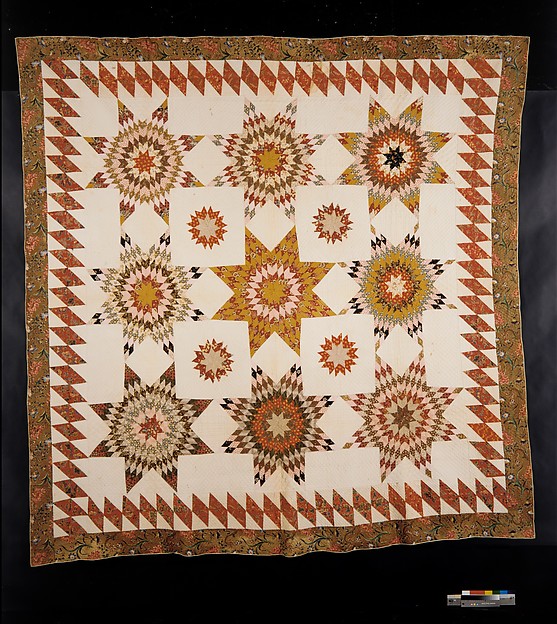
1840-1850 Star of Bethlehem Quilt in the Met Museum
Star of Bethlehem pieced quilt, c. 1840-1850
in The Metropolitan Museum of Art

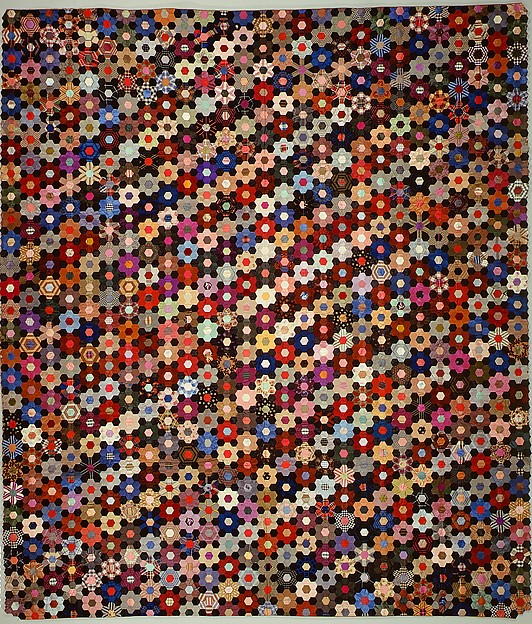
Patchwork, applique, strip, whole cloth, and mixed technique quilts all can be appropriate for the early to mid-1860s.  Patchwork designs in use during and just before the American Civil War include Nine Patch, Mill Wheel, Star of Bethlehem, Star of Lemoyne (and another example), Flying Geese, Feathered Star, Wild Goose Chase, Tumbling Blocks, Chimney Sweep/Album/Friendship Chain, Crown, Mariner's Compass, and even simple squares. Log Cabin quilts seem to gain popularity during and after the war. Hexagon or Honeycomb patterns are frequently mentioned in period sources; today this design/technique is also known as "Grandmother's Flower Garden" and "English Paper Piecing". The talented Miss Dories sometimes demonstrates sewing this pattern at events.
Hexagon Quilt, c. 1864, in the Metropolitan Museum of Art.
Silk hexagon quilt, started 1864,
in the Metropolitan Museum of Art.
Appliqued examples include the ubiquitous-yet-charming album quilts, as well as Rose of Sharon, Prarie Flower, Patriotic Eagle and Stars, Oakleaves, Triple Tulip, and Pineapple designs,  Pieced basket patterns with appliqued handles and/or flowers and fruits are fairly common; likewise patchwork quilts with appliqued borders.  An older technique ("Broderie Perse") involved cutting out chintz print motifs and appliqueing them onto the quilt top. I've used the museums' titles for the linked quilts; period names may differ.

1862 album quilt from the Art Institute of Chicago
"Circuit Rider's Quilt", 1862 album quilt,
in the Art Institute of Chicago.

In primary documents, quilts and patchwork are named among the prize categories of agricultural fairs and in exhibitions.  The second link includes a separate category for girls under twelve, with a four year-old, a seven year-old, and a five-year-old taking first, second and third place, respectively. A favorite period story of mine, "My Patchwork Quilt" (published in the 1840s), follows the development of a quilt, from the narrator first learning to sew until the work is completed; family anecdotes are tied in by the garment scraps used in the quilt--and a fair amount of social information comes through about the desirability of patchwork quilts, attitudes towards sewing them, how fabrics are acquired, and the process of making and quilting it.  Miss Leslie's Lady's House Book (11th ed./1850) has a more matter-of-fact discussion of popular bedcovers, and the different options available.  Patchwork designs and projects show up in period magazines.  Quilting was even addressed by sewing machine manufacturers.

Patchwork Cushion, Godey's 1852
Patchwork Cushion project in Godey's, 1852
1864 Patchwork from The Lady's Friend
Patchwork Pattern from The Lady's Friend, 1864

Quilts played their distinctive role in the war; the U.S. Sanitary Commission collected and distributed quilts, blankets, coverlets and comfortables to army hospitals.   Quilts might also be gifted to individual soldiers by their friends and relations.
1864 Sanitary Commission album quilt, in the Smithsonian
Sanitary Commission album quilt, 1864,
by The Ladies of the Fort Hill Sewing Circle
in the Smithsonian Museum of American History.
Sanitary Commission Quilt 1863 Susannah Pullen, Smithsonian
Star pattern quilt made for the U.S. Sanitary
Commission, 1863, by Susannah Pullen's
Sunday School class. Now in the Smithsonian.
For original quilts, you can't beat the International Quilt Study Center and Museum. They also have some articles specifically on Quilts of the Civil War. The Metropolitan Museum of Art, The Museum of Fine Arts Boston, and The Chicago Institute of Art also have a variety of nineteenth century quilts in their collections (and The Quilt Index has links to even more).  The Smithsonian's National Quilt Collection is also worth viewing.

Additionally, Barbara Brackman, noted quilt historian and author, blogs about 1860s quilts at the aptly-named Civil War Quilts; she also writes about antique quilts and reproduction fabric prints at Material Culture. I would particularly recommend her books Quilts from the Civil War, America's Printed Fabrics, and Facts and Fabrications.  Elaine Trestain's extensive collection of period quilts provides many of the fabric samples seen in Dating Fabrics: A Color Guide (which also has useful information on period fabric printing methods).

Sunday, January 17, 2016

Garters

Some of the stockings and socks we looked at before had ribbed cuffs for a closer fit. Others would rely on garters to keep them in place.  These may be fastened above or below the knee; Graham's Illustrated Magazine suggests below the knee for women, just above for men and "those women who resemble men in their shape".  A certain medical text recommends "looping up" the stockings instead of using garters, though I've found no other source to elaborate on this idea.

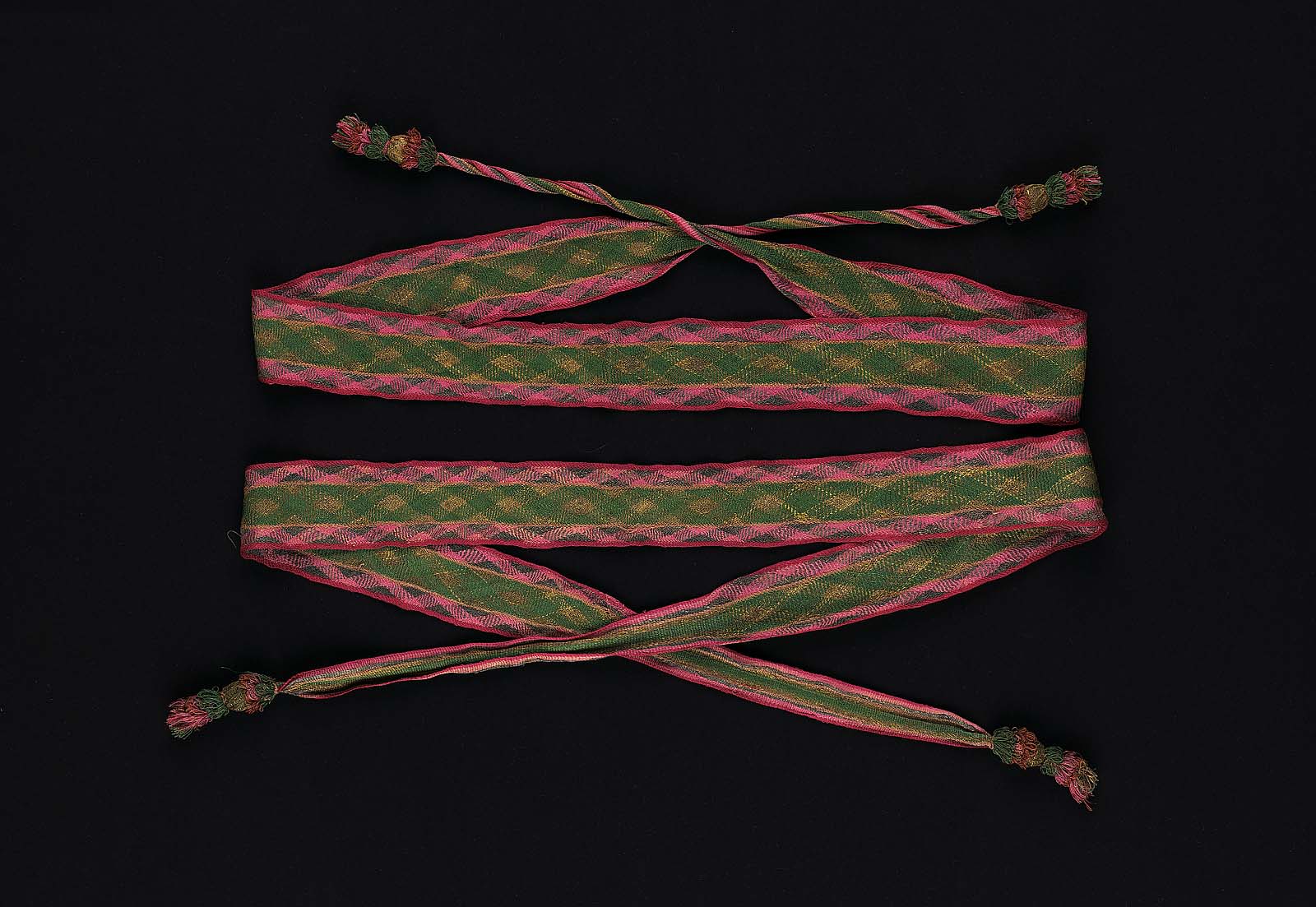
There are a few different styles of garters used in the mid-19th century.  One is a flat band or ribbon, a style which has been in use for several centuries to this point.
Silk garter, c.1862. Museum of Fine Arts.
Silk garter, late 16th century. Museum of Fine Arts.
These flat garters could be simple ribbons, or could have a decorative embroidered, beaded and/or padded bands attached to narrower ties.
Wool embroidered (Berlin work) garters,
c. 1801-1850, Smithsonian Design Museum.
Flat knit garters are also possible. One knitting pattern reads:
"Cast on 18 stitches. Knit in double knitting backwards and forwards until the garter is long enough. End in a point." --The Ladies' Self-Instructor..., page 180
Another knitting book notes that "Elastic Rib...as its name implies, is the appropriate stitch for garters", and goes on to explain using alternate knit and purl rows to create a stetchy material.  "Garter stitch", on the other hand, is plain knitting. The Method for Teaching Plain Needlework in Schools (1861) recommends that students knit both plain and ribbed garters to practice knitting and purling, respectively.

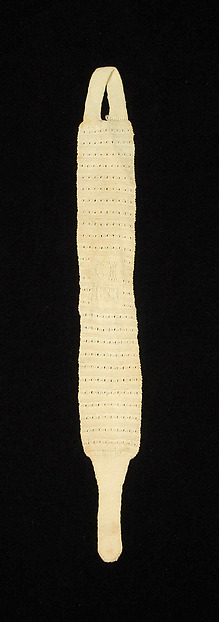
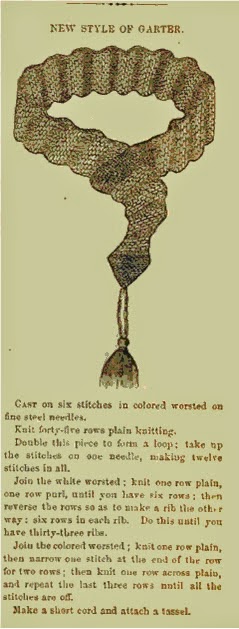
A second style of mid-century garter has a loop appended to the flat band.  The few examples I've seen are a springy knit material; the flat end is threaded through the loop (and in my experience, needs to be knotted to keep the garter in place).
Cotton garter, c. 1833, from The Met.
Instructions for knit garter with loop, tassel.
Appeared in Godey's, 1862.
Reproduced here.
Garters can also fasten with buckles, such as this early 19th century pair.  Flexibility, in this case, is provided by a plain silk-elastic band.
Garters with chenile embroidery, silk/elastic band and
metal clasps. Early 19th century. Museum of Fine Arts.
Garter buckles dated 1864, from Historic New England.
There is a potential fourth style, fabric over a stretchy core, like modern novelty garters.  However, I've only seen one such, this pink silk pair,c. 1851-1880 from the Museum of London, and need to investigate further.

Saturday, October 24, 2015

Civilian Winter Clothes

The Illustrated London News, Jan 1, 1859
Inspired by Anna Bauersmith's article on seasonal layers, here are project links for warm and winter clothes.  Most are 1859-65, but there are a few earlier ones as well, so check the date when determining if a project suits your impression.

Liz Clark's essays on Dressing Children and Infants for Cold Weather are also highly recommended.


Women's Items
Red Riding Hood, page 79, Peterson's (1862)
Tufted Hood* from Liz Clark
Mrs. Meister's Hood Pattern* (the shape is more 1850s)
Opera Hood (knit), page 122,  Godey's (1862)
Opera Hood (knit), page 378, picture 322, Peterson's (1865)
Norwegian Morning or Bonnet Cap, page 111, from The Illustrated Magazine (1863)
Neapolitan Opera Hood, Mlle. Riego's The Useful Knitting Book (1864)
Quilted Silk Hood, page 359-60,  Peterson's (1859)
Princess Capote, page 415, pic 359, Peterson's (1862) [New research by AWB suggests this may be a summer seaside garment.].
Capeline or Hood, page 287, Godey's (1862)
Algerian Knitted Opera Hood, page 284-5, New Peterson's Magazine (1865)
Knitted Opera or Travelling Hood Trimmed with Swansdown, page 599, 540 (illustrated), Godey's (1862)

Eugenie Collar from Mlle. Riego's Crochet Winter Book (1857)
Knitted Collar, page 171, picture page 115, Peterson's (1862)
Shetland Cravat, page 69-70, Peterson's (1865)
Ermine (knit) Tie and Cuffs, page 31-2, The What-not; or Ladies' Handy-book (1861)
Lady's Croquet Cuff and Cravate, Mlle. Riego's The Useful Knitting Book (1864)
The Eyder Necktie, Mlle. Riego's The Useful Knitting Book (1864)
Wool Scarf in Crochet (page 312, illustrated 264) Arthur's Illustrated Home Magazine (1860)
Braided scarf, with Mrs. Mescher's modern instructions.

Winter Cloak, page 74-75,  Peterson's (1859)
Crochet Cape, The Queen's Winter Knitting Book (1862)
Cloaks, general instructions, How to Do It: Or, Directions for Knowing and Doing Everything Needful (1864)
Winter Mantle or Sortie-De-Bal, in Crochet page 549, Godey's (1858)
Fall Paletote, illustration page 452, diagram 454, Godey's (1859)
Round Jacket for a Lady (knit), page 331-333, Peterson's (1856)
Polka Jacket in Crochet, page 168-169, Peterson's (1856)

Knitted Winter Spencer, page 53-4, from The Illustrated Magazine (1863)
Sontag, and Mrs. Mescher's modern translation of it.
Knitted Sontag, page 412-413, Peterson's (1862)
Loose Waistcoat or Bodice, The Queen's Winter Knitting Book (1862)
Habit Shirt or Bodice in Crochet a Tricoter, The Queen's Winter Knitting Book (1862)
Under Spencer or Jacket, The Queen's Winter Knitting Book (1862)
Chest Preserver, The Queen's Winter Knitting Book (1862)
Knitted Jacket, page 277, The Ladies' Companion and Monthly Magazine (1864)
(Also in the Illustrated London Magazine for 1864)
Lady's Under-Vest, Mlle. Riego's The Useful Knitting Book (1864)
Spanish Jacket, Mlle. Riego's The Useful Knitting Book (1864)
Winter Jacket in Double Crochet, pages 290-292, Peterson's (1864)
Fall and Winter Jacket, page 444-445, New Peterson Magazine (1865)
Nubia (shawl) with Mrs. Mescher's modern instructions.
Knitted Shawl in Colors, page 419, picture page , Peterson's (1862)
Plaid Shawl, Mlle. Riego's The Useful Knitting Book (1864)
Biarritz Shawl, page 186, Godey's (1862)

Knitted Undersleeve, from Godey's (1862), page 465
Knitted Sleeve, The Queen's Winter Knitting Book (1862)

Eugenie Machettes and Lady's Gauntlet Mitts from Mlle. Riego's Crochet Winter Book (1857)
Knitted Gauntlet, from The Lady's Companion (1865), page 55
Instructions for Knitted Mittens and Cuffs: "Another Pair of Lady's Mittens" from Godey's (1862), page 284-5
A New Stitch for Cuffs (crochet), page 187, Godey's, 1862

Knitted Under-Petticoat, from The Lady's Companion (1865), page 166
Knit Drawers, page 174-5, Peterson's (1862)

Crochet Dressing Slipper, page 446, Peterson's (1865)
Knitted Gaiter, page 335, The Ladies' Companion and Monthly Magazine (1864)
(Also in the Illustrated London Magazine for 1864)
Furred Winter Shoe, page 358-9,  Peterson's (1859)

Children's Items

Tufted Hood* from Liz Clark
Mrs. Meister's Hood Pattern* (the shape is more 1850s than 1860s)
Boy's Winter Hat in Knitting (page 312, illustrated 264) Arthur's Illustrated Home Magazine (1860)
Garden Hood for a Little Girl (knit), page 162-3, from The Illustrated Magazine (1863)

Instructions for Knitted Mittens and Cuffs: "Knitted Mittens" for a girl 2-3 years old; from Godey's (1862), page 389
Instructions for Knitted Mittens, for girls 8-10, from The Illustrated Magazine (1863)
Child's Muff in Imitation of Chincilla (knit), page 310, Peterson's (1865)

Infant's Shirt (knit), page 412, Peterson's (1862)

Baby's Sock in Crochet, page 413, Peterson's (1862)
Baby's Sock, Mlle. Riego's The Useful Knitting Book (1864)
A Little Girl's Stocking, Mlle. Riego's The Useful Knitting Book (1864)
Boy's Knickerbocker Stocking (ages 5-6), Mlle. Riego's The Useful Knitting Book (1864)
Child's Sock (2 patterns), How to Knit Socks (1863)

Crochet Gaiters from Mlle. Riego's Crochet Winter Book (1857)
Child's Warm Shoe in Crochet, page 163, The Ladies' Companion and Monthly Magazine (1864) (Also in the Illustrated London Magazine for 1864)
Crochet Boots for an Infant, page 222, The Ladies' Companion and Monthly Magazine (1864)
Baby's Boot in Knitting and Crochet, page 122, The What-not; or Ladies' Handy-book (1861)
Baby's Boot (quilted/wadded), page 410, Godey's (1862)
Child's Gaiter, Mlle. Riego's The Useful Knitting Book (1864)

Men's Items

Knitted Waistcoat, The Queen's Winter Knitting Book (1862)
Gentleman's Comforter, page 56, The What-not; or Ladies' Handy-book (1861)
Gentleman's Knit Stockings, page 58-9, The What-not; or Ladies' Handy-book (1861)
Gentleman's Knickerbocker Stocking in ribbed knitting, The Useful Knitting Book (1864)

Knit Knee Warmer, Godey's, 1862
For Everyone:

Basic Wool Shawl*
Two Knitted Comforters (scarves), The Queen's Winter Knitting Book (1862)

Mrs. Mescher's Muffatees*
Directions to Knit Mittens, page 92, Peterson's (1862)
To Knit a Mitten With One Finger, page 176, Peterson's (1862)
Knitted Mitten and a Very Easy Mitten, The Queen's Winter Knitting Book (1862)
Knitted Glove, The Queen's Winter Knitting Book (1862)
Two Muffatee Patterns, The Queen's Winter Knitting Book (1862)

Knit Stocking, The Queen's Winter Knitting Book (1862)
Knitted Knee Cap (?!?!), page 445, Peterson's (1865)
Socks (2-3 patterns), How to Knit Socks (1863)
Knee Caps, Mlle. Riego's The Useful Knitting Book (1864)

General Knitting Help in Period Sources
The 1862 run of Godey's, includes an explanation of pattern terms on pages 84-85.
The Illustrated Girl's Own Treasury (1861) includes knitting instructions and pattern abbreviations.
Peterson's (also in 1862) includes a variety of new knit stitches to adapt for one own's projects.

*Asterisked projects are modern instructions based on extent period pieces.  The projects not so marked are either period instructions, or modern explanations of period instructions.


Wednesday, August 12, 2015

Printed Fabrics of the early 1860s

A reproduced 1860s print.
Here are some more eye-training resources, this time for period textiles.  Learn the aesthetics of the time, and your options for reproduction textiles multiply!

Among the many books written on Victorian fabrics, these four are my favorites:

Eileen Trestain's  Dating Fabrics, A Color Guide 1800-1960 is probably the most concise and easy-to-use reference.  It's also among the least expensive and most portable. (See here for a longer review.) 

Barbara Brackman's America's Printed Fabrics, 1770-1890 has fewer examples, but is also easy to procure and use, and has additional information about period quilting. (Complete review.) Ms. Brackman's blog also discusses historic fabric and quilts.

The single most informative book I've found is Meller and Elffer's Textile Designs: Two Hundred Years of European and American Patterns Organized by Motif, Style, Color, Layout, and Period. It is literally hundreds of pages of fabric designs. (Complete review.)  

Florence Montgomery's Textiles in America 1650-1870 is an exhaustive reference of fabrics for furnishing as well as apparel. It features fewer examples of printed designs that Meller/Elffer, but has a lot of information about woven patterns, fibers, and different types of fabric. (Complete review.)

Although I've not had a chance to read it, Wearable Prints 1760-1860 comes highly recommended.

There are also a number of on-line references, less well-curated that the published sources, but still useful.  Googling "Fabric Swatch Book 1860", or 1850, gives any number of hits.  Close-ups of original garments also show the fabric's pattern (for ideas, here are some museum on-line collections).

Val from Time Travelling in Costume has a nice introductory post, featuring original swatch books and garments.  Trouvais also has some sample books, though not all are from the 1860s.

A booklet for Printed Textile Identification is provided by the British Dress and Textile Specialists (they also have some other useful free guides, including fiber and lace identification).

One can also browse Reproduction Fabrics for ideas: the year ranges can be a bit broad, but the fabrics are all available to purchase, no further searching required.  Additionally, the proprietress has posted two of her original fabric swatch books on-line, and also blogs about nineteenth century textile printing technology.

Tuesday, July 28, 2015

Men's Civilian Attire

"First Class: The Meeting", 1855, by Abraham Solomon
Having already devoted a number of posts to women's clothing, it's only fair to gather some resources for the men.

The best starting reference I've found is Mrs. Kessinger's wardrobe guide.  Several of the on-line discussion spaces named in the ladies' posts also address gents' attire, ie, The Sewing Academy, The Civilian Civil War Closet (you do need to log onto Facebook to view the latter).  As always, researching a subject before buying anything is advised.

For purchasing garments, NJ Sekela and Jas. Townshend appear to be the premiere outfitters, though I cannot speak from personal experience (note that Townshend covers a wide range of years, and not all items are suitable for ACW use, or for all impressions therein).  Kay Gnagey also has some gentlemen's ready-made items.

To those looking to make their own clothing, Jim Ruley's picture-heavy Tailoring Tutorials can help the novice tailor.  Rumor has it that the gentleman himself also drafts custom patterns for hire. Past Patterns has several men's patterns available for the 1850s-1860s, and I've heard good things about their vest pattern #018.  Peachtree Merchantile patterns are based on original garments, including trousers and an overcoat.  Martha McCain's "Fashion Historian" patterns for Simplicity, though now out of print, included several men's patterns with good shapes.  Thoughts on Men's Shirts in America, 1750-1900 by Brown and Chamberlain is apparently the definitive work on the subject, though sadly out of print.

Original patterns/tailoring systems online include Devere's The Tailor's Guide (1855) and these from the 1840s.  Most plain-sewing books include instructions for men's shirts, though their usefulness varies: The Workwoman's Guide (1840) is the most extensive; The Sampler (1855) actually includes cutting diagrams, though Plain Needle-Work (1852) has a nice finished illustration.

Wednesday, February 4, 2015

Clothing Resources for Civilians I

Following up on the "what to wear" post: where to get what you wear.

For the budget-minded reenactor, making your own clothing is by far the most economical option.  If you know how to sew, great!  If you want to learn, even better!  We're happy to help.  There are also other options: get something custom made, buy used, or buy "off the rack".  Whatever your choice(s), here are some on-line resources you may find helpful.

[Note: Outside sites ahead.  They don't represent the views of the 4th US or WCWA, etc. I am also not affliated with any, save for my personal blog, which is all my own views and not those of the 4th, etc.]

Sewing Advice and General Help

Patterns

  • KayFig/ FigLeaf (I've made up the Simplicity 2890 undergarments and the Kay Figg 611 wrapper, and highly recommend the designer based on these.  My thoughts on the wrapper pattern.)
  • The Dressmaker's Guide  I love this one so much that I now have two copies of it.  Full effusive praise here.
  • Past Patterns (Do not have personal experience with most of these, I hear mostly good things about them, and the lines are good)
  • Truly Victorian (Ditto)
  • Laughing Moon (Again, haven't personally made them, but they come highly recommended)
  • Simplicity: I have a lot of these, and have made up several of them (they go on-sale for $1-2 at Jo-Ann regularly).  The "Fashion Historian" and "Museum Curator" lines have good shapes, but you do need to be careful of modern techniques and ease added by the publisher (see this discussion and this one for specific commentary).  Avoid the steampunk and generic "historic" costume patterns. Currently in print, there seams to be one dress, and two undergarment sets.

For soft bonnets, there are some free patterns on line. For fancier wear, patterns, kits, blanks, and complete bonnets are available through Miller's Millinery, Timely Tresses (I am, again, a very satisfied customer), Mrs. Parker's, and Anna Worden Bauersmith (she makes lovely straw forms).

Weird Supplies, on-line
(hook-and-eye tape, hem tape, hoop steel, corset boning and busks, metal grommet setters, etc.)

  • Farthingale's Canada: my favorite place for busks and corset bones
  • Corsetmaking: corset & hoop supplies; I had a bad experience with their buckram-covered hoop steel
  • Originals by Kay: corset and hoop kits, hook-and-eye tape 
  • Abraham's Lady: corset supplies, hoopsteel, bonnet wire, twill tape, and hook-and-eye tape; I would personally not recommend using cotton hem tape, though 
  • Needle & Thread/ Wooded Hamlet: cage crinoline kits, tapes and trims 
  • Wm. Booth, Draper: wool tape and fine fabrics; this establishment caters to 18th century costuming, and not all items are appropriate for 19th century use
  • The Button Baron: buttons; note the year range (1840-1940), not all buttons are appropriate for all uses 

Local Suppliers (mostly Seattle, WA)
  • The Fitting Room: the ONLY local source I know for corset supplies; also makes custom corsets
  • Nancy's Sewing Basket: best local source for silks and fine cotton material; they also carry silk ribbon and vintage flowers for bonnets; be prepared to pay for quality
  • Pacific Fabrics: has some silks and passable cotton prints
  • Hancock Fabrics: carries 100% cotton shirting plaids, 100% cotton broadcloth for undergarments 
  • JoAnn: calico print selection getting very sparse; still carries Simplicity & Butterick patterns (see above); utility section includes 100% cotton crinoline (for lining fashion bonnets), toweling, and buckram (this is too flimsy for bonnet use, but can work in belts and swiss waists); muslin for toiles, linings, and cheap undergarments
  • Timeless Stitches (in the Tacoma Antique Mall) has shell, glass, and metal buttons, and other vintage sewing supplies [There's also a Timeless Stitches which sets up at WCWA events; these do not appear to be related]  
  • Pendleton Woolen Mill Outlet (Portland), carries wools
  • The Annual Sewing and Stitchery Expo has all manner of material and notions; best bet for laces and trims
  • Fremont Sunday Market: flea-market vendors occasionally carry usable vintage buttons
  • Hardwick's (in the U-district) has size 00 grommets and setting tools, and bolt cutters for your hoop-steel-cutting needs. 

This is getting a bit long, so the next installment will include resources for non-sewers.