Showing posts with label resources. Show all posts

Monday, May 1, 2017

Updating Dresses

The Seamstress (1858) by Charles Baugniet from The Athenium
The Seamstress (1858) by Charles Baugniet 

The ladies of Elizabeth Gaskell's Cranford aren't alone in their practice of  'elegant economy'.  Altering dresses to keep up with the prevailing style is a recurring theme in stories and magazine articles of the 1860s.

"Nothing, it seems to us, could be more graceful in a lady, in these times, than a little self-denial. Alter, turn, and freshen the dress that is passe. Buy new frames, and make new bonnets of the old. The dress that has been worn one season,--why not wear it another?" -The Ladies Repository 1865

Instructions from 1862 (appearing in both Godey's and Genessee Farmer) recommend disassembling a silk dress for washing, and taking the opportunity to update the sleeves. This is hardly a new practice: in The Behavior Book (1839/55), Miss Leslie advises buying an extra 1.5-2 yards when purchasing dress material, so that there fabric in reserve for new sleeves and any mending or alteration that may come up.

"Old Basquines can be modernized by cutting them shorter, especially in the front, and by making the sleeves narrow." -Peterson's, July 1865.

Peterson's and Godey's both ran the same article in 1862 about updating and widening plain, 2 or 3 flounce skirts.

Peterson's (1862) has tips for stylishly remaking dresses:
There have been but few new goods imported this season, economy being the order of the day. Old dresses are "made to look like new" as nearly as possible. Skirts worn out at the bottom are renewed or lengthened by a bias band, plaiting or ruffle, or silk of black or some color contrasting well with the dress. In this way two old dresses often make one stylish new one. Then antiquated bodies or worn out bodies are discarded and jaunty Zonave jackets with white shirt bodies and sleeves, or Garibaldi shirts, take their place. As the season advances, pique or Marseilles will take the place of silk or flannel for these articles.
A recurring motif in period stories is the economically-minded middle class woman in her re-made finery--occupying the same economic perch as the March family from Little Women.  I find it telling that quality of the material is the limiting factor in these cases: the labor to mend, alter, clean, and re-work these old dresses is no barrier to wear.
"On the bed lay my dress that poor old Swiss which I had worn ever since leaving off short frocks. It had been pieced down and tucked for this occasion; my own hands had clear-starched it to the last degree of sheerness and mamma by much contrivance had managed to procure fresh sash and gloves." 
"I cannot afford a new gown for you, Kate; but we will have Miss Brown to make over my green brocade."  
--"Katy Keith" and "Five Years" in Harper's New Monthly Magazine (1863)
Another Godey's 1862 article outlines various re-making practices, including cutting down old dresses for petticoats, mantles, children's clothing, etc.  Again, labor is cheap (assumed free), but the material is viewed as pricey enough to warrant recycling.

A favorite reference for resourcefulness is the 1866 Godey's article "Dress Under Difficulties", which recounts the tricks blockaded Southern women used to freshen their wardrobes.  While not all techniques will apply outside of late-war Southern impressions, I think the piece offers some insight into how problems of dress were considered and addressed.  It also has some interesting hints at how long certain garments were expected to be in service: the author notes, for instance, an "organdy muslin dress" lasting five summers or a crepe bonnet lasting three seasons (with the implication that these were impressively long periods).


Friday, June 24, 2016

The Prisoner's Hope, or Tramp! Tramp! Tramp!

As the war goes on, popular songs begin to reflect some of it's less-pleasant realities. Following 1862's courageous rallying songs, those from 1863-5 directly address homesickness, conscription, imprisonment, and death.

Illustration from "Libby Life: Experiences of a Prisoner of War in Richmond, Va. 1863-1864"

One of the more uplifting numbers, in my opinion, is George F. Root's 1864 "The Prisoner's Hope", also known by the first line of its refrain as "Tramp! Tramp! Tramp!". Here's sheet music, a lyric sheet, and an 1865 sequel "On, On, On The Boys Came Marching!". The following lyrics are taken from Beadle's Dime Song Book, vol. 16 (1864):

In the prison cell I sit,
Thinking, mother dear, of you,
And our bright and happy home so far away:
And the tears they fill my eyes,
Spite of all that I can do,
Though I try to cheer my comrades and be gay.

Chorus.
Tramp, tramp, tramp, the boys are marching,
Cheer up, comrades, they will come
And beneath the starry flag
We shall breathe the air again
Of the free land in our own beloved home.

In the battle front we stood
When their fiercest charge they made,
And they swept us oil a hundred men or more;
But before we reached their lines,
They were beaten back dismayed,
And we heard the cry of victory o'er and o'er.

Chorus

So within the prison cell,
We are waiting for the day
That shall come to open wide the iron door;
And the hollow eye grows bright,
And the poor heart almost gay,
As we think of seeing home and friends once more.

Chorus

Here are some of the recordings available on-line (and alternate verses).

Monday, May 23, 2016

Hospital Sketches

In honor of the field nurses and hospital steward who run the 4th's Field Hospital, here are some primary sources.
"Field Hospital on the Battle Field at Chancellorsville" (1863) by Edward Forbes
Field Hospital on the Battle Field at Chancellorsville by Edward Forbes (1863)
From the Library of Congress, which has many hospital images in its Civil War Collection.
Here are some first-hand accounts of army hospitals and volunteer nurses:

Hospital Sketches by Louisa May Alcott (1863) is based on the author's experience as a nurse in 1862-3.

Half a Century by Jane Grey Swisshelm includes accounts of the author's volunteer nursing at hospitals in Washington, D.C., and at the frontlines, c. 1863-4.

Crusader and Feminist: The Letters of Jane Grey Swisshelm includes letters written while working in Washington, D.C. hospitals (c.1863-4).

Hospital Transports: A Memoir by Frederick Law Olmstead (1863) is a US Sanitary Commission publication, chronicling events of 1862.

Nurse and Spy in the Union Army by Sarah Emma Evelyn Edmonds (1865) gives an account of the author's work as a field hospital nurse.

The Hospital Steward's Manual by Joseph Janvier Woodward (1863) naturally focuses on the responsibilities of stewards, but also goes into great detail about the organization of military hospitals, including job descriptions and wages for male and female nurses, laundresses, and cooks. This is very useful background information for anyone portraying an army hospital worker.

Armory Square Hospital, 1865 picture in the Library of Congress.
Ward K, Amory Square Hospital, Washington DC (1865)
Also from the LOC.  There's another ward shown here, including a period wheelchair.

More Resources:

Notes on Nursing (1860) by Florence Nightingale.  Though not about field hospitals, this book was a popular home medical reference during the period, and reflects the knowledge that volunteer nurses would have brought with them; authors such as Mrs. Beeton recommended that every woman have a copy of this book.

Facts Relating to Hospital Nurses (1857) is pre-war, and discusses British customs, but it also gives an interesting view of how contemporary hospitals, and the duties of nurses therein.

A Woman of Valor: Clara Barton in the Civil War by Stephen B. Oates. Before the Red Cross and the even before the Missing Soldiers' Office, Clara Barton acted a field nurse and independent relief worker for the Union Army.  This volume provides lots of interesting detail about how field hospitals were run (or mis-run), and the role of politics in wartime volunteering.

The Museum of Civil War Medicine has a great deal of information--if nothing else, check out the book list on their "Education and Research" page.

Sunday, April 24, 2016

The Battle Cry of Freedom

Frontispiece, Songs of the Soldiers 1864

Another very popular song, "The Battle-Cry of Freedom", was composed by George F. Root in 1862. It's also known by part of its first line as "Rally Round the Flag". The lyrics are here reproduced from Beadle's Dime Song Book, Issues 10-12 (1863), though it was reprinted frequently in 1864/1865.

        The Battle-Cry of Freedom
         by George F. Root (1862) 
Yes, we'll rally round the flag, boys, we'll rally once again
     Shouting the battle-cry of freedom
We'll rally from the hillside, we'll rally from the plain,
      Shouting the battle-cry of freedom. 
        CHORUS
    The Union forever hurrah, boys, hurrah,
    Down with the traitor, up with the star;
While we rally round the flag, boys rally once again,
    Shouting the battle-cry of freedom.  
We are springing to the call of our brothers gone before,
    Shouting the battle-cry of freedom;
And we'll fill the vacant ranks with a million freemen more
   Shouting the battle-cry of freedom.
       CHORUS--The Union for ever, etc. 
We will welcome to our numb'rs the loyal true and brave
    Shouting the battle-cry of freedom;
And altho' he may be poor, he shall never be a slave,
     Shouting the battle-cry of freedom.
        CHORUS--The Union forever, etc. 
We're springing to the call from the east and from the west
    Shouting the battle-cry of freedom;
And we'll hurl the rebel crew from the land we love the best
    Shouting the battle-cry of freedom.
        CHORUS--The Union forever, etc. 
Sheet music (1864) is available, as are songsheets with colorful illustrations.  Just about every "Civil War" album has a version of this song; many are also available on-line.

Thursday, April 21, 2016

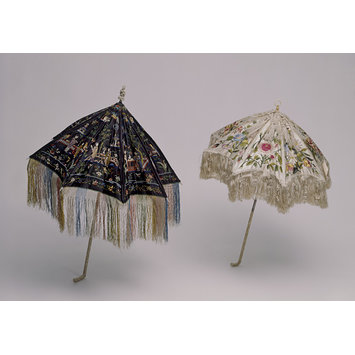
Parasols

Embroidered parasols with fringe, 1860s, in the Victorian and Albert Museum
Two parasols, c. 1860-70, in the Victoria & Albert Museum
My favorite article on parasols is Marta Vincent's overview; there's also an expanded version (sans color pictures) in the Spring 2016 Homefront Herald, starting on page 8.

The first thing about 1860s parasols is that they are small.  Of the closely-dated (1850-1870) originals in The Met's collection, nineteen have dimensions included.  Only two exceed 30" long, both of which are European in origin and dated to the 1850s; based on Marta's article, I suspect they date from the early 1850s, when parasols tended to be larger.  The other seventeen range from 22.6"-28.5", averaging 25.2" long.  The rib length is only given for three of the parasols: each is 26" long, with ribs of 10", 10", and 13".  The others have similar proportions, with the ribs just under half the stick length.
19th Century Parasol from E. Korsmo Collection
Four parasols from the author's collection. The black parasol in the
back has been recovered, the other three have their original canopies.
The four originals in my collection (estimated dates 1850s-1870s) are the same size as the Met's; they average 25.2" long (ranging 22"-28"), with ribs averaging 11" (10" to 13").

Period parasols can either have straight sticks ("walking" parasols) or ones which fold with a joint in the center ("carriage" parasols).  My collection has two folding parasols and two which do not fold; the 17 Met parasols consist of 11 folding (visible joint and sleeve), four straight, and two which are unclear.
Folding parasol stick joint, UK National Trust Parasol 1361428
The metal sleeve covers a joint, allowing the parasol to be
folded in half for transport or held straight while in use.
From an 1850 parasol in the UK National Trust collections.
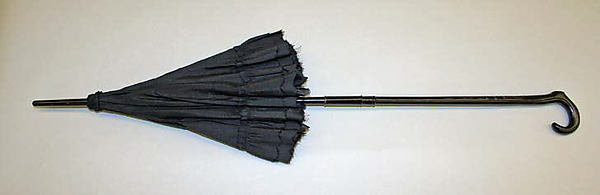
A very popular style of carriage/folding parasol has a second joint at the top of the stick, allowing the canopy to be tilted up to 90 degrees.  These "black marquise" parasols typically have black canopies, black (or rarely, white) linings, and all-black sticks; they are American in origin, and date from the 1860s and 1870s.
Black 1860s folding parasol from The Met
Black folding parasol, likely a marquise, c. 1860, from The Met.
Black tilting marquise parasols, E. Korsmo collection.
Folding and tilting black marquise parasols in the author's
collection.  The one on the right has been recovered.
Black folding marquise parasols, E. Korsmo collection.
Black marquise parasols closed and folded.  Both 28" long when
opened, they fold to 16" and 15".  From the author's collection.
While the straight-stick parasols can't fold, some dissemble in other ways.  One in my collection slides apart, with the carved handle separating from the metal upper stick--the mechanism is such that it actually can't close all the way with the handle in place, and there's a small notch at the end of the metal stick for the canopy clasp.  My other straight-stick parasol can be shortened by unscrewing part of the carved handle (this one can fully close with the handle in place).
Two straight dissasembling parasols, E. Korsmo collection
Straight parasols with detachable handles,
from the author's collection.
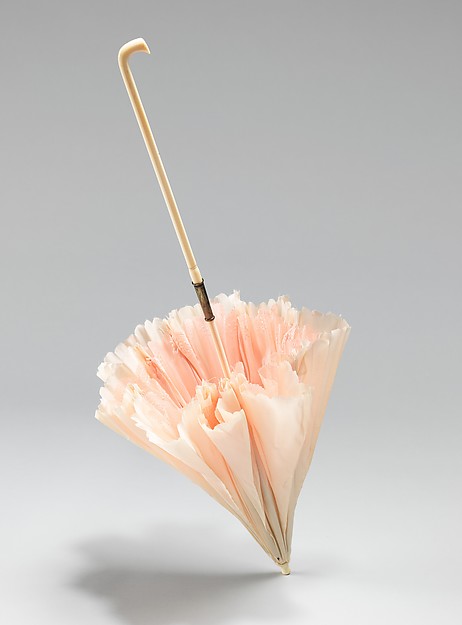
The sticks of parasols can be made of a variety of woods, metal, and precious materials including coral and ivory.  Steel ribs come into use around 1860; cane and whalebone (baleen) ribs are used earlier.
1860s Parasol in The Metropolitan Museum (Brooklyn Museum Costume Collection)
Folding parasol, 1860-1869, in The Met;
the white hooked handle may be carved bone or ivory.
1858-1865 Parasol, UK National Trust Collection
Parasol, c. 1858-1865, with wood and brass frame, cane ribs.
From the UK National Trust collections.
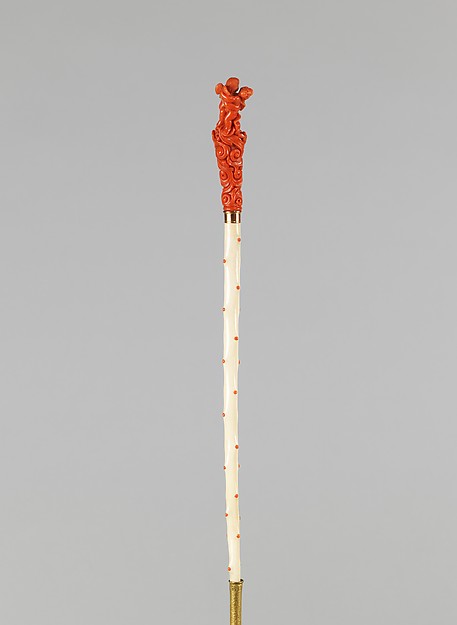
Carved parasol handle 1855-1865, The Met
Parasol handle of carved coral and ivory.
French, c. 1855-1865. From The Met.
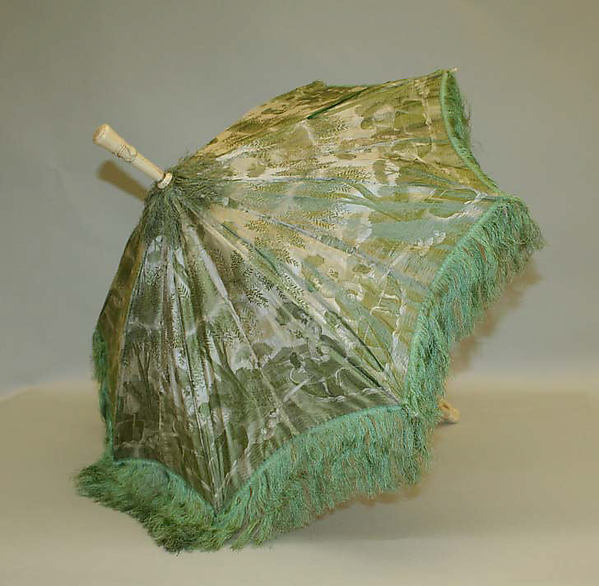
Canopies also show a range of decorations, including plain and figured material, embroidery, tucks, fringe, ruffles, tassels, beads, and lace.  All of the originals I've seen or read about have silk canopies; where present, linings are also silk, often very lightweight. The exception is a single Met parasol marked "silk/linen" (the coral/ivory one above).
Brocade parasol with silk fringe, c. 1860, from The Met.
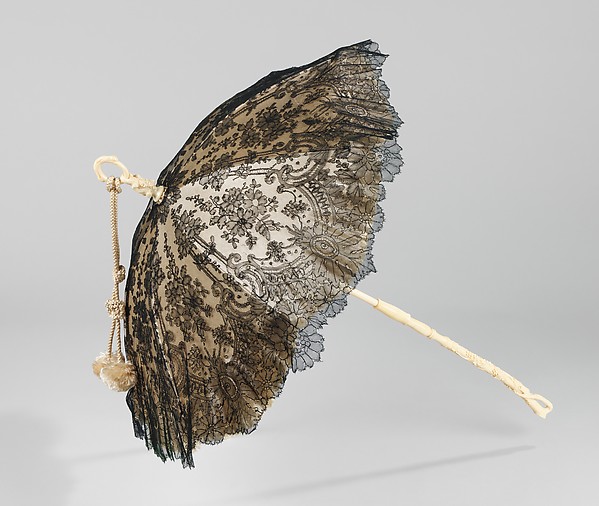
1860-1869 lace parasol, from The Met
Black Chantilly lace over a white silk canopy is a popular design
from the 1850s to 1870s. From The Met, which also has one in black.

The only current source for appropriately-sized reproduction parasols is Maggie Reese, who recently started producing 25" walking parasols; she is also one of the few people commercially re-covering antique parasols at this time.  For re-covering one's own antique frame, the late Marta Vincent wrote some succinct instructions at the Sewing Academy.

Red, White, and Blue; or Columbia, the Gem of the Ocean

"Our Flag is Still There" illustration from The Wisconsin Farmer, 1862
Another patriotic song, and one of my favorite ACW tunes: Red, White and Blue, also known by it's first line Columbia, the Gem of the Ocean. Lyrics are once again drawn from The Book of Popular Songs; they also appeared in periodicals and songbooks throughout the war years.
RED WHITE AND BLUE  
OH Columbia, the gem of the Ocean,
    The home of the brave and the free,
The shrine of each patriot's devotion,
    A world offers homage to thee.
Thy mandates make heroes assemble,
    When liberty's form stands in view,
Thy banners make tyranny tremble,
    When borne by the red, white, and blue.
         When borne by the red, white, and blue,
         When borne by the red, white, and blue,
         Thy banners make tyranny tremble,
         When borne by the red, white, and blue.  
When war waged its wide desolation,
    And threatened our land to deform,
The ark then of freedom's foundation,
    Columbia rode safe through the storm.
With her garland of victory o'er her,
    When so proudly she bore her bold crew,
With her flag proudly floating before her,
    The boast of the red, white and blue.
                                   The boast of, &c.  
The wine cup, the wine cup bring hither,
     And fill you it up to the brim,
May the memory of Washington ne'er wither,
     Nor the star of his glory grow dim.
May the service united ne'er sever,
    But e'er to their colors prove true,
The army and navy forever,
    Three cheers for the red, white, and blue.
                                    Three cheers for, &c. 
There is sheet music (1844) available; you can also hear it sung on-line.

Wednesday, April 20, 2016

Sewing Supplies

I have recently been apprised that Mill End in Portland carries busks, corset boning, and hoop steel--in addition to the gorgeous silks and fine cotton which always hypnotize me.  Bonus content at the link: Micalia's lovely reproduction clothing.

Tuesday, April 19, 2016

Hail, Columbia!

Frontispiece to The Union Memorial (1861)

In addition to being the "unofficial national song" of the 1860s, Hail, Columbia is also the battle cry of the WCWA's "Army of the Columbia."  Here are the lyrics, according to The Book of Popular Songs (1860):
HAIL Columbia! happy land!
Hail ye heroes! heaven born band!
    Who fought and bled in freedom's cause,
    Who fought and bled in freedom's cause,
And when the storm of war was gone,
Enjoyed the peace your valor won.
    Let independence be our boast,
    Ever mindful what it cost;
    Ever grateful for the prize,
    Let its altar reach the skies.
         Firm--united--let us be,
         Rallying round our liberty;
         As a band of brothers join'd
         Peace and safety we shall find.  
Immortal patriots! rise once more;
Defend your rights, defend your shore;
    Let no rude foe, with impious hand,
    Let no rude foe, with impious hand,
Invade the shrine where sacred lies,
Of toil and blood the well-earn'd prize.
     While offering peace sincere and just
      In heaven we place a manly trust,
      That truth and justice will prevail,
      And every scheme of bondage fail.
            Firm--united, &c.  
Sound, sound, the trump of fame!
Let Washington's great name,
      Ring through the world with loud applause,
      Ring through the world with loud applause,
Let every clime to freedom dear,
Listen with a joyful ear;
     With equal skill, and god-like power
      He govern'd in the fearful hour
      Of horrid war; or guides with ease,
      The happier times of honest peace.
            Firm--united, &c. 
For the tune, there's sheet music from 1857 (and an 1861 piano medley); you can also listen to recordings on youtube.

Thursday, March 31, 2016

Quilt Resources

Bedcover/Bride's Quilt, 1861, Chicago Art Institute
Appliqued Bedcover, 1861, in the
Art Institute of Chicago.
Let's explore some of the lovely options for early 1860s quilts! I'm far from an expert on the subject, but I've gathered some period examples and links for further research.

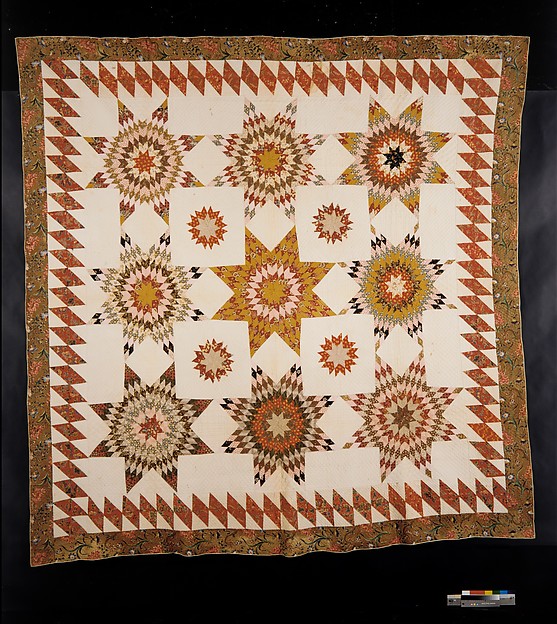
1840-1850 Star of Bethlehem Quilt in the Met Museum
Star of Bethlehem pieced quilt, c. 1840-1850
in The Metropolitan Museum of Art

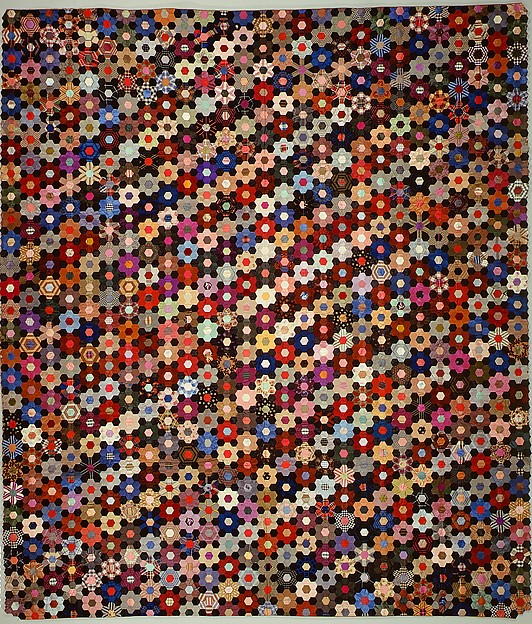
Patchwork, applique, strip, whole cloth, and mixed technique quilts all can be appropriate for the early to mid-1860s.  Patchwork designs in use during and just before the American Civil War include Nine Patch, Mill Wheel, Star of Bethlehem, Star of Lemoyne (and another example), Flying Geese, Feathered Star, Wild Goose Chase, Tumbling Blocks, Chimney Sweep/Album/Friendship Chain, Crown, Mariner's Compass, and even simple squares. Log Cabin quilts seem to gain popularity during and after the war. Hexagon or Honeycomb patterns are frequently mentioned in period sources; today this design/technique is also known as "Grandmother's Flower Garden" and "English Paper Piecing". The talented Miss Dories sometimes demonstrates sewing this pattern at events.
Hexagon Quilt, c. 1864, in the Metropolitan Museum of Art.
Silk hexagon quilt, started 1864,
in the Metropolitan Museum of Art.
Appliqued examples include the ubiquitous-yet-charming album quilts, as well as Rose of Sharon, Prarie Flower, Patriotic Eagle and Stars, Oakleaves, Triple Tulip, and Pineapple designs,  Pieced basket patterns with appliqued handles and/or flowers and fruits are fairly common; likewise patchwork quilts with appliqued borders.  An older technique ("Broderie Perse") involved cutting out chintz print motifs and appliqueing them onto the quilt top. I've used the museums' titles for the linked quilts; period names may differ.

1862 album quilt from the Art Institute of Chicago
"Circuit Rider's Quilt", 1862 album quilt,
in the Art Institute of Chicago.

In primary documents, quilts and patchwork are named among the prize categories of agricultural fairs and in exhibitions.  The second link includes a separate category for girls under twelve, with a four year-old, a seven year-old, and a five-year-old taking first, second and third place, respectively. A favorite period story of mine, "My Patchwork Quilt" (published in the 1840s), follows the development of a quilt, from the narrator first learning to sew until the work is completed; family anecdotes are tied in by the garment scraps used in the quilt--and a fair amount of social information comes through about the desirability of patchwork quilts, attitudes towards sewing them, how fabrics are acquired, and the process of making and quilting it.  Miss Leslie's Lady's House Book (11th ed./1850) has a more matter-of-fact discussion of popular bedcovers, and the different options available.  Patchwork designs and projects show up in period magazines.  Quilting was even addressed by sewing machine manufacturers.

Patchwork Cushion, Godey's 1852
Patchwork Cushion project in Godey's, 1852
1864 Patchwork from The Lady's Friend
Patchwork Pattern from The Lady's Friend, 1864

Quilts played their distinctive role in the war; the U.S. Sanitary Commission collected and distributed quilts, blankets, coverlets and comfortables to army hospitals.   Quilts might also be gifted to individual soldiers by their friends and relations.
1864 Sanitary Commission album quilt, in the Smithsonian
Sanitary Commission album quilt, 1864,
by The Ladies of the Fort Hill Sewing Circle
in the Smithsonian Museum of American History.
Sanitary Commission Quilt 1863 Susannah Pullen, Smithsonian
Star pattern quilt made for the U.S. Sanitary
Commission, 1863, by Susannah Pullen's
Sunday School class. Now in the Smithsonian.
For original quilts, you can't beat the International Quilt Study Center and Museum. They also have some articles specifically on Quilts of the Civil War. The Metropolitan Museum of Art, The Museum of Fine Arts Boston, and The Chicago Institute of Art also have a variety of nineteenth century quilts in their collections (and The Quilt Index has links to even more).  The Smithsonian's National Quilt Collection is also worth viewing.

Additionally, Barbara Brackman, noted quilt historian and author, blogs about 1860s quilts at the aptly-named Civil War Quilts; she also writes about antique quilts and reproduction fabric prints at Material Culture. I would particularly recommend her books Quilts from the Civil War, America's Printed Fabrics, and Facts and Fabrications.  Elaine Trestain's extensive collection of period quilts provides many of the fabric samples seen in Dating Fabrics: A Color Guide (which also has useful information on period fabric printing methods).

Monday, March 21, 2016

First Names

Illustration from The Ladies' Repository, 1852

This is not a post about when/who should use first names, but rather some interesting references to popular ones.  So, next time you're developing a persona, inventing a pseudonym, or devising names for your imaginary relatives and correspondents, here are some suggestions:

Most Popular Given Names.  Lists of the most common names for men and women, arranged by decade (calculated from U.S. Census returns).

The Ladies' Repository (1852) describes the histories of several common female names, including ones still used today (Mary, Sarah, Caroline), and some which have fallen out of favor (Mabel, Blanch).

Godey's lists some "Pretty Names for Girls" in 1855, as an antidote to having 'four Marys, three Anns, three Elizabeths, 1 Sarah, and 1 something else' for every dozen women.

Sunday, January 10, 2016

MNHS Civil War Collections

Here's another great on-line collection for research: the Minnesota Historical Society's Civil War Collection. In addition to artifacts (both military and civilian), there are assorted images, manuscripts, state muster documents, and the some of the Christie Family Letters (published in the book Brother of Mine).
Henry H. Sibley, c. 1865
First governor of Minnesota, and state millita officer.

Saturday, October 24, 2015

Civilian Winter Clothes

The Illustrated London News, Jan 1, 1859
Inspired by Anna Bauersmith's article on seasonal layers, here are project links for warm and winter clothes.  Most are 1859-65, but there are a few earlier ones as well, so check the date when determining if a project suits your impression.

Liz Clark's essays on Dressing Children and Infants for Cold Weather are also highly recommended.


Women's Items
Red Riding Hood, page 79, Peterson's (1862)
Tufted Hood* from Liz Clark
Mrs. Meister's Hood Pattern* (the shape is more 1850s)
Opera Hood (knit), page 122,  Godey's (1862)
Opera Hood (knit), page 378, picture 322, Peterson's (1865)
Norwegian Morning or Bonnet Cap, page 111, from The Illustrated Magazine (1863)
Neapolitan Opera Hood, Mlle. Riego's The Useful Knitting Book (1864)
Quilted Silk Hood, page 359-60,  Peterson's (1859)
Princess Capote, page 415, pic 359, Peterson's (1862) [New research by AWB suggests this may be a summer seaside garment.].
Capeline or Hood, page 287, Godey's (1862)
Algerian Knitted Opera Hood, page 284-5, New Peterson's Magazine (1865)
Knitted Opera or Travelling Hood Trimmed with Swansdown, page 599, 540 (illustrated), Godey's (1862)

Eugenie Collar from Mlle. Riego's Crochet Winter Book (1857)
Knitted Collar, page 171, picture page 115, Peterson's (1862)
Shetland Cravat, page 69-70, Peterson's (1865)
Ermine (knit) Tie and Cuffs, page 31-2, The What-not; or Ladies' Handy-book (1861)
Lady's Croquet Cuff and Cravate, Mlle. Riego's The Useful Knitting Book (1864)
The Eyder Necktie, Mlle. Riego's The Useful Knitting Book (1864)
Wool Scarf in Crochet (page 312, illustrated 264) Arthur's Illustrated Home Magazine (1860)
Braided scarf, with Mrs. Mescher's modern instructions.

Winter Cloak, page 74-75,  Peterson's (1859)
Crochet Cape, The Queen's Winter Knitting Book (1862)
Cloaks, general instructions, How to Do It: Or, Directions for Knowing and Doing Everything Needful (1864)
Winter Mantle or Sortie-De-Bal, in Crochet page 549, Godey's (1858)
Fall Paletote, illustration page 452, diagram 454, Godey's (1859)
Round Jacket for a Lady (knit), page 331-333, Peterson's (1856)
Polka Jacket in Crochet, page 168-169, Peterson's (1856)

Knitted Winter Spencer, page 53-4, from The Illustrated Magazine (1863)
Sontag, and Mrs. Mescher's modern translation of it.
Knitted Sontag, page 412-413, Peterson's (1862)
Loose Waistcoat or Bodice, The Queen's Winter Knitting Book (1862)
Habit Shirt or Bodice in Crochet a Tricoter, The Queen's Winter Knitting Book (1862)
Under Spencer or Jacket, The Queen's Winter Knitting Book (1862)
Chest Preserver, The Queen's Winter Knitting Book (1862)
Knitted Jacket, page 277, The Ladies' Companion and Monthly Magazine (1864)
(Also in the Illustrated London Magazine for 1864)
Lady's Under-Vest, Mlle. Riego's The Useful Knitting Book (1864)
Spanish Jacket, Mlle. Riego's The Useful Knitting Book (1864)
Winter Jacket in Double Crochet, pages 290-292, Peterson's (1864)
Fall and Winter Jacket, page 444-445, New Peterson Magazine (1865)
Nubia (shawl) with Mrs. Mescher's modern instructions.
Knitted Shawl in Colors, page 419, picture page , Peterson's (1862)
Plaid Shawl, Mlle. Riego's The Useful Knitting Book (1864)
Biarritz Shawl, page 186, Godey's (1862)

Knitted Undersleeve, from Godey's (1862), page 465
Knitted Sleeve, The Queen's Winter Knitting Book (1862)

Eugenie Machettes and Lady's Gauntlet Mitts from Mlle. Riego's Crochet Winter Book (1857)
Knitted Gauntlet, from The Lady's Companion (1865), page 55
Instructions for Knitted Mittens and Cuffs: "Another Pair of Lady's Mittens" from Godey's (1862), page 284-5
A New Stitch for Cuffs (crochet), page 187, Godey's, 1862

Knitted Under-Petticoat, from The Lady's Companion (1865), page 166
Knit Drawers, page 174-5, Peterson's (1862)

Crochet Dressing Slipper, page 446, Peterson's (1865)
Knitted Gaiter, page 335, The Ladies' Companion and Monthly Magazine (1864)
(Also in the Illustrated London Magazine for 1864)
Furred Winter Shoe, page 358-9,  Peterson's (1859)

Children's Items

Tufted Hood* from Liz Clark
Mrs. Meister's Hood Pattern* (the shape is more 1850s than 1860s)
Boy's Winter Hat in Knitting (page 312, illustrated 264) Arthur's Illustrated Home Magazine (1860)
Garden Hood for a Little Girl (knit), page 162-3, from The Illustrated Magazine (1863)

Instructions for Knitted Mittens and Cuffs: "Knitted Mittens" for a girl 2-3 years old; from Godey's (1862), page 389
Instructions for Knitted Mittens, for girls 8-10, from The Illustrated Magazine (1863)
Child's Muff in Imitation of Chincilla (knit), page 310, Peterson's (1865)

Infant's Shirt (knit), page 412, Peterson's (1862)

Baby's Sock in Crochet, page 413, Peterson's (1862)
Baby's Sock, Mlle. Riego's The Useful Knitting Book (1864)
A Little Girl's Stocking, Mlle. Riego's The Useful Knitting Book (1864)
Boy's Knickerbocker Stocking (ages 5-6), Mlle. Riego's The Useful Knitting Book (1864)
Child's Sock (2 patterns), How to Knit Socks (1863)

Crochet Gaiters from Mlle. Riego's Crochet Winter Book (1857)
Child's Warm Shoe in Crochet, page 163, The Ladies' Companion and Monthly Magazine (1864) (Also in the Illustrated London Magazine for 1864)
Crochet Boots for an Infant, page 222, The Ladies' Companion and Monthly Magazine (1864)
Baby's Boot in Knitting and Crochet, page 122, The What-not; or Ladies' Handy-book (1861)
Baby's Boot (quilted/wadded), page 410, Godey's (1862)
Child's Gaiter, Mlle. Riego's The Useful Knitting Book (1864)

Men's Items

Knitted Waistcoat, The Queen's Winter Knitting Book (1862)
Gentleman's Comforter, page 56, The What-not; or Ladies' Handy-book (1861)
Gentleman's Knit Stockings, page 58-9, The What-not; or Ladies' Handy-book (1861)
Gentleman's Knickerbocker Stocking in ribbed knitting, The Useful Knitting Book (1864)

Knit Knee Warmer, Godey's, 1862
For Everyone:

Basic Wool Shawl*
Two Knitted Comforters (scarves), The Queen's Winter Knitting Book (1862)

Mrs. Mescher's Muffatees*
Directions to Knit Mittens, page 92, Peterson's (1862)
To Knit a Mitten With One Finger, page 176, Peterson's (1862)
Knitted Mitten and a Very Easy Mitten, The Queen's Winter Knitting Book (1862)
Knitted Glove, The Queen's Winter Knitting Book (1862)
Two Muffatee Patterns, The Queen's Winter Knitting Book (1862)

Knit Stocking, The Queen's Winter Knitting Book (1862)
Knitted Knee Cap (?!?!), page 445, Peterson's (1865)
Socks (2-3 patterns), How to Knit Socks (1863)
Knee Caps, Mlle. Riego's The Useful Knitting Book (1864)

General Knitting Help in Period Sources
The 1862 run of Godey's, includes an explanation of pattern terms on pages 84-85.
The Illustrated Girl's Own Treasury (1861) includes knitting instructions and pattern abbreviations.
Peterson's (also in 1862) includes a variety of new knit stitches to adapt for one own's projects.

*Asterisked projects are modern instructions based on extent period pieces.  The projects not so marked are either period instructions, or modern explanations of period instructions.


Tuesday, September 15, 2015

What's Your Job?

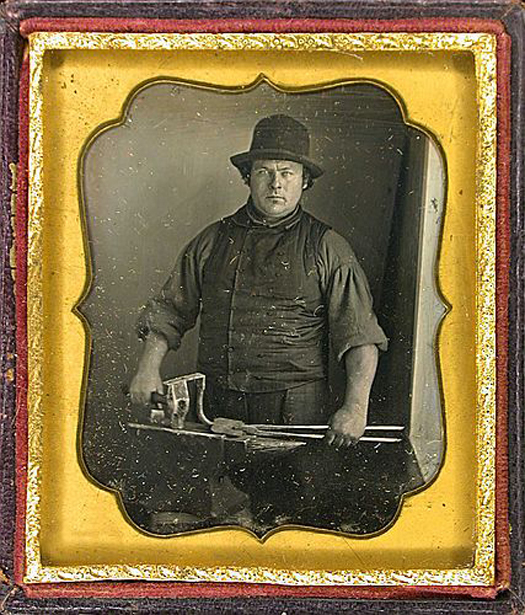
Blacksmith with tools, c. 1852.
Note the vest, scarf and rolled sleeves.
Image from The Design Observer Group.
Wondering about civilian professions in the 1860s?  Unsure what to wear? Curious about the 'tools of one's trade'?  Here are some resources for occupational images (either staged daguerreotypes/tintypes/CDVs showing 'types' of workers with their tools, or actual documentary pictures).  Many of these are loosely dated, or slightly/rather pre-war, but they still have useful background information.  Even the professional soldiers of the '60s would have interacted with tradesmen (and perhaps trained for an occupation at some point), while wartime volunteers all would have some sort of job before enlisting.


These Dated Images from the 1840s and 50s show a diverse range of trades and professions.

There are also slideshows of occupational images from the1840s/50s On Youtube.

The American Daguerreotype Society has fewer images, but with more commentary on them.

And there are more pictures here, but without useful contextual information.

These 1860s Russian CDVs show a great diversity of jobs and tools, with a mixture of traditional Russian and modern European dress--look to other sources for collaborating stylistic choices, unless you're portraying a very recent immigrant.

Women's occupational images. (For more about jobs open to women, check out Virginia Penny's 1863 book "The Employments of Women").

Illustrations of poor Londoners, 1851.  These include working people and the indigent.

The Library of Congress's Daguerretype collection: enter the occupation of interest, and voila!