Showing posts with label New Reenactors. Show all posts

Wednesday, August 19, 2015

Hair Styling 101, 102, 103...

Arthur's Home Magazine, June '64
"As to the different ways of dressing the hair, it is impossible to describe a hundredth part of their number; we can only refer our readers to the fashionable coiffures and the fashion-plates. "
-Le Follet, 1863

To aid in that task, here are some picture tutorials for basic early '60s hair-dressing.  Hopefully, they'll help you see how some of the coiffures go together, and get started on a style or styles that suits.  Several of the ladies had a hair-styling party at the June drill/meeting, and this seems to be a topic upon which we can all help eachother out.  Perhaps with some collaborative hair-dressing at Snoqualmie and Fort Worden?

(Re-posted from the blog-mistress's personal blog):

Basics of 1850s-1860s hair
Tools and Decorations
1860: Braids upon Braids
1862: Braids & Rolls
Simplified Early '60s Side Braids
Waterfall, c.1864-7

Tuesday, August 11, 2015

Beginning First Person Interpretation

For those interested in trying it out, a few thoughts on first person living history:


First person interpretation is pretending to be a person from the past—and not alluding to the fact that you are a twenty-first century person in funny clothes talking about the past.

We call it "first person" because you are using the grammatical first person ("I/me/my, we/us/our") to convey your information. For example:

First person: "I fear prices will keep rising as long as the blockade lasts."
"We are making a quilt for the hospital."

Second person: "If you lived here in 1855, you'd be sharing this one room with all of your siblings."

Third person: "He wrote most of his letters at this desk."
"The soldiers often complained of inadequate rations."
"They didn't have electricity."

In first person, the speaker is placing himself or herself in the past. In second, the person being spoken to is placed in the past. In third person, the person(s) being spoken about is(are) placed in the past.

How to do it

In short, start using "I" statements. Everything you already know and share about the period is still relevant—you're merely changing how you present the information.

There are two main groups of people you'll interact with in first person: other reenactors (in first person), and the public (people not in first person).  Most of the techniques are relevant to both, though the later group in particular may need some prompting to understand that you are from the past--in first person rather than in third.  You'll also get the occasional corny attempt at humor ("Where's the TV?"; Waves cell phone--"Have you ever seen one of these?"); I prefer to handle these with a polite smile, "I am unfamiliar with that term", and getting back on topic.

It's fun to do first-person with other reenactors, and you don't need to plan out elaborate scenarios and scripts. At the bare minimum, all you need to have worked out is that you're in the same place—knowing where and when you are.

When are you? Where are you? 
Some events make this clear in advance: the event and everyone at it is in Gettyburg, PA July 1-3, 1863, for example. Others events are less well-defined, in which case you need to either work out your location/date or avoid using specific (time-sensitive) details that might not fit. Discussing the upcoming presidential election is an excellent topic for the summer of 1864, but makes less sense if your conversation partner thinks its the spring of 1861 and was just about to bring up their thoughts on the recently-past election. Complaining about blockade-caused shortages as a Georgian in 1863 is great...that is, if you're not talking to a northern shop-keeper who's noticed no such hardships, or to your southern neighbor of '61, who's still anticipating a quick war after First Manassas.

Dropping the year into your conversation can also help orient the public to your first-person conversation.  Ie, "Look at our new cook stove. Poor Thornhill was actually cooking over an open hearth until it arrived last year--imagine cooking on a hearth in 1854! But then, with the expense of shipping it around Cape Horn, we're quite lucky to have it at all."

Who are you?
Unless you're at a planned event where you share a backstory with other people--who are portraying your close friends, family and neighbors--this sort of background information is largely for your own benefit. It's both very important (your persona's social, political and geographical background informs everything you say/think/do in character), and not very important (unless you bring it up, no one will ever ask about your character's childhood home, or deceased relatives, or favorite food). To start, work out the very basic concepts such as your name, your relationships to other people present at the event (if any), and what you're doing there. You can build a more elaborate persona as you feel comfortable with it.

Introduce yourself!
Use a period form of introduction to do so, and you're already in first person.
(I've put forms of introduction and address in a separate post).

Keep Talking, Keep Trying
Venture an opinion: on the weather, on the shop-keeper's prices, on that bonnet you saw in Godey's, on the President's recent proclamation, on the war, on a patent medicine you tried. Ask a question, How's your health? Where's a good place to buy shoes? Have you seen my husband pass this way? What do you think of the military occupation/weather/recent political event/lastest fashion fad? Have you seen the latest edition of Harper's? Tell an amusing anecdote. Offer advice. Anticipate a coming event: the ball tonight, the end of the war, your sweetheart's next letter. Discuss your day/the children/that new Dickens novel you're reading. Attempt to recruit your conversation partner into some future project: planning a charity ball, supporting a political candidate, investing in your land speculation scheme.

I find first-person opportunities provide excellent fodder for your next first-person encounter: discussing the last ball over dinner, or recounting the time that the maid tripped and invented "flying aspic".  If you interact with the same people, you'll also start to develop shared stories and backgrounds which can be referenced on future occasions.

Period literature can make a pleasant topic of discussion. Incidents and opinions found in period diaries, letters, and travelogues can also be adapted for personal use: for example, one lady at Nisqually last year portrayed a character who had crossed Panama by mule, and regaled us with stories of the trip. Avoid taking well-known incidents and putting yourself into them—unless you actually are portraying one of the Pinkerton agents who thwarted the first assassination attempt against Lincoln (or whatever the particular situation is).

Do Something/ Start Conversations
This applies to in-character interactions as well, but it's vital to conversations with the "public". Visitors don't always know that you're in character, and might not know how to approach you. even if they do.  Doing something provides one way to break the ice—the public can ask questions about it, or you can greet them and volunteer information about your activity.

This is also great for you, as it focuses the sort of questions you'll be getting. Even if you don't feel like you know everything a person from you period would know, you can research a narrow topic until you feel comfortable with it (most people aren't looking for a dissertation). So, read up on period laundry methods if you're washing clothes. Consider where you bought/procured the food you're cooking with. Know who you're writing that letter to, and be able to name the equipment you're using to write it.  Someone who sees you cooking is more likely to ask you a question or two about your menu/tools/where you acquired your ingredients--ie, the questions you're prepared for--than to grill you for minutiae on politics, or transportation, or fashion.  

Then, when a visitor comes up to you, start talking to them. I like to start with a "good morning", or "good afternoon" ("hello" seems to be uncommon in 1860s, and "hi" is right out). The visitor will often ask when I'm making/doing, and I can explain that I'm tatting/rolling gingerbread/sewing a skirt. If they don't ask another question, I can offer a few more details (tatting is a sort of lace-making; I'm using it to make a decorative trim for a chemise, which is a sort of undershirt that keeps my other clothing nice). Eventually, the visitor will either start helping carry the conversation, or they will take their leave. Either way, you've just taught them something. And you did it in first person!

Admit That You Don't Know
This where I most often end up breaking character. Someone asks a question, and you don't know the answer. The cardinal rule of living history and museum interpretation is do not make it up.* So, don't. Own up to your ignorance. Offer what relevant information you do have. If it's something that can be handled in character, great—after all, there are things your character wouldn't know. If that's not the case, ie, the question is one that your character should be able to answer, then you need make it clear that you're breaking character when you say no. And later, you can try to find the correct answer for next time.

Some ways to answer in character:

"I've no idea what the clerks are paid, but it's surely more than I earn picking potatoes. Are you looking for a position?"

"My maid handles the laundry. I don't know how she gets those ink spots out, but my undersleeves always come back neat and clean. Nevertheless, I've started wearing sleeve protectors when handling a large correspondence."

"How old's the wheat? Well, I planted it late spring, and it's ready to harvest now, and that's my main concern." [If the questioner persists in asking about the dates for the wheat variety, I'd break character to say that I don't know.]

To gracefully demur: "Actually, I don't know how much the seasonal workers were paid, but we're continuing to research the topic.  I do know that servants in this area earned around $X per month, and expect that unskilled labor was paid at a similar level."

Keep Learning
The more you know, the more... Questions you can answer. Conversations you can enjoy. Interesting scenarios you can devise. Different personas you can try.

The more accurately you can present the past to others.

Some resources for developing more advanced personas and research:
Resources from the Atlantic Guard Soldiers' Aid Society
Linda Trent's "Creating Believable and Sustainable Characters"
First Person Character Worksheet
Discussion: Staying in First Person
In the Right Mind part I
In the Right Mind part II

To Re-Cap

First person interpretation is pretending to be someone from the past—using "I" and "we" in your conversations.

When doing first person with other reenactors:
  1. Know who, where and when you are
  2. Introduce yourself
  3. Keep trying
  4. Continue to learn

When doing first person interactions with the public:
  1. Know who, where and when you are
  2. Do something
  3. Start conversations
  4. Admit when you don't know the answer (stay in character if you can)
  5. Continue to learn

*To clarify, yes, you are lying: first person is a mutually-agreed-upon-fantasy, in which everyone knows that you were not actually born in 18XX, but both you and the visitors are pretending otherwise. All liberties need to be confined to this 'mutual fantasy' dressing and not get mixed into the history itself. We're here to educate, and inventing 'facts' does a disservice to everyone (including future generations of interpreters who get to keep disabusing returning visitors and their grandchildren of stories—that have no basis in fact—invented by previous living historians). The public is are trusting you to tell them what the past was like, and are granting you license in the presentation. So, go ahead and relate the funny privy story you read (in a period source) as though it happened to you, or use your own experience with the horsehair sofa as a warning about sitting carefully (happened while using period items in the prescribed way), but don't invent something out of wholecloth and pass it off as history.

Sunday, August 2, 2015

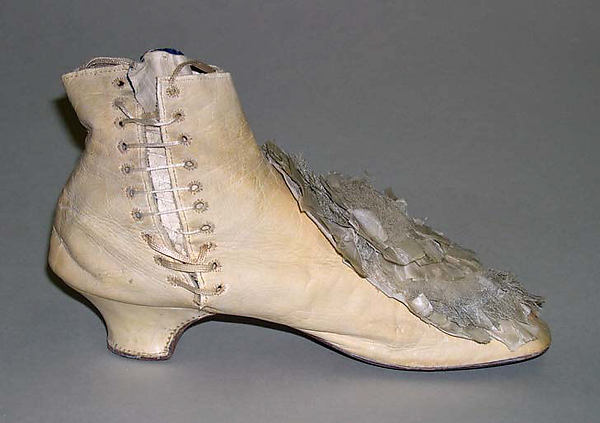
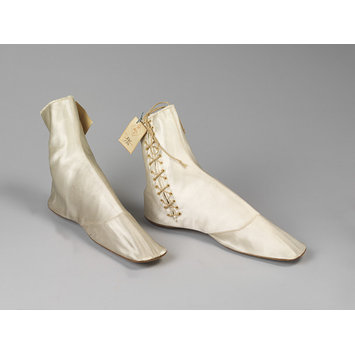
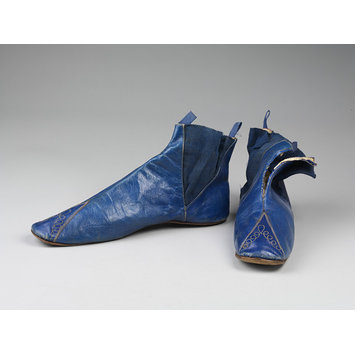
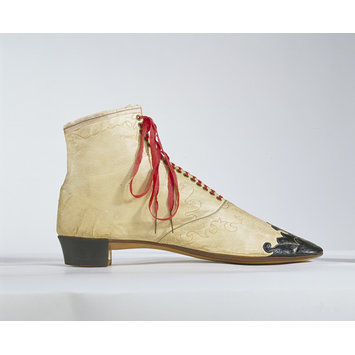
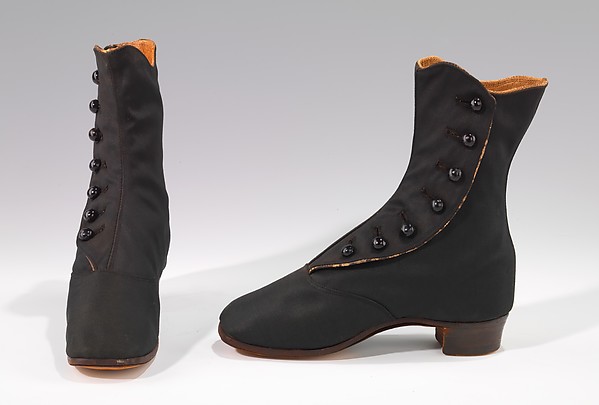
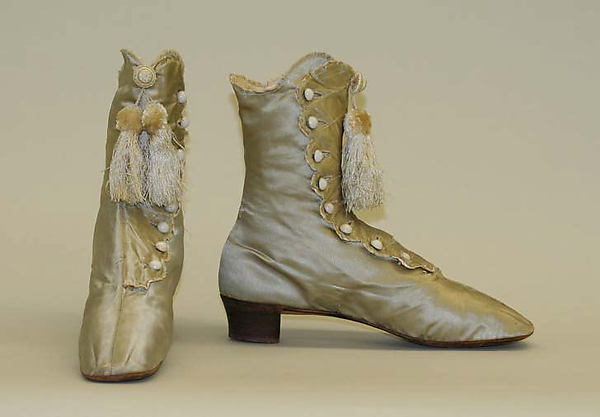
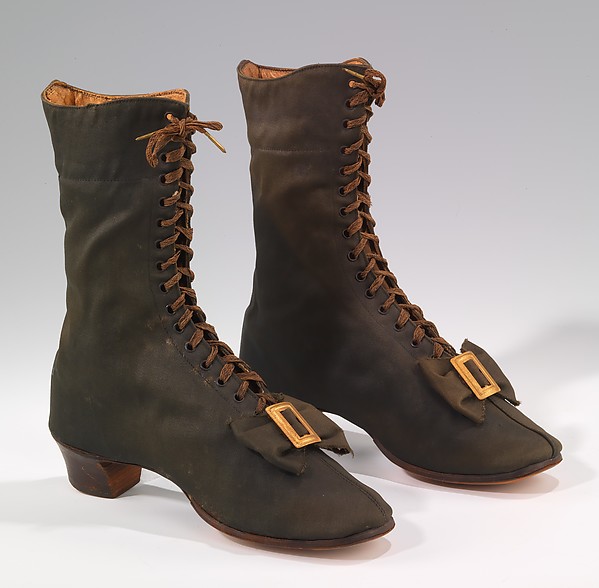
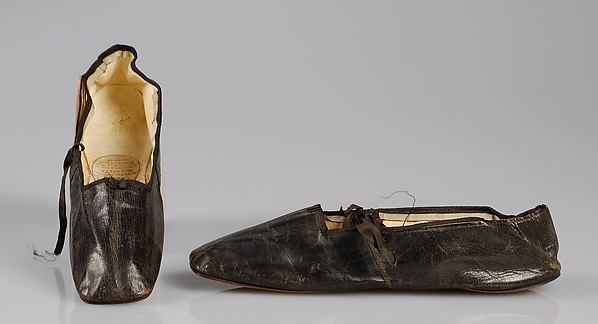
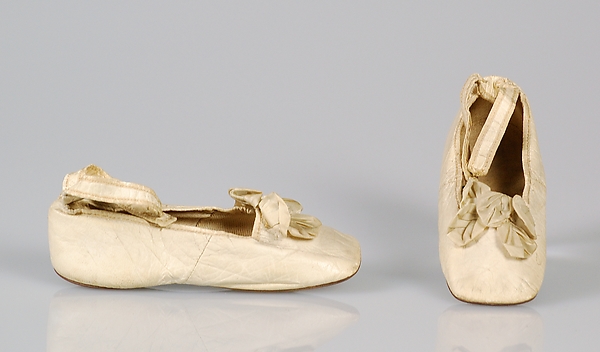
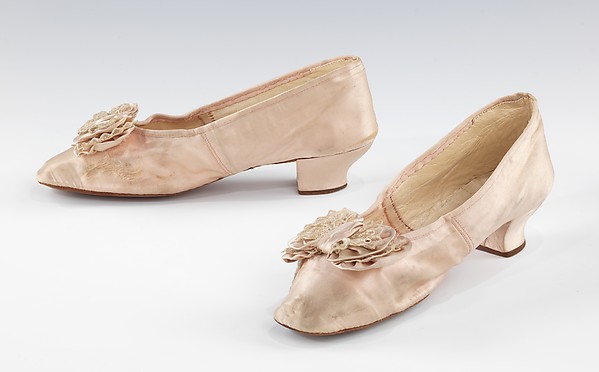
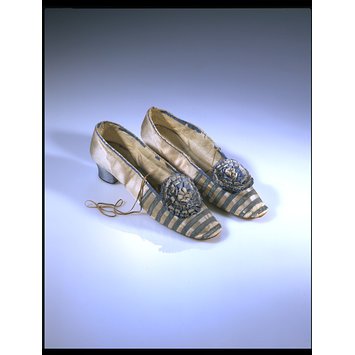
Shoes c. 1860-65

Here's some visual references for shoes and boots of the early 1860s.  These are mostly civilian examples, but there's some (er, one) military as well.

Let's start with the ladies.  Ankle-high boots or "gaiters" are very popular in this period.  The may be fastened up the front with laces, or up the side with laces, elastic gussets ("congress gaiters"), or buttons. Non-functional buttons may also be present on a slip-on elastic boot; I've seen no examples of laced shoes with decorative buttons.  Every Lady Her Own Shoemaker (1856) recommends the front lacing style for those who wear their shoes out unevenly--the shoes may be made on a 'straight last' with no left or right, and then can be worn on either foot, prolonging the wearing life of the shoe.

Ladies' boots featured in Der Bazaar, 1862
Leather shoe, c. 1860-79, from The Met
Embroidered (wool on canvas) boots with elastic gusset, c.1845-65, VAM
Satin boots, c. 1850, VAM, (There's a very similar pair in black, too)
Women's leather/elastic boots, c. 1860s, VAM
Leather boots with contrasting "foxing" or "toe cap", 1850s, from the VAM
Silk boots c.1860s-1870, from The Victoria and Albert Museum
The tall boots often called "Victorian" are primarily from later in the 19th century (or even the 20th). Still, there are mid-century examples of ladies' boots of which rise somewhat above the ankle-not all the way up the calf, but above the ankle.

Wool boots, c. 1865-75, from The Met
Wedding shoes, likely of silk, 1865, from The Met
Wool boots, 1860-69, from The Met
Lower styles are also worn, particularly for in-home and formal wear (though boots may also be used for these occasions-consider those lovely silk ones above).  The prevailing shoe fashion frequently has open tops (ala "slippers"/ "ballet flats"), low or no heel, and rounded, square or shallow pointed toes--none of those extreme modern, angled points.  The shoes may be slip-on, or have straps across the ankle, or ties that criss-cross.

Ladies' shoes from Der Bazaar, 1862
Leather slippers, c. 1845-65, from The Met
Leather shoes, 1866, from The Met
Silk evening slippers, 1855-65, from The Met
Silk satin shoes, c. 1855-65, from VAM
Materials include silk, leather, and wool for the uppers, with leather soles.  The originals I've looked at had silk uppers with linen or cotton linings underneath.  Every Lady Her Own Shoemaker mentions that a wide variety of materials may be used--with linings under the lighter weights and leather foxing to extend the wearing life--particularly that left-over dress fabric be employed to make matching shoes.

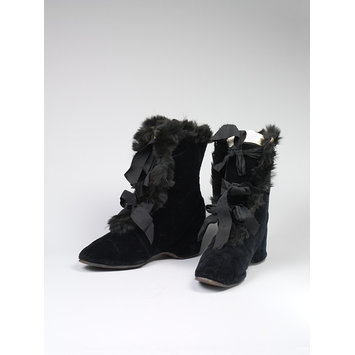
For a whimsical finish, here are a pair of velvet and rabbit fur carriage shoes (warm shoes to wear while travelling), with quilted silk for extra warmth:
Lady's Carriage Boots, c. 1850s, VAM

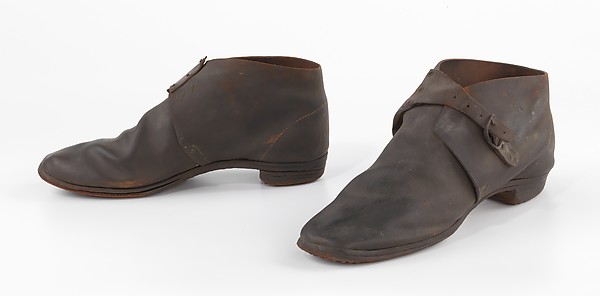
And now for the gents (thank you for your patience!)  I'm afraid that examples of men's shoes a little harder to find by my usual methods. They are out there, however, such as these leather brogans which were reportedly worn by a POW returning home after the Civil War.
Men's brogans, c. 1860-65, from The Met
In civilian-land, both shoes and boots are available: leather is a popular material, but fabric may also be used (such as the cotton velvet referenced in this story).  As with women's shoes, fabric uppers may be protected by leather toe caps or foxing. 

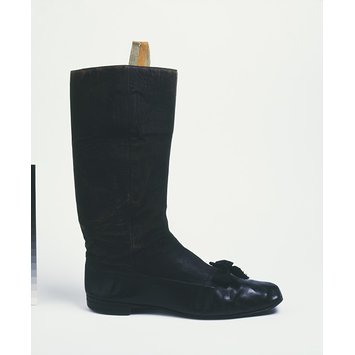
Consider these "opera boots" for formal-wear:
Opera boots, 1840s, from the VAM
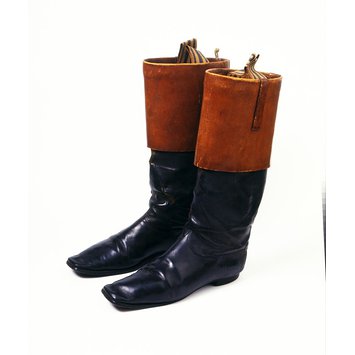
Top boots are apparently useful for riding, walking, and general wear:
Men's Top Boots, 1840s, VAM
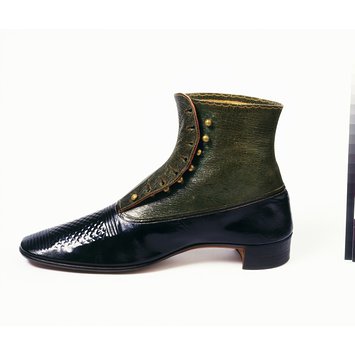
There are also shorter boots available, such as these eye-catching snake skin and patent leather ones:
Men's short boots (leather/snake skin), c. 1851, from VAM


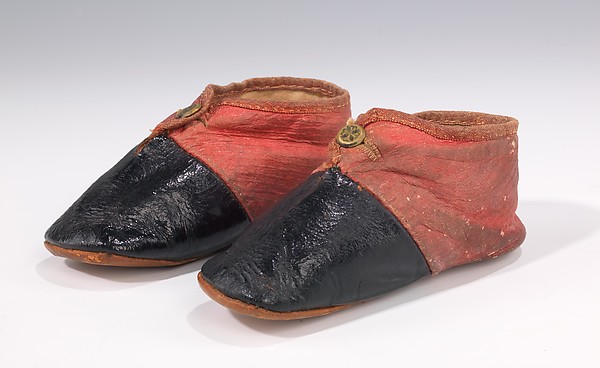
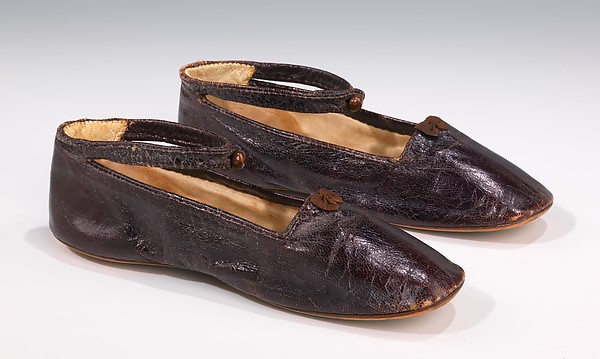
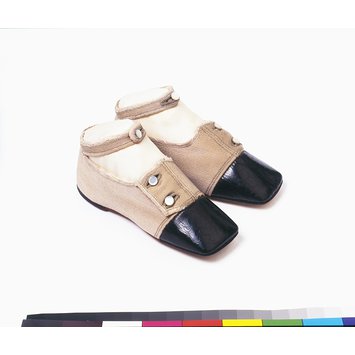
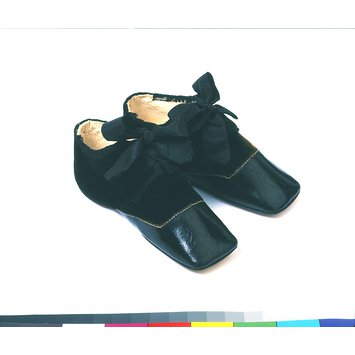
Children's shoes end up looking like tiny versions of mom's shoes, noting that the ankle-strap is very common on open-top shoes.  Silk, cloth, leather, and velvet are among the materials used.
Silk baby bootees with tatted decoration, early 19th century, VAM
Infant shoes, c. 1860, from The Met

Leather shoes (about a modern toddler size 10), c.1850-69, from The Met
Children's shoes, c. 1851, cloth and patent leather, from the VAM
Children's shoes, c. 1851, velvet and patent leather, from the VAM


Tuesday, July 28, 2015

Men's Civilian Attire

"First Class: The Meeting", 1855, by Abraham Solomon
Having already devoted a number of posts to women's clothing, it's only fair to gather some resources for the men.

The best starting reference I've found is Mrs. Kessinger's wardrobe guide.  Several of the on-line discussion spaces named in the ladies' posts also address gents' attire, ie, The Sewing Academy, The Civilian Civil War Closet (you do need to log onto Facebook to view the latter).  As always, researching a subject before buying anything is advised.

For purchasing garments, NJ Sekela and Jas. Townshend appear to be the premiere outfitters, though I cannot speak from personal experience (note that Townshend covers a wide range of years, and not all items are suitable for ACW use, or for all impressions therein).  Kay Gnagey also has some gentlemen's ready-made items.

To those looking to make their own clothing, Jim Ruley's picture-heavy Tailoring Tutorials can help the novice tailor.  Rumor has it that the gentleman himself also drafts custom patterns for hire. Past Patterns has several men's patterns available for the 1850s-1860s, and I've heard good things about their vest pattern #018.  Peachtree Merchantile patterns are based on original garments, including trousers and an overcoat.  Martha McCain's "Fashion Historian" patterns for Simplicity, though now out of print, included several men's patterns with good shapes.  Thoughts on Men's Shirts in America, 1750-1900 by Brown and Chamberlain is apparently the definitive work on the subject, though sadly out of print.

Original patterns/tailoring systems online include Devere's The Tailor's Guide (1855) and these from the 1840s.  Most plain-sewing books include instructions for men's shirts, though their usefulness varies: The Workwoman's Guide (1840) is the most extensive; The Sampler (1855) actually includes cutting diagrams, though Plain Needle-Work (1852) has a nice finished illustration.

Monday, June 1, 2015

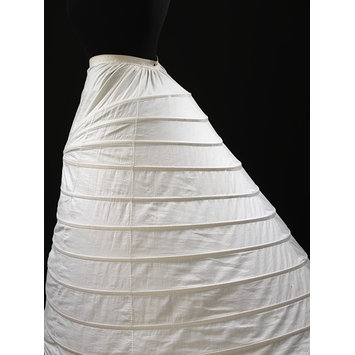
Concerning Hoopskirts

This 1858 illustrator has apparently confused
the crinoline with the lightning rod.

"The circles were all changed to polygons, and at every angle was a neat splice of white cord, or a bandage galloon, or a delicate suture of linen thread, and in one place where the break was particularly bad--a regular compound fracture as the doctors would say--and the steel protruded through the skin, the dear little woman had put it into splints of whalebone, and wound it round and round with bonnet-wire! I felt the tears come into my eyes as I looked at Mrs. Lambswool's hoops. 

When did she get that set? I counted on my fingers, and calculated that it must have been at least six months ago. It was the regular old-fashioned Champagne-glass figure and I reflected that had Mrs. Lambswool married somebody besides a poor book-keeper she would have had at least two new sets since that was bought."

--"My Velvet Shoes" in Harper's New Monthly Magazine (1860), hat tip to Jessamyn

Fiction though it may be, this internal monologue by a cash-strapped husband gives some useful insight into hoops in the year 1860.  We see how a set may be repaired and made to last by an economically-minded woman; we learn that shapes were changing rapidly enough for six-month-old hoops to be "old-fashioned" (it is later revealed that Mrs. Lambswool turned down a stylish friend's invitation because she was ashamed of her outmoded hoops); we learn that replacing hoops every two months or so is normal for someone who is not struggling financially; we later learn that purchasing hoops is embarrassing for a man, and that many different brands of hoops are available.  The new set bought to replace the above has 30-springs and cost $3 (for a top brand); in comparison, $5 was expected to buy a quality pair of men's boots, $0.50-$1 gets a cheap pair of shoes, and $0.50 is paid for a good clothes basket with a lid.

1858 Hoop skirt illustration from Peterson's Magazine
Hoop in Peterson's, 1858
This story indicated that even people in financially precarious situations made a point of wearing hoops.  Other sources confirm that hoops were ubiquitous, rich and poor:

"Hoop skirts--Have become, if possible, still a more confirmed and indispensable article of dress..." - Hesperian (1861)

"Five years ago when hooped skirts were first introduced, every one predicted for them a speedy decline, and fall; but after encountering the shafts of ridicule and opposition in every conceivable form, they still not only remain a fixed fact, but have become a permanent institution, which no caprice of fashion will be like to wholly destroy." -Peterson's, November 1861 (page 384).  Current prices at that time for "Demorest's Prize Medal Hoop Skirts" range from $0.50 for a 12 spring skirt to $2.00 for a 40 spring one.  Children's sizes are also available, from $0.19 to $1.00.  The skirts are noted for their quality construction and cheap cost.

As early as March 1857, Frank Leslie's New York Journal ran instructions for a "hoop petticoat": make a 2.5 yard (90" circumference) petticoat with six tucks, and then insert cane, steel, or whalebone into each.  The author finds these petticoats to be more durable than crinoline (the original "crinoline" being a petticoat made of the stiff linen/horsehair material called by that name), as well as cheap and easy to make at home.

A writer for The Saturday Review (1862) had hoped that fashionable women would abandon hoops once their servants started wearing them.  He is disappointed that this is not the case.

Servants' crinolines ridiculed in Punch, November 21, 1863

In occupied New Orleans, Miss Clara Solomon writes on Sunday, June 22nd, 1862:  “A. is by me grumbling as she is “devoting her whole energy to her hoop”; but these indispensable articles have become much reduced in price, as there had been an influx from Yankee Land, & it is useless to say you will not purchase Yankee importations when the majority of individuals do.”"

A defense of hoops in Ballou's Dollar Monthly (1863) appeals to both the convenience of wearing hoops and to the public stigma of appearing without them.  It includes this advice to complaining husbands:
"Now let me advise thee don that coatapet minus the wires, also thy wife's wrapper, just to see how nice thee will feel with thy feet hampered and muffled in the tangling skirts of heavy gowns. I think, too, thee might take a stroll on the shore, where the winds can have a fling at the cumbersome drapery. I trust thee will by that time be quite cured of anti-hoopopathy, and perfectly ready to enthrone Queen Crinoline." (The statement was attributed to a quaker woman, thus the 'thee's.)

Many different designs in hoop skirts were available in the 1850s-60s, and they were constantly changing; in 1858 alone, 16 different patents were issued in the US for hoop skirts, skeleton skirts, improved fasteners, buckles, etc.

While most (I daresay all) of us won't be acquiring dozens of hoops with minute styling differences for each of the years 1861-1865, an over-view of the popular shape will help train the eye.  To a small degree, changes in the fashionable form can be imitated by adding a bustle-pad ('tournure' or 'dress improver') to change the back-fullness and adopting petticoats and skirts of varying fullness and set.
"'The Crystal' hoop-skirt from Sherwood & Douglas; made of boiled bone,
this skirt has an 'adjustable tournour' and is superior to last season's 'skeleton hoops'."
July, 1856, Mrs. Stephens' Illustrated Magazine.
The dome-shaped "Princess Royal" Skirt, 
Frank Leslie's, 1858.
Covered Cage Crinoline, 1858, from VAM
Godey's, 1859; This arrangment promises more convenient wearing than the
"skeleton skirt", with removable steels for easy laundering
Crinoline Ad in La Follet, 1863, the round "dome" has become more conical
The "Patent Ondina or Waved Jupon" skirts in this 1864 advertisement
show the development of a more elliptical-shaped hoop. 
1865 Crinoline from Der Bazar: narrow upper, flat front, and long back
Egg-shaped foot-print of the 1865 crinoline
Although no picture is included, there's a very optimistic description of an 'inflatable' hoop found in Godey's in 1856:
I can think of a few things more charming, and would expect to see this write-up in Punch rather than Godey's!

[Edited to add: Punch did oblige with a cartoon on this topic, January 17, 1857:]

A final note on nomenclature: how did they name their skirt-supports?  Searching through Google Books, 1855-1865, "crinoline" is one of the most commonly used general terms, with "hoop" and "cage" being used casually (by fans and detractors alike). "Skeleton skirt" shows up in patent and advertising materials, as does "expansion skirt"; both get rather less usage in fiction, perhaps due to their specificity.  "Hoop-skirt" and "hoop petticoat" are also period terms. "Covered crinoline" is used rarely, and only late in the war.  The french "jupon" also is used in some publications.

I've found no period uses of the terms "cage crinoline" and "covered cage" in reference to skirt-supports.

Thursday, May 21, 2015

Quick-Start Civilian Reenacting: Secondary Sources

Deep Creek is this weekend; in honor of the new season, here are some secondary sources that I find informative and enjoyable.

There's a lot to learn about the 19th century, and we don't all have the time or inclination to become experts in every sub-field.  Well-researched secondary sources can make interesting, and very readable introductions topics one hasn't previously considered.

For civilian women just starting out, Bonny Blue Historical Help has some straightforward "do's and don't's" for planning your first outfit.

Liz Clark's articles are well-researched and amusing.  In addition to the free patterns, her compendium has a lot of advice for progressive reenacting at all levels, especially with children (beginners, check out "Assembling Your Best-Bet Wardrobe" and "The True Cost of Accuracy"). A subject search or inquiry posted at the Sewing Academy will usually get you some friendly advice and links.

Virginia's Veranda & the archive: Mrs. Mescher has a host of fascinating articles on topics near the civilian ACW reenactor's heart.  Whether you're looking for resources for your laundress impression, trying to find an accurate basket, or want a succinct history of calling cards, there's a lot to read (and extensive bibliographies if you want to find more).

The Atlantic Guard Soldiers' Aid Society has a wide range of articles on reenacting, as well as period clothing & material culture, farming, crafts, society, and most other topics under the sun.

Anna Worden Bauersmith has several helpful "101 Articles" on civilian reenacting.  She also does lovely advanced research on straw bonnets, sewing accessories, shawls, and hair nets. (If you're having trouble with a fashion bonnet sliding around, see her blog post on bonnet stays).

Scroll through The Victorian Needle to learn about 19th century jewelry design and materials.

The Pragmatic Costumer explains corsets, for those still ambivalent about wearing them.

Time Traveling in Costume has a basic run-down of women's watches and watch chains. The authentic campaigner (a great military reenactor forum) also has a watch primer, as does Old Sacramento Living History.

A detailed guide to period glasses and spectacles from the Historic Eyewear Company.

An introduction to period parasols from Marta Vincent.

A fabric-choosing flow chart for women's dresses, courtesy of Heather Sheen.

The Citizen's Companion and Homefront Herald also regularly publish articles on civilian history and re-enactment.

[For the military side of things, The Authentic Campaigner is a good place to ask questions.]

Friday, April 24, 2015

Learning From Original Items

You have to learn history before you can share it with others. Here are some of my favorite resources for viewing original clothing and material culture from the 1860s.

Local Museums
Make a research appointment at Seattle's MOHAI or the Washington State Historical Society in Tacoma. There's nothing like seeing a real artifact up close--unless that's seeing it up close, with a professional on-hand for commentary. Smaller institutions also may have collections available to view, so ask at your local museum or historic society.

Museum On-Line Collections
Featuring clothing, housewares, pictures, and documents of historic interest.
Historic New England
Museum of Fine Arts Boston
Met Online Collections
Minnesota Historical Society's Civil War Collection.
The Museum of London
The Victoria and Albert Museum
Washington State Historical Society Online Collections
Wisconsin Historical Museum Online Collections
The Henry Ford Museum: Collections Access
Library of Congress Digital Collections
UK National Trust
The Smithsonian Online Collections
Museum of the Confederacy/American Civil War Museum

For manufactured goods heading West in the 1850s and 1860s, you can't beat the Arabia and Bertrand collections:
Steamboat Arabia, More Pictures, Even More Pictures and the Virtual Tour.
Steamboat Bertrand (and the official site).

Textile/Clothing-specific Resources
FIDM Museum & Galleries
Kent State University Gallery of Costume (and Inside Out display)
Europeana Fashion Project (Museum Collection Database)
Demode Couture
The Fashionable Past
Fashion Timeline at Corsets and Crinolines
CDVs at The Graceful Lady
Images of period dresses from private collections, at All The Pretty Dresses
More CDVs from the Barrington House Museum
CDVs, fashion plates, and patterns from La Couturiere Parisienne
Original bonnets and caps from  Mrs. Parker's Millinery
Quilts at the International Quilt Study Center & Museum
More quilts at the Shelburne Museum

Wednesday, April 1, 2015

Rounding Out Your Impression: Primary Sources

Glamour: 1865 (from Peterson's Magazine, January)
One benefit of reenacting 150(+) years in the past, is that the books, magazine, pamphlets, and newspapers of the time are in the public domain.  Yes, you can actually read the same papers that your ancestors got their news, humor, and fashion advice from.  Why not pick up a copy of Harper's and find some truly dreadful Victorian jokes to share around the next campfire?  Or regale your comrades with Mr. Foster's hit new song?

Here are some of the resources I've found useful for tracking down written primary sources from the 1850s-1860s.

The Library of Congress: It's not always the easiest to navigate when looking for a particular title, but they have tons of resources which are fun to browse.

Google Books (Advanced Search): One of the easiest ways to search for a particular topic is using this advanced search.  Enter your subject or title in the "all the words" bar ("leather work", "etiquette", "Godey's", "agriculture", "housework", etc.), check "full view only" (to get things you can read for free on-line) and set the year range (say 1855-1870).  Advanced tips: the "more editions" button can get you from the 1861 set of a magazine, to all the available years; compound words are sometimes spelled differently in the period: ie, "sunbonnet", "sun-bonnet", "sun bonnet"--if one search yields no hits, try varying the spelling.

Internet Archive: Less useful for subject-browsing that Google or LOC, Internet Archive can track down specific titles which the others may not have.  It's particularly nice for finding a whole year's worth of a magazine or newspaper (many period periodicals were published in bound volumes after the initial run of issues, and these are often what have survived in libraries and ended up posted on-line).

Project Gutenberg: If you know the title or author of a period book, you can search here: e-books, all public domain, and all free.  Unfortunately, I've never found a 'sort/exclude by date' option, so it's not easy to browse for specifically 1860s titles.

Harper's Weekly (and here): Probably the most famous of the national newspapers in the 1860s. Don't have time to read it all?  Check out the Cartoon of the Day.

And some of my specific favorites:

Links to Etiquette, Advice, and Household Books

Links to Literature and Sheet Music including the excellent Levy Sheet Music Collection from Johns Hopkins (allows you to search by title, subject, or instrumentation, and to limit the year range).

Links to Textbooks

Added 8/4/15: The British Library has an extensive collection of historic images from the 17th-19th centuries on their flicker account.  And they're all public domain!

Luminous-Lint has historic photographs (and information on the history of photography).

Friday, February 27, 2015

Introductions

"Allow me to introduce you."
New to first-person conversation?  There's no better place to start than at the beginning. The preferred period method for introductions features a person presenting one friend to another--you meet people largely on the recommendation of your existing acquaintances.  
"Mrs. Jones, have you met my sister, Mrs. Smith?"

"Mrs. Denny, allow me to present M. Hugo, from Paris."

"Miss Thomas, may I present Dr. Adams?"

When making an introduction, you always present one person to the other; the higher ranking person is addressed first. To determine precedence in this and most other social situations, some guidelines:
  1. Ladies outrank gentlemen (this is the most important rule)
  2. Married ladies outrank unmarried ladies (also universal)
  3. Older persons outrank young ones
  4. Accord higher precedence to people with whom you are less familiar, and lower to your close family and friends
  5. Social status—this is bit nebulous, unless you're dealing with actual aristocrats—but could come up if you're introducing two people of the similar age, gender, marital status, and proximity to yourself, in which case the one of greater social prominence goes first
Dropping in additional information (relationship to you, recent travel abroad, a visitor's hometown) is appropriate. The idea is to get people acquainted with each other, after all, and those details may help start a conversation.

Miss Leslie (The Behavior Book, 1853) writes that it is acceptable for ladies who are travelling alone to introduce themselves to genteel (female) strangers, when there is no one available to make an introduction. Similarly, persons meeting a the house of a mutual friend (according to Charles Day in Hints on Etiquette and the Usages of Society, 1844) may introduce themselves, as the host's invitation indicates that they are both respectable. Another period option is to present a letter of introduction from a mutual associate.  In certain situations (public balls),  a designated 'floor manager' or 'master of ceremonies' is delegated to introduce potential partners for the dance only; these introductions are different from normal social introductions and do not allow for future social interaction.

In any case, make sure to use social titles and surnames, when speaking to adults. Avoid reenactorisms, such as calling a middle-aged woman "Miss Betty"*, or addressing the postmaster as "George"**.  Use of first names, in period writing and address, is limited to family members, children, servants, and some intimate correspondence between friends. The exception is to differentiate between people with the same title and last name, in which case the first name is added for the junior parties.

Example: The Smith family has four daughters and three sons. Both the eldest son and the eldest daughter are married. The middle son and daughters are grown-up, but unmarried. The youngest son and daughter are still children, and not brought into adult society.

The family is addressed as:

Mr. Smith (dad)
Mrs. Smith (mom)

Mr. John Smith (eldest son)
Mrs. John Smith (daughter-in-law)
Mr. Robert Smith (younger adult son)
(Master) Michael Smith (child)

Mrs. Brown (married daughter)
Mr. Brown (son-in-law)
Miss Smith (eldest unmarried daughter)
Miss Deborah Smith (other unmarried daughter)
(Miss) Liza Smith (child)

In public, Mr. Smith refers to his wife as Mrs. Smith; she calls her husband Mr. Smith (what they say privately is their own business). They call their children by their given names. [Note: Mr. Day's book condemns the practice of calling one's own children Mr._ or Miss_, which means some people did it.]

When Master Smith grows up, he will be styled "Mr. Michael Smith" (unless/until he attains a professional distinction styling him as "Dr.", "Professor", or "Reverend", or assumes a notable military rank). The younger men will continue to use their first names in any situation where multiple "Mr. Smith"s create ambiguity.

Similarly, Mrs. Brown uses her husband's first name when more than one Brown is around. When Miss Smith marries, her sister Deborah will stop using her first name and simply be "Miss Smith". When little Liza is old enough to enter society, if any of her older sisters are still unmarried, she'll be styled Miss Elizabeth Smith. If Deborah never marries, she'll continue to hold the title of "Miss Smith"; in that case, Liza could pass right from "Miss Elizabeth Smith" to "Mrs. MarriedLastName" without ever being the sole "Miss Smith".

Women can attain professional titles, but they are very, very rare. The Rev. Miss Antoinette Brown (later Rev. Mrs. Blackwell) and her future sister-in-law, Dr. Elizabeth Blackwell, are quite exceptional--as is their shared sister-in-law, Lucy Stone.  [In order, they are the first woman ordained by a mainstream protestant sect in America, the first woman to receive a medical degree in America, and the the first prominent woman in America to keep her own name after marriage.]

References
Leslie, Eliza. The Behavior Book. Philadelphia: Willis P. Hazard, 1853. Available here. 
Day, Charles William. Hints on Etiquette and the Usages of Society. Boston: William Ticknor & Co, 1844 Available here.
Thornwell, Emily. The Ladies' Guide to Perfect Gentility. New York: Derny & Jackson,1856 Available here.


*That's "Miss Betty Thompson" if she's a spinster, with an elder sister who is also a spinster ("Miss Thompson"); exceptions if you can document a local custom appropriate to your impression

**It's only appropriate if he's your son or brother.

Wednesday, February 25, 2015

Clothing Resources for Civilians II

If you don't want to make your own clothing, there are still options available: buy used, hire a dressmaker, or buy off the rack.  Be careful, in all cases, that 1) the materials used is appropriate to the time and garment, 2) the pattern/shape is appropriate to the period and you, and 3) that it fits you, or can be altered to fit you. Women's clothing in particular tends to be highly individualized, and it's hard to reproduce a good, period look if the clothes aren't carefully fitted.  

Appropriate clothing material is a huge topic on its own.  For a quick and dirty guide:

Cottons-- Good choice for daywear.  For dresses, look for period appropriate prints (it's own post), plaids, and stripes.  Solid-colored cotton dresses are rare-to-non-existent, excepting some sheer materials.  Trim on cotton dresses is usually limited to self-fabric accents, with the print of the fabric serving as the decoration. Solid white cotton is used for undergarments (chemises, drawers, petticoats) and white accessories such collars, cuffs, undersleeves, and chemisettes.

Wool-- Lighter weight (tropical) wools are good for day dresses and outerwear.  Solid colors are appropriate, as well as stripes, plaids, and prints (hard to find); finer wool dresses may be richly trimmed.  Some warm undergarments are made of wool (petticoats, drawers, waistcoats).  Wool flannel is also used in gymnastic and bathing costumes.

Silk-- Appropriate for nice day and evening-wear; also for fashion bonnets, fine accessories, and to trim good wool dresses.  Silk dresses may be richly trimmed, or kept plain to show off the material. Solid colors, woven designs (stripes, plaids,"figured" silk), and prints (hard to find) are appropriate.  Look for smooth textures rather than 'slubby' finishes.  Silk is by far the most common material for evening and ball gowns; rare exceptions exist, none of which are cotton quilting prints.

Linen-- Available in the period, but not popular for women's dresses.  May be appropriate in place of cotton for undergarments, white accessories, aprons, and household uses.

Blends of the above were also used in period.  Rayon, polyester, acetate and other synthetic fibers did not exist.  They don't breath as well as natural fibers and melt when exposed to flame--use cautiously or not at all.

[Link warning: outside sites ahead.  Not affiliated with or representative of the 4th US, WCWA, etc. Though I'm aiming to suggest vendors of accurate goods, not all items on linked sites are appropriate for a given impression. This list is not exhaustive, and I have not ordered from all the persons/companies listed, nor can I make any guarantees on their behalf.]

Where to Buy Used
  • Facebook groups: Civil War Reenactors Trade Blanket exists for this reason; The Authentic Civil War Civilian and The Civilian Civil War Closet also sometimes have items or shops listed (you can also post requests, ie, "Does anyone have X item for sale to fit a size Y?")
  • Talk to other reenactors at events; some of the "sutlers" at WCWA events sell by consignment.
  • The authentic campaigner has classified ads, but I have no experience with them (and the site tends towards military).
  • Originals by Kay has some used garments posted with their ready-mades
  • Ebay (quality varies, go carefully... and run screaming from polyester, 'goth/steampunk' descriptors and most items made abroad) 

Some Custom-Sewists

Originals by Kay, once again
The Fitting Room, custom corsets (local)
Joy Melcher
Michelle Forbes

Where to Shop New (Ready-made)

(These are just a few places I've found which carry accurate items--and not necessarily all the items they carry are accurate for our period.  When in doubt, ask for references, do some research or run it by someone whose taste you trust).

Stockings: Burley & Trowbridge, Ezra Barnhouse Goods, Aldridge Clothiers, Abraham's Lady, Originals by Kay, Mrs. Christen's, The Lady in White (does beautiful work, does not have a website; ask for contact information)

Shoes: Robert Land (I have & love his lady's 1860s shoes), Fugawee's, American Duchess's "Gettysburg" boots, Ezra Barnhouse (slipper and overshoes), NJ Sekela [Edited Mr. Land has retired from shoe-making, at a great loss to the reenacting community.]

Undergarments (Chemise/Drawers, Petticoats, Hoops): The Lady in White, Originals by Kay, Needle and Thread/ Wooded Hamlet (cage crinolines), The Dressmaker's Shop (cage crinonlines)

Women's Dresses: Originals by Kay, Abraham's Lady

Fashion and sun bonnets: Anna Bauersmith, Timely Tresses, Mrs. Parker's Millinery, Miller's Millinery, The Dressmaker's Shop (Here's an interesting post from Anna about the wearing of early '60s fashion bonnets)

Caps and Accessories: Victorian Needle (Jewelry),  Southern Serendipity (headdresses and jewelry), Originals by Kay, again (everything), Talbott & Co (sunbonnets and aprons)


Given how long the ladies' clothing list has become, men's and children's attire will have to wait for another time.