Showing posts with label Civilians. Show all posts

Monday, May 1, 2017

Updating Dresses

The Seamstress (1858) by Charles Baugniet from The Athenium
The Seamstress (1858) by Charles Baugniet 

The ladies of Elizabeth Gaskell's Cranford aren't alone in their practice of  'elegant economy'.  Altering dresses to keep up with the prevailing style is a recurring theme in stories and magazine articles of the 1860s.

"Nothing, it seems to us, could be more graceful in a lady, in these times, than a little self-denial. Alter, turn, and freshen the dress that is passe. Buy new frames, and make new bonnets of the old. The dress that has been worn one season,--why not wear it another?" -The Ladies Repository 1865

Instructions from 1862 (appearing in both Godey's and Genessee Farmer) recommend disassembling a silk dress for washing, and taking the opportunity to update the sleeves. This is hardly a new practice: in The Behavior Book (1839/55), Miss Leslie advises buying an extra 1.5-2 yards when purchasing dress material, so that there fabric in reserve for new sleeves and any mending or alteration that may come up.

"Old Basquines can be modernized by cutting them shorter, especially in the front, and by making the sleeves narrow." -Peterson's, July 1865.

Peterson's and Godey's both ran the same article in 1862 about updating and widening plain, 2 or 3 flounce skirts.

Peterson's (1862) has tips for stylishly remaking dresses:
There have been but few new goods imported this season, economy being the order of the day. Old dresses are "made to look like new" as nearly as possible. Skirts worn out at the bottom are renewed or lengthened by a bias band, plaiting or ruffle, or silk of black or some color contrasting well with the dress. In this way two old dresses often make one stylish new one. Then antiquated bodies or worn out bodies are discarded and jaunty Zonave jackets with white shirt bodies and sleeves, or Garibaldi shirts, take their place. As the season advances, pique or Marseilles will take the place of silk or flannel for these articles.
A recurring motif in period stories is the economically-minded middle class woman in her re-made finery--occupying the same economic perch as the March family from Little Women.  I find it telling that quality of the material is the limiting factor in these cases: the labor to mend, alter, clean, and re-work these old dresses is no barrier to wear.
"On the bed lay my dress that poor old Swiss which I had worn ever since leaving off short frocks. It had been pieced down and tucked for this occasion; my own hands had clear-starched it to the last degree of sheerness and mamma by much contrivance had managed to procure fresh sash and gloves." 
"I cannot afford a new gown for you, Kate; but we will have Miss Brown to make over my green brocade."  
--"Katy Keith" and "Five Years" in Harper's New Monthly Magazine (1863)
Another Godey's 1862 article outlines various re-making practices, including cutting down old dresses for petticoats, mantles, children's clothing, etc.  Again, labor is cheap (assumed free), but the material is viewed as pricey enough to warrant recycling.

A favorite reference for resourcefulness is the 1866 Godey's article "Dress Under Difficulties", which recounts the tricks blockaded Southern women used to freshen their wardrobes.  While not all techniques will apply outside of late-war Southern impressions, I think the piece offers some insight into how problems of dress were considered and addressed.  It also has some interesting hints at how long certain garments were expected to be in service: the author notes, for instance, an "organdy muslin dress" lasting five summers or a crepe bonnet lasting three seasons (with the implication that these were impressively long periods).


Monday, March 20, 2017

Living History Symposium

(Cross-posted from my own blog: this isn't a 4th US event, but it is highly relevant)

Dear Living Historians, Historical Interpreters, and Reenactors:

You are cordially invited to a Living History Symposium on Sunday, March 26, 2017, from 12-4 in the afternoon. Guest speakers will be presenting on a variety of mid-nineteenth century subjects, to share their research and help you 'round out' your impression. The current offerings include:

*Dining in the 1850s & 1860s
*Early Photography
*Food Preservation
*The Genteel Hobby of Gardening
*Yeast and Innovations in Leavening
*Mrs. Mowett's Interactive Etiquette 

A tour of Historic Fort Steilacoom will commence at noon. The presentations will be held in Quarters 2, starting at 1pm. There is no charge to attend; visitors are advised to bring a water bottle. Feel free to invite your friends!


Monday, February 6, 2017

Event Weekend: Antique Show and Craft Party

Over the weekend, members of the 4th held a display at the Puyallup Antique Show.  The monthly member meeting also occurred on Saturday--thanks to Mr. Talbot for supplying pizza to the assembled multitudes.

On Sunday, a particular sporting event truncated the Antique Show, so many of the civilians (and Mr. Talbot), met to share tea and company.

Saturday, December 24, 2016

Event: Fort Steilacoom Christmas.

December 10th was very busy day for the 4th.  After the ceremony for Mr. and Mrs. Powers, we participated in Fort Steilacoom's Christmas Candlelight Tour.  The year was 1859 and, with much of the 4th Infantry still up on San Juan Island for the Pig War, the 9th garrisoned the fort. Col. Casey, however, had recently returned to Steilacoom, and those in residence found time for some holiday observances.  

4th US Fort Steilacoom Christmas dance
Yours truly called the dance figures for
a fine group of young officers and ladies.

4th US Fort Steilacoom Christmas officers' family
Mr. Miller was seen enjoying the company of Col. and Mrs. Casey.
He seems to have evaded the photographer.

4th US Fort Steilacoom Christmas officers
Captain Jones visits other officers in the bachelors' quarters.

4th US Fort Steilacoom Christmas soldiers
Mr. Talbot and the boys are finally allowed indoors,
after a long evening on sentry duty.


[The editress again apologizes for the tardiness of this piece.  The festive season has been unfortunately busy.]

Saturday, December 3, 2016

How to Dress, March 1860

Home Dress, Godey's, March 1860


DRESS: HOW TO ADORN THE PERSON.
BY MRS. M. L.

Who is there amongst us wholly indifferent on this point? We really think not one. Some may be careless, and some misjudging, yet even the most eccentric have some fancy of superiority in their oddities. Our desire is simply to advise and aid those who are not confident in their own good taste. Simple as the subject of dress may be, and frivolous as many deem it, yet it is very essential, and, indeed, important. We would not have it occupy all the attention of our fair friends, but we wish to assist those who would dress well, without devoting too much thought to the attainment of this object.

All are indebted, more or less, to the adornments of the person. Let them be neglected, and the deficiency would be evident, even though the cause might not be traced. Therefore, let us give it our attention, and see in what we can improve that which is good, and remedy that which is defective. Our province is to advise, not to dictate; therefore, we must make no rules absolute. The most attractive part of our subject, of course, is taste and style; yet we consider many useful hints with regard to neatness, quality, and expenditure. There is no doubt that the grand regulator of dress must be the purse; yet the humble, by good taste, may furnish an agreeable contrast, and, in fact, gain more in appearance by neat and well-chosen garments, than the rich in gaudy attire. The great difficulty with most of our fair friends is conformity of habiliments, the temptations of the plate-glass windows so often leading them to purchase dresses without having one other article of attire to correspond. The dress, of course, must be worn, at the sacrifice of good taste. In our days, dress, as well as cookery, has become a science, as much as an art ; even the minutiae of a lady's dress, such as the purse, pocket-handkerchief, etc., are now objects of care and labor. We remember, not very many years ago, when a plain silk or leather purse was considered all-sufficient ; at present, each lady seems to use a purse of more artistic production than her neighbor. As we remember well when crochetwork and knitting were mysteries and high accomplishments, and we consider that we are indebted for the wide dissemination of the taste for working and the means of producing the many beautiful articles we now see to the Lady's Book, we hope, in the same way, that our trifling efforts, through its pages, will not prove vain, and that we shortly may witness the evidence of an improved taste and style in dress.

We have no paucity of material to complain of now ; the varieties of texture and design are endless. Our chief difficulty lies in selection. Neither can we murmur at excessive prices. We are told that a Roman empress was refused by her lord a robe of silk as being too costly ! In our days, the most simple maiden is clad in what a Roman empress could not afford. Cotton and its beautiful printed varieties was but little known in those days; the empress was therefore condemned to heavy woolen textures—not bareges—or stiff and unpliable robes of linen. It is true, the long and flowing drapery looks well and classical in sculpture, yet in fact it could not have been as pleasant and convenient as our own style.

Let us now to our task—to consider and review our dresses, bonnets, and shawls, or their substitutes. These claim our first attention ; but we shall not omit the many minor articles forming the toilet of a lady. It is not to be denied, that all of us acknowledge the superiority of the French in everything that appertains to the toilet ; then let us endeavor to discover the main points and reasons of that superiority. Why do we always blindly follow their dictates, and yet never approach them ? We are led by the mere spirit of imitation, unguided by reason. We believe it is natural to French women to dress well, and they give the subject less consideration than we do. Whatever they pronounce comme il faut we fancy and follow, very seldom thinking of the comme il faut ourselves. Fashion is woman's idol, or what the magazines and their dressmakers designate as fashion. We blindly follow fashion, without consulting its becomingness; neither do we consider sufficiently the changes of season that a summer fashion will not suit a winter dress; and if we wear tarletan flounces on muslins and zephyr bareges, we must do the same on heavy merinos and gloomy carmelites. Again, our ladies will make a material fit only for morning wear in a full-dress style, and vice versa. This is bad taste, and gives the appearance of being ill-dressed.

We will now review a little our material for dresses. We are infinitely better off in this respect than our great-grandmothers of seventy years since; ay, and even have a very much greater variety of choice than our mothers had twenty-five years ago. Every season brings a number of novelties in designs and textures, for our choice and use. Every quarter of the globe sends its fabrics, formerly rare indeed, and to be obtained only at a great cost. Our own manufactures, too, are greatly improved, although the old ladies say there are no such cottons made as in their days. There are, indeed, but we procure a silk dress for the price they paid for one of their cottons. To our own taste, a cotton dress, good and neat in pattern, is, for most ladies, young ones especially, the prettiest for morning wear; then it must be well made. We would recommend every lady to be particular on that point, i. e. to have her dress well fitting ; and if economy be the consideration, let her have two dresses in lieu of three, and let the cost of the third pay for the making of the two.

There is a very remarkable reason why the French appear, at a general view, so much neater than ourselves. It is one which is beyond our power to regulate, and has doubtless arisen from our great and practical freedom. They have, so to speak, a class-dress, even in cities, where there is no decided costume. No one thinks in Paris of dressing the same as her neighbor, who is in a rank of life superior to herself. Servants will not attire themselves like the bourgeoisie,' these, again, do not imitate their superiors in rank or station. Therefore, all servants will be dressed in neat and new apparel, when requisite, and do not purchase the faded finery of their mistresses, or the cheap and gaudy things which look like it ; and the marchande de mode would disdain to wear the cast-off velvets of a duchess. She finds her own neat merino and straw bonnet much more becoming her style and station.

The French pay, too, a much greater attention to combination and assimilation of colors ; and their linen, collars, etc. are got up with so much greater care, which gives the finish to their dress. We cannot complain of this  as much as we might have done some years ago, for collars, caps, etc. are generally ironed in the French style.

Having now seen in what material points we differ from the French, let us consider how best we shall dress ourselves. Much we fear we shall have to encounter "Fashion" at every point; and we certainly are of opinion that, if the "Bloomer costume" were to appear in the Lady's Book on the first of the month, we should see it in Chestnut Street or Broadway within a week after. We most sincerely trust that it will not make its appearance under such authoritative auspices. We do not admire the dress; it is unfeminine, and therefore to be avoided. We are thoroughly delighted that those nondescript paletots have disappeared, and the graceful mantillas for summer, and burnous for winter wear, have substituted them. With the cloaks there is a little inconsistency prevailing, when lace hoods are worn upon silken mantles. A hood is most surely meant as a protection from weather ; in such materials it can afford none, and is a most ungraceful appendage, giving the effect of high shoulders. In consideration of its probable utility, we can pardon it for winter wear.

Godey's Lady's Book, March 1860

Monday, September 5, 2016

Event: Fort Worden, Day 3 & Final

The final day of the event saw a return to cool, damp weather.  Though well-suited for marching in wool uniforms, it proved less conducive to drawing an audience.  Wet canvas aside, spirits were high during take-down, and the younger members of the 4th are particularly to be commended for their enthusiasm.  
Fort Worden 2016 Reenactment Encampment
Monday morning mist over the camp.
Particular thanks to Mr. & Mrs. Strand, who organized the entire event and provided the mess.  Also to Mrs. Talbot for her work with USAS (and making delicious cookies for the group), Mr. Wyland for saving the dance, and to the military vehicle drivers who transported everyone between the two camps.


Sunday, September 4, 2016

Event: Fort Worden 2016, Day 2

The mixed-era fun continued to a second day, the highlights of which included numerous Lee and Grant sightings, Civil War trivia, swing dancing, a massive group tintype, and trekking up to the motorcade camp.

Fort Worden 2016 General Grant
General Grant, next to the "deuce and a half" transport which ferried
visitors between the camps.
Fort Worden 2016 General Lee
General Lee meets the Eastern Front.
Fort Worden 2016 Mixed Era Military Reenactors
I count five soldiers, four countries, three centuries, and one saloon. 

Fort Worden 2016 Mixed Era Military Reenactment Group Photo
Group photo!

Fort Worden 2016 1860s Field Hospital
Mr. & Mrs. Keyes show visitors the field hospital.

Fort Worden 2016 Military Vehicles Camp
The military vehicle collectors' camp has two things in abundance:
nice people, and camouflage.

Saturday, September 3, 2016

Event: Fort Worden 2016, Day 1

We had an exciting day at Fort Worden, with Civil War, Revolutionary War, WWII, and military vehicle collectors all in attendance.    
Fort Worden 2016 Reenactment 4th Recruiter
Sgt. Hick explains soldiers' daily life to the public.
Fort Worden 2016 Reenactment Land Ship
The USS Tahoma's Land Ship. 
Fort Worden 2016 Reenactment Revolutionary Camp
Revolutionary War camp.
Fort Worden 2016 Reenactment Fife & Drum
Fife and Drum Corps.
Fort Worden 2016 Reenactment Grant's Tent
General Grant's Command Tent
Fort Worden 2016 Reenactment USAS Ladies
Ladies at the USAS tent.
Fort Worden 2016 Reenactment Saloon
Miss Ruby's Saloon serves cold drinks.
The fun continued into the evening, with an 1860s dance at the USO hall.
Fort Worden 2016 Resting Between Dances
The Dancers and Audience Rest Between Dances.
Fort Worden 2016 French Quadrille
Dancing the French Quadrille.

Friday, September 2, 2016

Event: Fort Worden 2016, Day 0

The event properly starts tomorrow, but we're here, we're setting up, and we're ready for some fun. So far, there are Yankees and rebels (Revolutionary War Edition) on the parade ground, APCs on the hill, and Soviets in the parlor.  
Fort Worden 2016 Reenactment Camp on Parade Ground
The Civil War reenactors occupy prime real estate
in front of the Coastal Artillery Museum.
Fort Worden 2016 Reenactment Camp
The infantry and navy camps (and a neat cloud formation).
Fort Worden 2016 Reenactment 4th US Fly
With teamwork, the kitchen fly can be raised!

Monday, July 18, 2016

Event: Port Townshend

Members of the 4th put on a living history demonstration at Old Fort Townshend over the weekend. While the author was unable to attend, Mr. Strand's pictures indicate that a lively (and delicious) time was had by all.  Thanks to Mr. Mosby for organizing the company mess.

4th US Camp at Fort Townshend 2016 photo by J. Strand
In Camp

4th US Companyd Street Fort Townshend 2016 photo by J. Strand
The Company Street

4th US Firing Demo Fort Townshend 2016 photo by J. Strand
A Firing Demonstration

Monday, July 4, 2016

Event: Color Guard Ceremony and 4th of July Parade

The 4th had a rather busy Indepedence Day, with a color guard ceremony in Puyallup, two parades (DuPont and Steilacoom), and a potluck lunch at Fort Steilacoom.

4th US Reenactors at 4th of July Flag Ceremony
Members serve as a color guard during a
4th of July flag ceremony in Puyallup.
4th US Reenactors Dupont 4th of July Parade 2016
Waiting for the Dupont parade to start.


Friday, July 1, 2016

Dress in Warm Weather, 1856

Crinolines in a gale, Punch 1863
Disorder of a lady's toilet can be excused when it occurs rarely, or for a short time, as in such cases it seems evidently owing to a temporary embarrassment; but if it occur daily or constantly, if it seem the result of negligence or slovenliness, it is unpardonable. 
To suppose that great heat of weather will authorize the disorder of the toilet, and will permit us to go in slippers, or with our legs and arms bare, or to take nonchalant and improper attitudes, is an error of persons of a low class, or destitute of education. Even the weather of dog-days would not excuse this; and if we would remain thus dressed, we should excuse ourselves from seeing company... 
--The Lady's Guide to Perfect Gentility (1856), p. 119-120

Thursday, June 23, 2016

Event: Battle of Fullbright Park (Union Gap, WA)

The second WCWA reenactment of the season took place last weekend at Union Gap's Fullbright Park.  Captain Jones reports that the 4th "made numbers", ie, had a least 8 pre-registered soldiers participate in the event.  We were also fortunate to be joined by Mr. Spellman of the 12th US, and by a new recruit. The Union Soldiers' Aid Society was on-hand to provide refreshments.

Under the leadership of Captain Jones, Sergeants Strand & Hicks, and Corporal Franks, the 4th acquitted themselves with courage valor, most notably holding off the entire rebel line to permit a flank maneuver by the volunteers.  Unfortunately, this was not enough to prevent a rebel raid on the union camp. [Note to the War Department: consider recruiting Miss D. and her frying pan for special defense objectives.]

Special thanks to Messrs. Strand and Mosby for transporting the company trailor, Mr. Strand for providing the mess, and Mr. & Mrs. Talbott for securing USAS supplies.  The young men of the 4th, notably Messrs. Franks, Franks, and Walker, worked very hard to set up and strike camp, and were in regular attendance on the ladies, as best their duties would permit.

The event was documented here (including aerial shots of the battles).  As the blogmistress's camera malfunctioned, pictures are from Sgt. Hicks.

2016 Union Gap 4th US USAS
USAS Sewing Circle

2016 Union Gap 4th US
Pre-Event Cartridge-Making Party
4th US 2016 Union Gap Reenactment
Company Drill


Monday, May 23, 2016

Hospital Sketches

In honor of the field nurses and hospital steward who run the 4th's Field Hospital, here are some primary sources.
"Field Hospital on the Battle Field at Chancellorsville" (1863) by Edward Forbes
Field Hospital on the Battle Field at Chancellorsville by Edward Forbes (1863)
From the Library of Congress, which has many hospital images in its Civil War Collection.
Here are some first-hand accounts of army hospitals and volunteer nurses:

Hospital Sketches by Louisa May Alcott (1863) is based on the author's experience as a nurse in 1862-3.

Half a Century by Jane Grey Swisshelm includes accounts of the author's volunteer nursing at hospitals in Washington, D.C., and at the frontlines, c. 1863-4.

Crusader and Feminist: The Letters of Jane Grey Swisshelm includes letters written while working in Washington, D.C. hospitals (c.1863-4).

Hospital Transports: A Memoir by Frederick Law Olmstead (1863) is a US Sanitary Commission publication, chronicling events of 1862.

Nurse and Spy in the Union Army by Sarah Emma Evelyn Edmonds (1865) gives an account of the author's work as a field hospital nurse.

The Hospital Steward's Manual by Joseph Janvier Woodward (1863) naturally focuses on the responsibilities of stewards, but also goes into great detail about the organization of military hospitals, including job descriptions and wages for male and female nurses, laundresses, and cooks. This is very useful background information for anyone portraying an army hospital worker.

Armory Square Hospital, 1865 picture in the Library of Congress.
Ward K, Amory Square Hospital, Washington DC (1865)
Also from the LOC.  There's another ward shown here, including a period wheelchair.

More Resources:

Notes on Nursing (1860) by Florence Nightingale.  Though not about field hospitals, this book was a popular home medical reference during the period, and reflects the knowledge that volunteer nurses would have brought with them; authors such as Mrs. Beeton recommended that every woman have a copy of this book.

Facts Relating to Hospital Nurses (1857) is pre-war, and discusses British customs, but it also gives an interesting view of how contemporary hospitals, and the duties of nurses therein.

A Woman of Valor: Clara Barton in the Civil War by Stephen B. Oates. Before the Red Cross and the even before the Missing Soldiers' Office, Clara Barton acted a field nurse and independent relief worker for the Union Army.  This volume provides lots of interesting detail about how field hospitals were run (or mis-run), and the role of politics in wartime volunteering.

The Museum of Civil War Medicine has a great deal of information--if nothing else, check out the book list on their "Education and Research" page.

Thursday, May 19, 2016

WCWA Quilt Projects

Here are some fun projects to look forward to at WCWA reenactments this summer:

Fort Hill Sewing Circle Civil War Album Quilt, from the Smithsonian via quiltstudy.org

1) A Ladies' Aid Society Quilt.  This will be a "quilt as you go" style quilt, in which blocks of a standard size are individually pieced, quilted, and bound; the finished blocks are then whip-stitched together into a quilt.  The technique is found in most of the Aid Society/Sanitary Commission quilts explored in Weeks and Beld's Civil War Quilts, and it seems very well suited to a group effort.

Other period (or slightly post-period) quilts with this technique:
Susannah Pullen's Quilt
An 1880s "Quilt as You Go" (Also some pictures of an 1860s Soldiers' Aid Quilt)
A Post-War Quilt (Possibly started during the war and finished later--it's easy to add more blocks with this method).

I envision this project as one that ladies (and gentlemen) can work on at their leisure, doing as much or as little as suits.  A large number of participants is not required for success, and the work is small enough to be carried around easily.  It'll also start conversations with the public about a technique that's not well known.  For those interested in participating, but unsure how to start, I'll provide some easy period block patterns and even pre-cut fabric.

Amherst Civil War 4-Patch Quilt, 1864, from the Smithsonian


2) An inscribed a four-patch quilt, based on the 1864 "Amherst" Quilt (Smithsonian Record). This will be a drop-in activity for visitors or reenactors who want to participate without necessarily having the time, knowledge or materials to make a finished square on their own. Instead, they can join four pre-cut squares into a quilt block; I'll teach a basic running stitch to anyone interested. Those who can't or won't sew may choose to sign a white square for inclusion in the quilt.

These will both likely be long-term projects, but I look forward to seeing where they go.  Even if we don't end up with two reproduction quilts for the field hospital, it should be a valuable learning and interpreting experience.

Thursday, April 21, 2016

Parasols

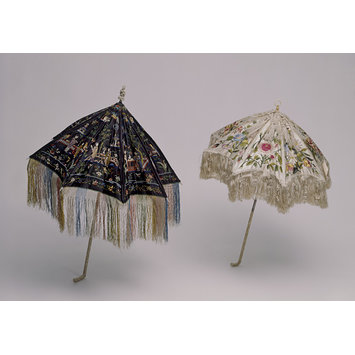
Embroidered parasols with fringe, 1860s, in the Victorian and Albert Museum
Two parasols, c. 1860-70, in the Victoria & Albert Museum
My favorite article on parasols is Marta Vincent's overview; there's also an expanded version (sans color pictures) in the Spring 2016 Homefront Herald, starting on page 8.

The first thing about 1860s parasols is that they are small.  Of the closely-dated (1850-1870) originals in The Met's collection, nineteen have dimensions included.  Only two exceed 30" long, both of which are European in origin and dated to the 1850s; based on Marta's article, I suspect they date from the early 1850s, when parasols tended to be larger.  The other seventeen range from 22.6"-28.5", averaging 25.2" long.  The rib length is only given for three of the parasols: each is 26" long, with ribs of 10", 10", and 13".  The others have similar proportions, with the ribs just under half the stick length.
19th Century Parasol from E. Korsmo Collection
Four parasols from the author's collection. The black parasol in the
back has been recovered, the other three have their original canopies.
The four originals in my collection (estimated dates 1850s-1870s) are the same size as the Met's; they average 25.2" long (ranging 22"-28"), with ribs averaging 11" (10" to 13").

Period parasols can either have straight sticks ("walking" parasols) or ones which fold with a joint in the center ("carriage" parasols).  My collection has two folding parasols and two which do not fold; the 17 Met parasols consist of 11 folding (visible joint and sleeve), four straight, and two which are unclear.
Folding parasol stick joint, UK National Trust Parasol 1361428
The metal sleeve covers a joint, allowing the parasol to be
folded in half for transport or held straight while in use.
From an 1850 parasol in the UK National Trust collections.
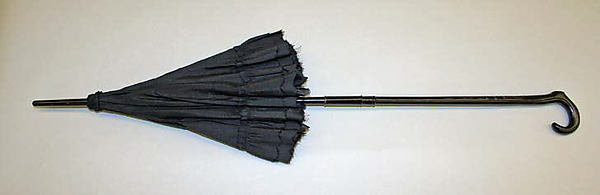
A very popular style of carriage/folding parasol has a second joint at the top of the stick, allowing the canopy to be tilted up to 90 degrees.  These "black marquise" parasols typically have black canopies, black (or rarely, white) linings, and all-black sticks; they are American in origin, and date from the 1860s and 1870s.
Black 1860s folding parasol from The Met
Black folding parasol, likely a marquise, c. 1860, from The Met.
Black tilting marquise parasols, E. Korsmo collection.
Folding and tilting black marquise parasols in the author's
collection.  The one on the right has been recovered.
Black folding marquise parasols, E. Korsmo collection.
Black marquise parasols closed and folded.  Both 28" long when
opened, they fold to 16" and 15".  From the author's collection.
While the straight-stick parasols can't fold, some dissemble in other ways.  One in my collection slides apart, with the carved handle separating from the metal upper stick--the mechanism is such that it actually can't close all the way with the handle in place, and there's a small notch at the end of the metal stick for the canopy clasp.  My other straight-stick parasol can be shortened by unscrewing part of the carved handle (this one can fully close with the handle in place).
Two straight dissasembling parasols, E. Korsmo collection
Straight parasols with detachable handles,
from the author's collection.
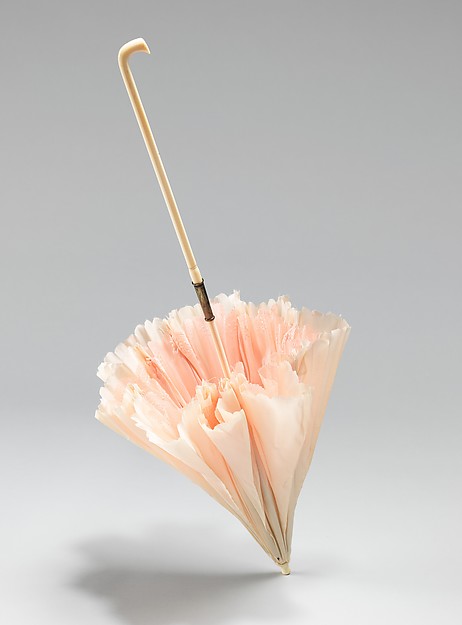
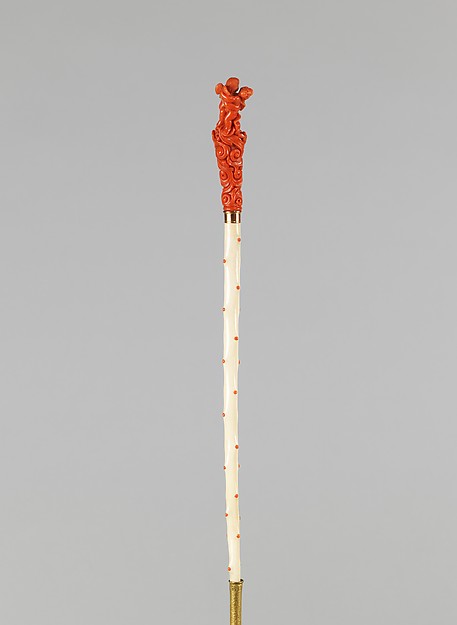
The sticks of parasols can be made of a variety of woods, metal, and precious materials including coral and ivory.  Steel ribs come into use around 1860; cane and whalebone (baleen) ribs are used earlier.
1860s Parasol in The Metropolitan Museum (Brooklyn Museum Costume Collection)
Folding parasol, 1860-1869, in The Met;
the white hooked handle may be carved bone or ivory.
1858-1865 Parasol, UK National Trust Collection
Parasol, c. 1858-1865, with wood and brass frame, cane ribs.
From the UK National Trust collections.
Carved parasol handle 1855-1865, The Met
Parasol handle of carved coral and ivory.
French, c. 1855-1865. From The Met.
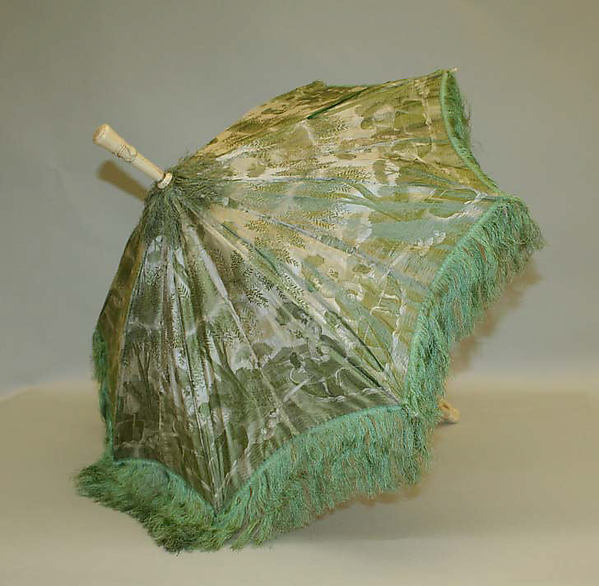
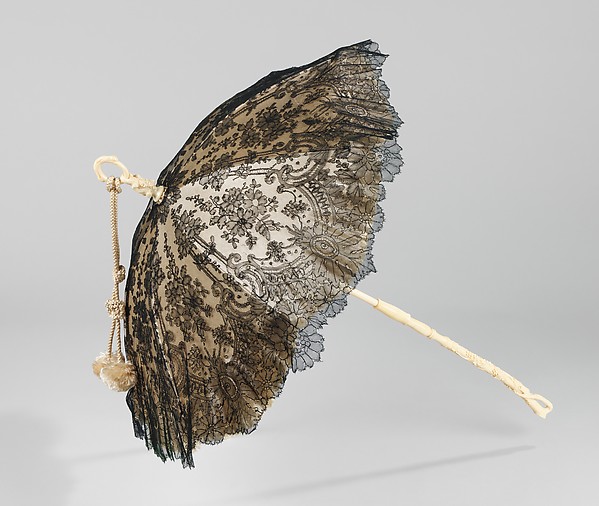
Canopies also show a range of decorations, including plain and figured material, embroidery, tucks, fringe, ruffles, tassels, beads, and lace.  All of the originals I've seen or read about have silk canopies; where present, linings are also silk, often very lightweight. The exception is a single Met parasol marked "silk/linen" (the coral/ivory one above).
Brocade parasol with silk fringe, c. 1860, from The Met.
1860-1869 lace parasol, from The Met
Black Chantilly lace over a white silk canopy is a popular design
from the 1850s to 1870s. From The Met, which also has one in black.

The only current source for appropriately-sized reproduction parasols is Maggie Reese, who recently started producing 25" walking parasols; she is also one of the few people commercially re-covering antique parasols at this time.  For re-covering one's own antique frame, the late Marta Vincent wrote some succinct instructions at the Sewing Academy.