Showing posts with label period advice. Show all posts

Monday, May 1, 2017

Updating Dresses

The Seamstress (1858) by Charles Baugniet from The Athenium
The Seamstress (1858) by Charles Baugniet 

The ladies of Elizabeth Gaskell's Cranford aren't alone in their practice of  'elegant economy'.  Altering dresses to keep up with the prevailing style is a recurring theme in stories and magazine articles of the 1860s.

"Nothing, it seems to us, could be more graceful in a lady, in these times, than a little self-denial. Alter, turn, and freshen the dress that is passe. Buy new frames, and make new bonnets of the old. The dress that has been worn one season,--why not wear it another?" -The Ladies Repository 1865

Instructions from 1862 (appearing in both Godey's and Genessee Farmer) recommend disassembling a silk dress for washing, and taking the opportunity to update the sleeves. This is hardly a new practice: in The Behavior Book (1839/55), Miss Leslie advises buying an extra 1.5-2 yards when purchasing dress material, so that there fabric in reserve for new sleeves and any mending or alteration that may come up.

"Old Basquines can be modernized by cutting them shorter, especially in the front, and by making the sleeves narrow." -Peterson's, July 1865.

Peterson's and Godey's both ran the same article in 1862 about updating and widening plain, 2 or 3 flounce skirts.

Peterson's (1862) has tips for stylishly remaking dresses:
There have been but few new goods imported this season, economy being the order of the day. Old dresses are "made to look like new" as nearly as possible. Skirts worn out at the bottom are renewed or lengthened by a bias band, plaiting or ruffle, or silk of black or some color contrasting well with the dress. In this way two old dresses often make one stylish new one. Then antiquated bodies or worn out bodies are discarded and jaunty Zonave jackets with white shirt bodies and sleeves, or Garibaldi shirts, take their place. As the season advances, pique or Marseilles will take the place of silk or flannel for these articles.
A recurring motif in period stories is the economically-minded middle class woman in her re-made finery--occupying the same economic perch as the March family from Little Women.  I find it telling that quality of the material is the limiting factor in these cases: the labor to mend, alter, clean, and re-work these old dresses is no barrier to wear.
"On the bed lay my dress that poor old Swiss which I had worn ever since leaving off short frocks. It had been pieced down and tucked for this occasion; my own hands had clear-starched it to the last degree of sheerness and mamma by much contrivance had managed to procure fresh sash and gloves." 
"I cannot afford a new gown for you, Kate; but we will have Miss Brown to make over my green brocade."  
--"Katy Keith" and "Five Years" in Harper's New Monthly Magazine (1863)
Another Godey's 1862 article outlines various re-making practices, including cutting down old dresses for petticoats, mantles, children's clothing, etc.  Again, labor is cheap (assumed free), but the material is viewed as pricey enough to warrant recycling.

A favorite reference for resourcefulness is the 1866 Godey's article "Dress Under Difficulties", which recounts the tricks blockaded Southern women used to freshen their wardrobes.  While not all techniques will apply outside of late-war Southern impressions, I think the piece offers some insight into how problems of dress were considered and addressed.  It also has some interesting hints at how long certain garments were expected to be in service: the author notes, for instance, an "organdy muslin dress" lasting five summers or a crepe bonnet lasting three seasons (with the implication that these were impressively long periods).


Saturday, December 3, 2016

How to Dress, March 1860

Home Dress, Godey's, March 1860


DRESS: HOW TO ADORN THE PERSON.
BY MRS. M. L.

Who is there amongst us wholly indifferent on this point? We really think not one. Some may be careless, and some misjudging, yet even the most eccentric have some fancy of superiority in their oddities. Our desire is simply to advise and aid those who are not confident in their own good taste. Simple as the subject of dress may be, and frivolous as many deem it, yet it is very essential, and, indeed, important. We would not have it occupy all the attention of our fair friends, but we wish to assist those who would dress well, without devoting too much thought to the attainment of this object.

All are indebted, more or less, to the adornments of the person. Let them be neglected, and the deficiency would be evident, even though the cause might not be traced. Therefore, let us give it our attention, and see in what we can improve that which is good, and remedy that which is defective. Our province is to advise, not to dictate; therefore, we must make no rules absolute. The most attractive part of our subject, of course, is taste and style; yet we consider many useful hints with regard to neatness, quality, and expenditure. There is no doubt that the grand regulator of dress must be the purse; yet the humble, by good taste, may furnish an agreeable contrast, and, in fact, gain more in appearance by neat and well-chosen garments, than the rich in gaudy attire. The great difficulty with most of our fair friends is conformity of habiliments, the temptations of the plate-glass windows so often leading them to purchase dresses without having one other article of attire to correspond. The dress, of course, must be worn, at the sacrifice of good taste. In our days, dress, as well as cookery, has become a science, as much as an art ; even the minutiae of a lady's dress, such as the purse, pocket-handkerchief, etc., are now objects of care and labor. We remember, not very many years ago, when a plain silk or leather purse was considered all-sufficient ; at present, each lady seems to use a purse of more artistic production than her neighbor. As we remember well when crochetwork and knitting were mysteries and high accomplishments, and we consider that we are indebted for the wide dissemination of the taste for working and the means of producing the many beautiful articles we now see to the Lady's Book, we hope, in the same way, that our trifling efforts, through its pages, will not prove vain, and that we shortly may witness the evidence of an improved taste and style in dress.

We have no paucity of material to complain of now ; the varieties of texture and design are endless. Our chief difficulty lies in selection. Neither can we murmur at excessive prices. We are told that a Roman empress was refused by her lord a robe of silk as being too costly ! In our days, the most simple maiden is clad in what a Roman empress could not afford. Cotton and its beautiful printed varieties was but little known in those days; the empress was therefore condemned to heavy woolen textures—not bareges—or stiff and unpliable robes of linen. It is true, the long and flowing drapery looks well and classical in sculpture, yet in fact it could not have been as pleasant and convenient as our own style.

Let us now to our task—to consider and review our dresses, bonnets, and shawls, or their substitutes. These claim our first attention ; but we shall not omit the many minor articles forming the toilet of a lady. It is not to be denied, that all of us acknowledge the superiority of the French in everything that appertains to the toilet ; then let us endeavor to discover the main points and reasons of that superiority. Why do we always blindly follow their dictates, and yet never approach them ? We are led by the mere spirit of imitation, unguided by reason. We believe it is natural to French women to dress well, and they give the subject less consideration than we do. Whatever they pronounce comme il faut we fancy and follow, very seldom thinking of the comme il faut ourselves. Fashion is woman's idol, or what the magazines and their dressmakers designate as fashion. We blindly follow fashion, without consulting its becomingness; neither do we consider sufficiently the changes of season that a summer fashion will not suit a winter dress; and if we wear tarletan flounces on muslins and zephyr bareges, we must do the same on heavy merinos and gloomy carmelites. Again, our ladies will make a material fit only for morning wear in a full-dress style, and vice versa. This is bad taste, and gives the appearance of being ill-dressed.

We will now review a little our material for dresses. We are infinitely better off in this respect than our great-grandmothers of seventy years since; ay, and even have a very much greater variety of choice than our mothers had twenty-five years ago. Every season brings a number of novelties in designs and textures, for our choice and use. Every quarter of the globe sends its fabrics, formerly rare indeed, and to be obtained only at a great cost. Our own manufactures, too, are greatly improved, although the old ladies say there are no such cottons made as in their days. There are, indeed, but we procure a silk dress for the price they paid for one of their cottons. To our own taste, a cotton dress, good and neat in pattern, is, for most ladies, young ones especially, the prettiest for morning wear; then it must be well made. We would recommend every lady to be particular on that point, i. e. to have her dress well fitting ; and if economy be the consideration, let her have two dresses in lieu of three, and let the cost of the third pay for the making of the two.

There is a very remarkable reason why the French appear, at a general view, so much neater than ourselves. It is one which is beyond our power to regulate, and has doubtless arisen from our great and practical freedom. They have, so to speak, a class-dress, even in cities, where there is no decided costume. No one thinks in Paris of dressing the same as her neighbor, who is in a rank of life superior to herself. Servants will not attire themselves like the bourgeoisie,' these, again, do not imitate their superiors in rank or station. Therefore, all servants will be dressed in neat and new apparel, when requisite, and do not purchase the faded finery of their mistresses, or the cheap and gaudy things which look like it ; and the marchande de mode would disdain to wear the cast-off velvets of a duchess. She finds her own neat merino and straw bonnet much more becoming her style and station.

The French pay, too, a much greater attention to combination and assimilation of colors ; and their linen, collars, etc. are got up with so much greater care, which gives the finish to their dress. We cannot complain of this  as much as we might have done some years ago, for collars, caps, etc. are generally ironed in the French style.

Having now seen in what material points we differ from the French, let us consider how best we shall dress ourselves. Much we fear we shall have to encounter "Fashion" at every point; and we certainly are of opinion that, if the "Bloomer costume" were to appear in the Lady's Book on the first of the month, we should see it in Chestnut Street or Broadway within a week after. We most sincerely trust that it will not make its appearance under such authoritative auspices. We do not admire the dress; it is unfeminine, and therefore to be avoided. We are thoroughly delighted that those nondescript paletots have disappeared, and the graceful mantillas for summer, and burnous for winter wear, have substituted them. With the cloaks there is a little inconsistency prevailing, when lace hoods are worn upon silken mantles. A hood is most surely meant as a protection from weather ; in such materials it can afford none, and is a most ungraceful appendage, giving the effect of high shoulders. In consideration of its probable utility, we can pardon it for winter wear.

Godey's Lady's Book, March 1860

Saturday, October 1, 2016

Letters and Stamps

"The practice of inclosing [sic] letters in envelopes is now universal; particularly as when the letter is single no additional postage is charged for the cover. The postage now is in almost every instance pre-paid, it being but three cents when paid by the writer and five if left to the receiver. Therefore, none but very poor or very mean people send unpaid letters. Letter-stamps for the United States post should be kept in a little box on your writing-table. You can get them always by sending to the post-office--from a dollar's worth or more down to fifty or twenty-five cents' worth at a time. In a second box, keep stamps for the city or penny post, which transmits notes from one part of the town to another. And in a third, stamps to go on the covers of newspapers."

--The Behavior Book (1853 ed.) by Miss Leslie

Thursday, September 1, 2016

Making Beds

Beds and Their Draperies from
The Workwoman's Guide (1838) 

As soon as you quit your bed, take off the bed-clothes, (each article separately,) and spread them widely over the chairs, turning the mattrass [sic] or bed as far down as it will go. This will give the bedding time to air; and in all houses it should be done every morning, the whole year round. Before you leave the room, raise the windows as high as they will go, (unless it should be raining, or snowing,) that the apartment may be well ventilated...  
There is but one way of making a bed properly; and yet it is surprising how little that way is known or remembered. First, shake up the bed high and evenly, turning it over, and see that the foot is not higher than the head. If there is a mattrass above the bed, turn the mattrass half up, and then half down, till you have shaken up the bed beneath. Next, spread on the under-sheet, laying it well over the bolster to secure it from dragging down and getting under the shoulders. However, to most beds now, there is a bolster-case. Then tuck in the under-sheet, well, at both sides, to prevent its getting loose and disordered in the night. For the same reason tuck in the upper sheet, well, at the foot, leaving the sides loose. Tuck in the blankets at bottom, but not at the sides. Lay the counterpane smoothly over the whole. Turn it down at the top, and turn down the upper-sheet above it so as to conceal the blankets entirely. 
--Eliza Leslie, The Behavior Book (1853), pages 12-14

Monday, August 1, 2016

Conduct in Public Places

Crinolines (1865) by Eugene-Louis Boudin
"Any lover-like airs or attitudes, although you may have the right to assume them, are in excessively bad taste in public." (295)
--The Gentlmen's Book of Etiquette and Manual of Politeness,1860

Friday, July 1, 2016

Dress in Warm Weather, 1856

Crinolines in a gale, Punch 1863
Disorder of a lady's toilet can be excused when it occurs rarely, or for a short time, as in such cases it seems evidently owing to a temporary embarrassment; but if it occur daily or constantly, if it seem the result of negligence or slovenliness, it is unpardonable. 
To suppose that great heat of weather will authorize the disorder of the toilet, and will permit us to go in slippers, or with our legs and arms bare, or to take nonchalant and improper attitudes, is an error of persons of a low class, or destitute of education. Even the weather of dog-days would not excuse this; and if we would remain thus dressed, we should excuse ourselves from seeing company... 
--The Lady's Guide to Perfect Gentility (1856), p. 119-120

Wednesday, June 1, 2016

Accomplishments

All accomplishments have the one great merit of giving a lady something to do; something to preserve her from ennui; to console her in seclusion; to arouse her in grief; to compose her to occupation in joy. And none answers this purpose much better than fancy work, or even plain work. The former can often be brought advantageously into the rear of other pursuits--as a reserve. The latter cannot well be carried into society, except as a charity...Not that it is recommended to take into a party your husband's stockings to mend, or dear Charles's shirts, over which he was naturally so irritable at the absence of buttons, or Louisa's pinafores to run strings into; let the work have the characteristics of recreation combined with utility, and the most scrupulous cannot be offended. Such is indeed the spirit of the day; for we are a more sensible people than our grandsires were.  
Sketching and archery stand first among out-door amusements. They are healthy, elegant, and appropriate to the feminine character; while--first thought of mammas!--they assemble rather than exclude the younger members of the other sex.  
-The Habits of Good Society (1863), page 268-9
The Croquet Match (1864) by George Elgar Hicks

Friday, April 1, 2016

Regarding Beards

James A. Clay
"A man to whom nature has given a handsome beard, deforms himself sadly by shaving--at least, that is our opinion; and on this point fashion and good taste agree. The full beard is now almost as common as the shaven face in all our large cities."--How to Behave: A Pocket Manual of Etiquette and Guide to Correct Habits, etc. (1865)

Tuesday, March 1, 2016

Low Society

On the Brink (1865) by Alfred Elmore
Bad society then may be divided into three classes: 1. That in which both morals and manners are bad; 2. That in which the manners are bad, be the morals what they will; 3. That in which the manners appear to be good, but the morals are detestable. The first is low, the second vulgar, the third dangerous society. 
Few people but undergraduates, young ensigns, and aspiring clerks and shop-boys, will need to be warned against low society. Where vice wears no veil, and decency forever blushes, the man of any self-respect, to say nothing of taste and education, will speedily be disgusted. The first proof of lowness is seen at once in undue familiarity. If there are women in company, you will at once discover their character from the manner in which they allow themselves to be addressed; but if not you will doubtless ere long be yourself subjected to a freedom of treatment, which you will readily distinguish from ease of manner, and know to be beyond the proper limits. Familiarity on first introduction, is always of bad style, often even vulgar, and, when used by the openly immoral, is low and revolting. A man of self respect will not be pleased with it even when it comes from the most respectable, or his superiors; he will despise it in his equals, and will take it almost as an insult from those who do not respect themselves... 
--The Habits of Good Society (1863), page 37

Monday, February 1, 2016

Hosting a Ball

Godey's, February 1860
The lady of the house must, in short, linger till supper-time in the neighborhood of the door by which her guests enter the rooms; she must have a pleasant smile for everybody and, if possible, she should know everybody's name, and how many they are in family. To a large ball you ask a great number of people with whom you have a slight acquaintance, and of course a number of gentlemen arrive who may be your husband's or son's friend's [sic] or recruits levied by an ami de la maison. To these a bow rather more inclined than to your own friends, and a particularly amiable smile, is necessary; but in order to put them quite at their ease, you should be able to come forward and say some little polite phrase or other...The master of the house, too, if he is not gone out of town "on business," for that night, should be in the neighborhood of his spouse, in order to introduce to her any of his own recruits. The sons will hang about the same quarter for the same purpose, but the daughters will be otherwise occupied. It is their duty to see that the dances are formed, and a well-bred young lady does not dance till she has found partners for all the young ladies or as many of them as can be supplied from the ranks of the recruits present.   
--The Habits of Good Society (1863), page 388-9

Sunday, January 3, 2016

On Sarcasm

Godey's, 1861
Be careful also how you indulge in sarcasm.  If you are constitutionally inclined to this, you will find that there is no point in your character which needs to be more faithfully guarded.  There are some few cases in which severe irony may be employed to advantage; cases in which vice and error will shrink before it, when they will unhesitatingly confront every other species of opposition. 
It too often happens, however, that those who possess this talent use it indiscriminately; and perhaps even more frequently to confound modest and retiring virtue than to abash bold and insolent vice. 
--The Lady's Guide to Perfect Gentility (1856), p. 145

Monday, December 14, 2015

Flattery

Godey's, January 1863
How to treat flattery.—If a gentleman approaches you with words of flattery, and profuse attentions, especially after a short acquaintance, extend no encouraging smile or word ; for a flatterer can never be otherwise than an unprofitable companion. It is better, by a dignified composure, to appear not to notice, than, with smiles and blushes, to disclaim flattery ; since these are frequently considered as encouragements for further effusions of these " painted words."
You may with propriety accept such delicate attentions as polished and refined men are desirous of paying, but never solicit them, or appear to be expecting them. 
--The Lady's Guide to Perfect Gentility (1856), 147

Tuesday, December 1, 2015

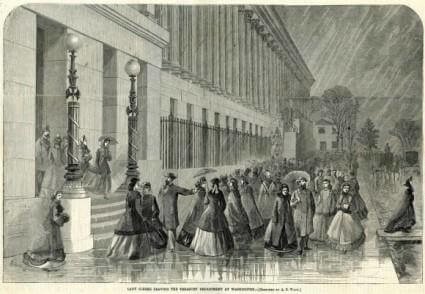
Walking in Mud, 1856

"When tripping over the pavement, a lady should gracefully raise her dress a little above the ancle. (sic)  With the right hand, she should hold together the folds of her gown, and drawn them towards the right side. To raise the dress on both sides, and with both hands, is vulgar.  This ungraceful practice can only be tolerated for a moment, when the mud is very deep."
--The Lady's Guide to Perfect Gentility (1856) p.80 

Harper's Weekly, February 1865

Monday, November 23, 2015

Slang

"Noon-Regent Street" by William Powell Frith, 1862

The use of slang phrases among people of education and social standing seems to be on the increase. We hear them in the drawing-room, from the lips of cultivated men and women, almost as frequently as on the street; but never without an involuntary loss of respect for the persons who use them. A sensible and discriminating writer, referring to this subject, says:--“Ladies frequently use slang phrases, with a slight pause or smile to serve as marks of quotation, or rather as an apology. But to modify a fault is not to remove it. Resolve that you will never use an incorrect, an inelegant, or a vulgar phrase or word, in any society whatever. If you are gifted with wit, you will soon find that it is easy to give it far better point and force in pure English, than through any other medium, and that brilliant thoughts make the deepest impression when well worded. However great it may be, the labor is never lost which earns for you the reputation of one who habitually uses the language of a gentleman, or of a lady.”--Arthur's Home Magazine, 1865

[Those not following this advice may enjoy the following titles:  The Slang Dictionary (London, 1865), A Dictionary of Modern Slang (London, 1859), Dictionary of Americanisms (Boston, 1859).]

Tuesday, November 3, 2015

Borrowing Advice, 1856

Four Rules for Borrowers: 
1. The Iron Rule.--Never borrow anything whatever, if you can possibly do without it, nor then unless with the consent of the owner. 
2.The Silver Rule.-- Use the article borrowed more carefully than if it was you own; don't retain it beyond the time agreed on. 
3. The Golden Rule.--As soon as you have done using the thing borrowed return it, with thanks. 
4. The Diamond Rule.--Never borrow "Peterson's Magazine", but subscribe for it.
-Peterson's Magazine, October 1856 (page 268)


Monday, November 2, 2015

Dressing Advice, 1859

April 1859, Lady's Home Magazine
"Every lady of good taste who is accustomed to move in society, must be aware of the vast importance of adapting her dress to the occasion on which it is worn. Morning dress is not evening dress; nor is the same style of costume which may be appropriate for the carriage, suitable for walking; especially at the present season, when everything of a very showy or costly character contrasts somewhat incongruously with the foggy atmosphere and the muddy streets. But out-door walking dress should be adapted to the time as well as to the occasion. A recherche [elegant or refined] style of dress, which would be very much out of place at ten in the morning, may be perfectly proper and consistent with good taste at a later period of the day. When a lady is seen at an early hour in the morning wearing a dress of moire antique, or a rich flounced silk robe of bright and gay hues, with a bonnet resting on the back of her head and adorned with showy flowers or feathers, people are prompted to exclaim, "Where can she be going?" or "Where can she have come from?" Walking costume in the early morning should be characterised by the most rigorous simplicity. It may consist of a dress of merino, or any other warm woollen (sic) material; a bonnet of grey, brown, or mixed straw, trimmed with dark-colored ribbon or velvet, and a cloak of black or grey cloth. A lady thus attired looks like a lady, and she may walk out at any early hour without exciting attention, or calling forth unpleasant remarks. Nobody will presume to say, "Where can she be going?" or "Where does she come from?" About the middle of the day, and in fine weather, the silk robe, the velvet mantle, the costly cashmere shawl, and the gay bonnet are worn in the right time, and in the carriage, or for walking (as the state of the weather may determine) they are in the right place.  
But if early out-door morning costume (whatever be the rank and condition of the wearer,) should be marked by the most scrupulous simplicity, in-door morning dress, on the other hand, is by no means subject to the same rule. Indeed, this style of costume is frequently distinguished by a remarkable degree of richness The loose peignoir of pointed cashmere is lined with gay colored silk, and confined round the waist by a rich silk cord and tassels. These peignoirs, or loose robes-de-chambre, are sometimes made of plain as well as figured cashmere, and they may be trimmed up the fronts, round the deep cape, and at the ends of the sleeves, with plush or velvet, or with a broad band of quilted satin. The skirt of nansouk [or "nainsook", a fine, plain-woven cotton, "not so closely woven as cambric, but heavier than batiste"*] worn under the peignoir is always ornamented with a broad border of needlework, which is frequently carried up the front in the tablier form. The under-sleeves and collar should be of worked cambric or nansouk muslin." 
--"General Remarks", page 199, Lady's Home Magazine, 1859

*Fabric definition from Textiles in America 1650-1870 by Florence M. Montgomery