Showing posts with label knit. Show all posts

Sunday, January 17, 2016

Garters

Some of the stockings and socks we looked at before had ribbed cuffs for a closer fit. Others would rely on garters to keep them in place.  These may be fastened above or below the knee; Graham's Illustrated Magazine suggests below the knee for women, just above for men and "those women who resemble men in their shape".  A certain medical text recommends "looping up" the stockings instead of using garters, though I've found no other source to elaborate on this idea.

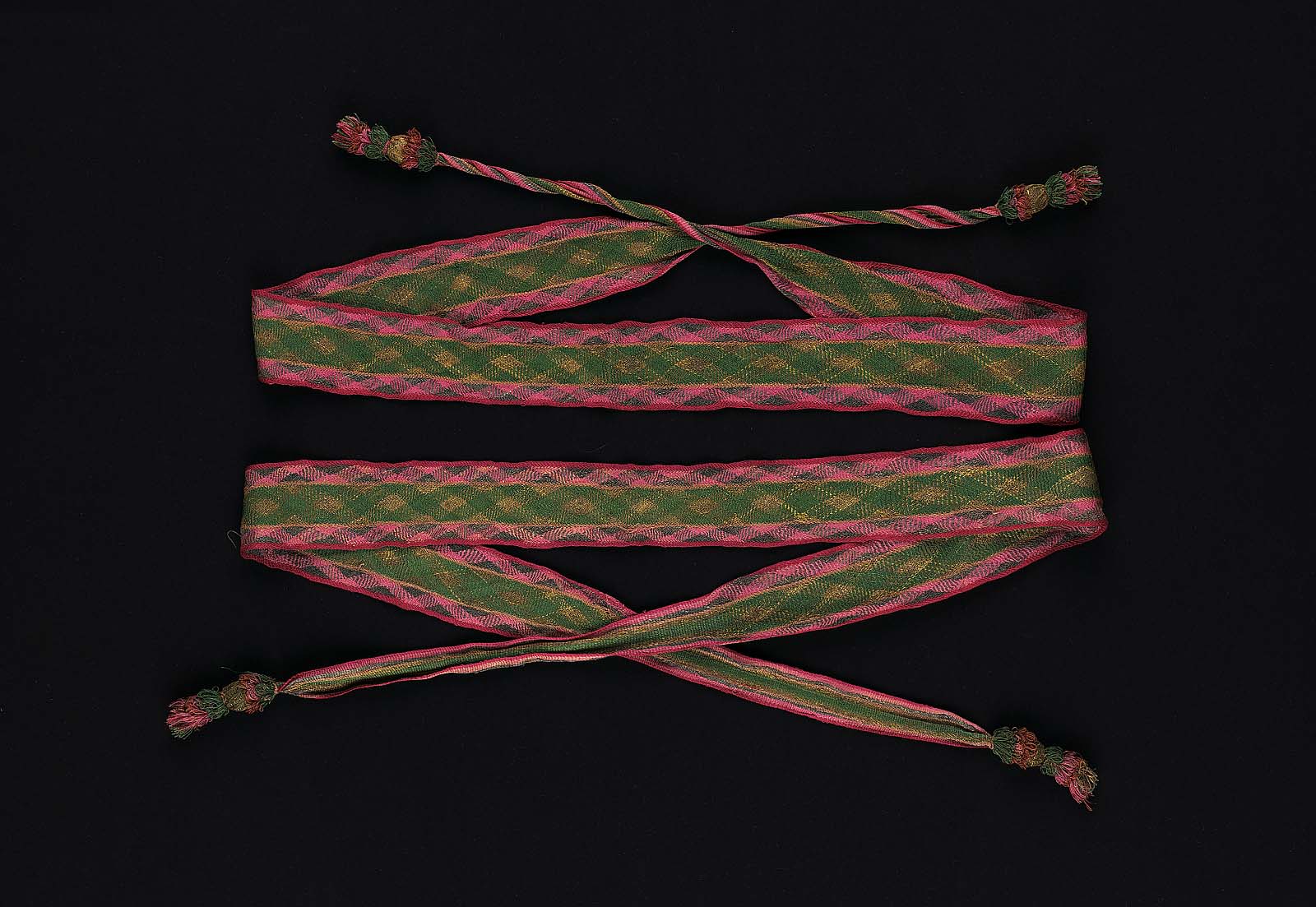
There are a few different styles of garters used in the mid-19th century.  One is a flat band or ribbon, a style which has been in use for several centuries to this point.
Silk garter, c.1862. Museum of Fine Arts.
Silk garter, late 16th century. Museum of Fine Arts.
These flat garters could be simple ribbons, or could have a decorative embroidered, beaded and/or padded bands attached to narrower ties.
Wool embroidered (Berlin work) garters,
c. 1801-1850, Smithsonian Design Museum.
Flat knit garters are also possible. One knitting pattern reads:
"Cast on 18 stitches. Knit in double knitting backwards and forwards until the garter is long enough. End in a point." --The Ladies' Self-Instructor..., page 180
Another knitting book notes that "Elastic Rib...as its name implies, is the appropriate stitch for garters", and goes on to explain using alternate knit and purl rows to create a stetchy material.  "Garter stitch", on the other hand, is plain knitting. The Method for Teaching Plain Needlework in Schools (1861) recommends that students knit both plain and ribbed garters to practice knitting and purling, respectively.

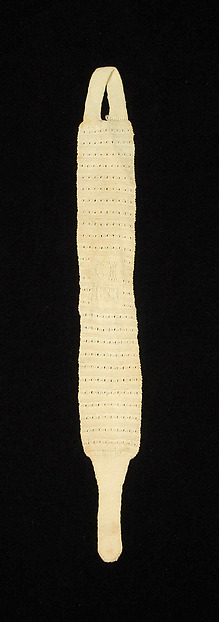
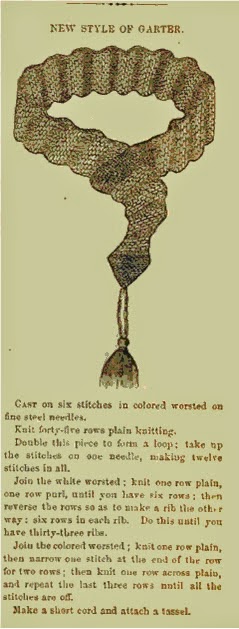
A second style of mid-century garter has a loop appended to the flat band.  The few examples I've seen are a springy knit material; the flat end is threaded through the loop (and in my experience, needs to be knotted to keep the garter in place).
Cotton garter, c. 1833, from The Met.
Instructions for knit garter with loop, tassel.
Appeared in Godey's, 1862.
Reproduced here.
Garters can also fasten with buckles, such as this early 19th century pair.  Flexibility, in this case, is provided by a plain silk-elastic band.
Garters with chenile embroidery, silk/elastic band and
metal clasps. Early 19th century. Museum of Fine Arts.
Garter buckles dated 1864, from Historic New England.
There is a potential fourth style, fabric over a stretchy core, like modern novelty garters.  However, I've only seen one such, this pink silk pair,c. 1851-1880 from the Museum of London, and need to investigate further.

Tuesday, January 12, 2016

Stockings and Socks

I'm treating men's and women's stockings and socks together, as extent examples are rarely differentiated.  Cotton, silk, wool, and linen stockings are all found in museum collections, while period literature mentions silk, cotton, and wool frequently.  These were available for sale in a variety of colors, styles, and sizes, with home manufacture by hand or by machine also possible.
White silk stockings, c. 1850-60
Snowshill Wade Costume Collection,
via UK National Trust Collections
According to "Manufactures of the United States in 1860" (U.S. Government, 1865), stocking frames had been used in the U.S. since 1723, with a mechanized version invented in 1832.  Circular frames (allowing a stocking to be knit without a seam up the back) arrived in 1835.  By the end of 1863, the U.S. had issued 126 patents for various knitting machines and improvements, including both models for use in homes and in factories.

The power knitting frame improved productivity by up to 150-fold: a worker who turned two pounds of cotton into stockings each week now handled 300 pounds of cotton in the same time. From June 2, 1859 to June 1, 1860, factories in the United States produced some 1,447,200 pairs of stockings, as part of a hosiery industry using 2,927,636 pounds of wool and 3,982,342 pounds of cotton annually. This commercial production was fairly equally divided between New England and the Mid-Atlantic States, with little in the West and none in the South.
Machine-knit silk stockings, 1851
from the Victoria & Albert Museum
When knit by hand, stockings could be made in a single piece, shaped by adding or subtracting stitches as the knitting progressed (some early machine-knit stockings had the increases and decreases worked by hand, too).  Another option was to knit the material into a (seamless) tube by machine, then cut and sew it into shape. Alternatively, stocking could be made out of flat knit fabric; two pieces are cut and joined together: a welt which goes under the foot, and a main piece which covers the top of the foot, wraps around the heel, and also comprises the upper portion.  The wool stockings below show seams consistent with this style of construction.
Wool stockings, c. 1860-70, from The Met
Another option is to sew stockings from woven cloth, specifically from old wool garments.  This method, though economical, is rarely mentioned.
Men's sock pattern, from cloth
The American Agriculturalist, 1865
The American Family Encyclopedia (1856) tells us that "although the stocking loom has, in a great measure, superseded the use of the knitting needles, the latter are not entirely laid aside; and stockings knitted by hand, though generally less beautiful in appearance, can be more depended upon for durability as well as for accurate fitting."  This is borne out by the patterns available for knitting socks and stockings by hand (or, less often, for crocheting them), and by the inclusion of knit stockings in school needlework curricula. Knitting machines or stocking frames were also marketed for at-home use.
From Peterson's Magazine, 1864
Nonetheless, ready-made stockings came in a variety of materials, styles, and sizes.  This encyclopedia names the "usual sizes" as "childrens', girls', maids', slender womens', womens' full size, [womens'] large size, boys', youths', mens', men's out size, gouty hose, fishermens' hose". Both socks and stockings are commonly available in silk, spun silk, silk with cotton feet, cotton, worsted [smooth and tightly spun wool], lambs' wool, etc.  There are even light "gauze hose" (cotton and worsted) to be worn under the silk stockings.
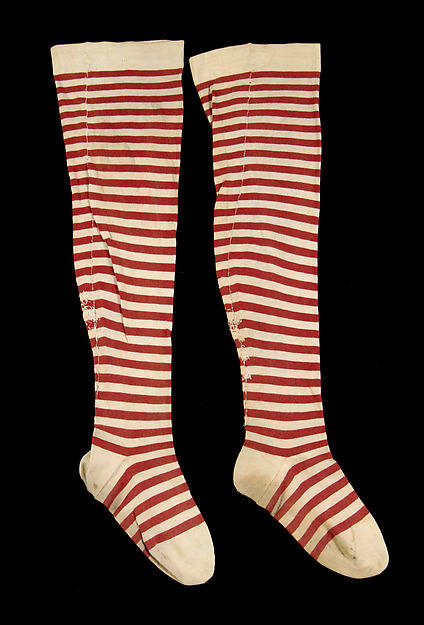
Striped cotton stockings, red and white
c. 1850-70, from The Met
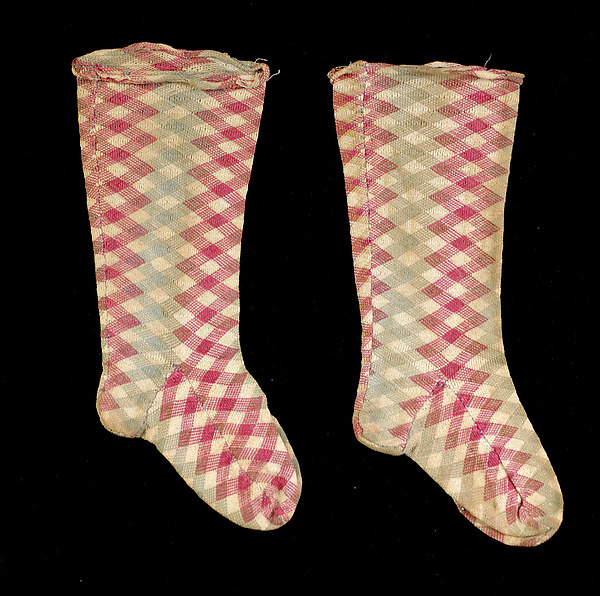
Striped stockings were popular for women's wear in the early 1860s (and one source suggests they were "purloined" from men's fashion). When only part of the stocking is decorated, it is most likely to be either up the sides of the ankle, or over the top of the foot and ankle (even up the leg to the mid-calf).
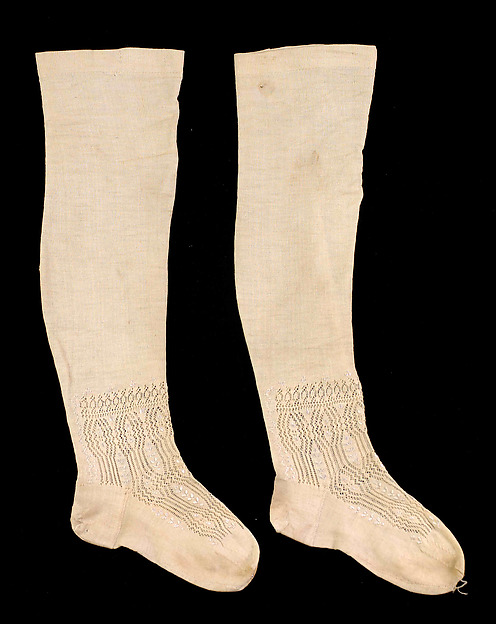
"Openwork" cotton stockings, c. 1860-70
from The Met
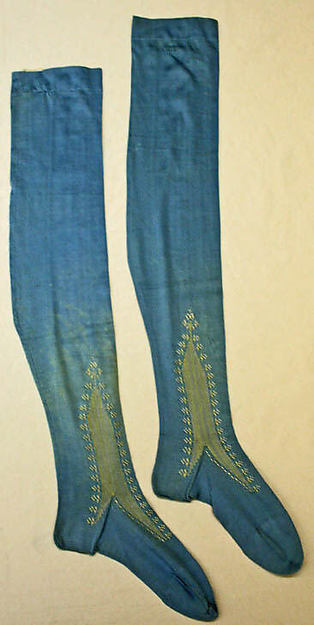
In 1864, Peterson's tells us that:"Stockings will be worn colored this winter; the silk stockings with narrow stripes around them are very suitable for this season of the year; the ground of the stocking should match either the dress or the petticoat in color. Merino stockings are also manufactured in brilliant colors--violet with black stripes, gray with blue, and black with Solferino; indeed they are to be procured of all shades." Arthur's Lady's Home Magazine (1864) lists many fashionable colors for stockings, noting that white is only used for "full dress" (ie, very formal attire).  Striped and plaid stockings are worn by day, while colored stockings with decorative clocking are used for evening.
Blue silk stockings with yellow 
"clocks", c.1865, from the Met
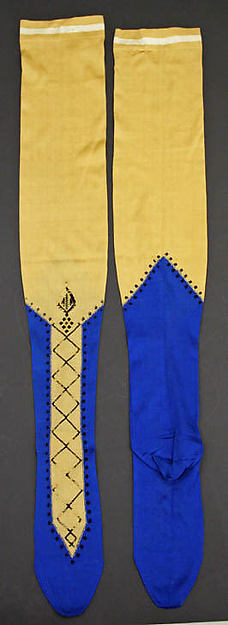
A neat (and unexpected) design appears in these multi-colored silk stockings from 1865: they're made to look like a pair of open shoes with crossed laces!
Silk stockings, c. 1865
from The Met
During the Civil War, women on both sides of the conflict knitted socks for the army; songs  and poems lauded sock-knitting as a patriotic endeavor.
"Knit socks for the soldiers. Make them to come above the calf of the leg, rib them for three or four inches at the top, make the heels and toes of double thickness." --Healthside, 1861
Army Sock Pattern, American Agriculturalist, 1861
I have found no period differentiation between "socks" and "stockings", though both terms are used. The surviving examples tend to vary based on leg length, with socks extending about one foot-length above the ankle and stockings 2.5 or 3 foot-lengths.  Further investigation is warranted.
Tentative update: a pair of women's, hand-knit silk stockings, c. 1862, in the MNHS collection has dimensions of 5" by 27.5".

The Victoria and Albert Museum has a number of very modern-looking socks produced for the Great Exhibition, including these silk and elastic knit socks:
Silk and elastic knit socks, 1851, from VAM.


Saturday, October 24, 2015

Civilian Winter Clothes

The Illustrated London News, Jan 1, 1859
Inspired by Anna Bauersmith's article on seasonal layers, here are project links for warm and winter clothes.  Most are 1859-65, but there are a few earlier ones as well, so check the date when determining if a project suits your impression.

Liz Clark's essays on Dressing Children and Infants for Cold Weather are also highly recommended.


Women's Items
Red Riding Hood, page 79, Peterson's (1862)
Tufted Hood* from Liz Clark
Mrs. Meister's Hood Pattern* (the shape is more 1850s)
Opera Hood (knit), page 122,  Godey's (1862)
Opera Hood (knit), page 378, picture 322, Peterson's (1865)
Norwegian Morning or Bonnet Cap, page 111, from The Illustrated Magazine (1863)
Neapolitan Opera Hood, Mlle. Riego's The Useful Knitting Book (1864)
Quilted Silk Hood, page 359-60,  Peterson's (1859)
Princess Capote, page 415, pic 359, Peterson's (1862) [New research by AWB suggests this may be a summer seaside garment.].
Capeline or Hood, page 287, Godey's (1862)
Algerian Knitted Opera Hood, page 284-5, New Peterson's Magazine (1865)
Knitted Opera or Travelling Hood Trimmed with Swansdown, page 599, 540 (illustrated), Godey's (1862)

Eugenie Collar from Mlle. Riego's Crochet Winter Book (1857)
Knitted Collar, page 171, picture page 115, Peterson's (1862)
Shetland Cravat, page 69-70, Peterson's (1865)
Ermine (knit) Tie and Cuffs, page 31-2, The What-not; or Ladies' Handy-book (1861)
Lady's Croquet Cuff and Cravate, Mlle. Riego's The Useful Knitting Book (1864)
The Eyder Necktie, Mlle. Riego's The Useful Knitting Book (1864)
Wool Scarf in Crochet (page 312, illustrated 264) Arthur's Illustrated Home Magazine (1860)
Braided scarf, with Mrs. Mescher's modern instructions.

Winter Cloak, page 74-75,  Peterson's (1859)
Crochet Cape, The Queen's Winter Knitting Book (1862)
Cloaks, general instructions, How to Do It: Or, Directions for Knowing and Doing Everything Needful (1864)
Winter Mantle or Sortie-De-Bal, in Crochet page 549, Godey's (1858)
Fall Paletote, illustration page 452, diagram 454, Godey's (1859)
Round Jacket for a Lady (knit), page 331-333, Peterson's (1856)
Polka Jacket in Crochet, page 168-169, Peterson's (1856)

Knitted Winter Spencer, page 53-4, from The Illustrated Magazine (1863)
Sontag, and Mrs. Mescher's modern translation of it.
Knitted Sontag, page 412-413, Peterson's (1862)
Loose Waistcoat or Bodice, The Queen's Winter Knitting Book (1862)
Habit Shirt or Bodice in Crochet a Tricoter, The Queen's Winter Knitting Book (1862)
Under Spencer or Jacket, The Queen's Winter Knitting Book (1862)
Chest Preserver, The Queen's Winter Knitting Book (1862)
Knitted Jacket, page 277, The Ladies' Companion and Monthly Magazine (1864)
(Also in the Illustrated London Magazine for 1864)
Lady's Under-Vest, Mlle. Riego's The Useful Knitting Book (1864)
Spanish Jacket, Mlle. Riego's The Useful Knitting Book (1864)
Winter Jacket in Double Crochet, pages 290-292, Peterson's (1864)
Fall and Winter Jacket, page 444-445, New Peterson Magazine (1865)
Nubia (shawl) with Mrs. Mescher's modern instructions.
Knitted Shawl in Colors, page 419, picture page , Peterson's (1862)
Plaid Shawl, Mlle. Riego's The Useful Knitting Book (1864)
Biarritz Shawl, page 186, Godey's (1862)

Knitted Undersleeve, from Godey's (1862), page 465
Knitted Sleeve, The Queen's Winter Knitting Book (1862)

Eugenie Machettes and Lady's Gauntlet Mitts from Mlle. Riego's Crochet Winter Book (1857)
Knitted Gauntlet, from The Lady's Companion (1865), page 55
Instructions for Knitted Mittens and Cuffs: "Another Pair of Lady's Mittens" from Godey's (1862), page 284-5
A New Stitch for Cuffs (crochet), page 187, Godey's, 1862

Knitted Under-Petticoat, from The Lady's Companion (1865), page 166
Knit Drawers, page 174-5, Peterson's (1862)

Crochet Dressing Slipper, page 446, Peterson's (1865)
Knitted Gaiter, page 335, The Ladies' Companion and Monthly Magazine (1864)
(Also in the Illustrated London Magazine for 1864)
Furred Winter Shoe, page 358-9,  Peterson's (1859)

Children's Items

Tufted Hood* from Liz Clark
Mrs. Meister's Hood Pattern* (the shape is more 1850s than 1860s)
Boy's Winter Hat in Knitting (page 312, illustrated 264) Arthur's Illustrated Home Magazine (1860)
Garden Hood for a Little Girl (knit), page 162-3, from The Illustrated Magazine (1863)

Instructions for Knitted Mittens and Cuffs: "Knitted Mittens" for a girl 2-3 years old; from Godey's (1862), page 389
Instructions for Knitted Mittens, for girls 8-10, from The Illustrated Magazine (1863)
Child's Muff in Imitation of Chincilla (knit), page 310, Peterson's (1865)

Infant's Shirt (knit), page 412, Peterson's (1862)

Baby's Sock in Crochet, page 413, Peterson's (1862)
Baby's Sock, Mlle. Riego's The Useful Knitting Book (1864)
A Little Girl's Stocking, Mlle. Riego's The Useful Knitting Book (1864)
Boy's Knickerbocker Stocking (ages 5-6), Mlle. Riego's The Useful Knitting Book (1864)
Child's Sock (2 patterns), How to Knit Socks (1863)

Crochet Gaiters from Mlle. Riego's Crochet Winter Book (1857)
Child's Warm Shoe in Crochet, page 163, The Ladies' Companion and Monthly Magazine (1864) (Also in the Illustrated London Magazine for 1864)
Crochet Boots for an Infant, page 222, The Ladies' Companion and Monthly Magazine (1864)
Baby's Boot in Knitting and Crochet, page 122, The What-not; or Ladies' Handy-book (1861)
Baby's Boot (quilted/wadded), page 410, Godey's (1862)
Child's Gaiter, Mlle. Riego's The Useful Knitting Book (1864)

Men's Items

Knitted Waistcoat, The Queen's Winter Knitting Book (1862)
Gentleman's Comforter, page 56, The What-not; or Ladies' Handy-book (1861)
Gentleman's Knit Stockings, page 58-9, The What-not; or Ladies' Handy-book (1861)
Gentleman's Knickerbocker Stocking in ribbed knitting, The Useful Knitting Book (1864)

Knit Knee Warmer, Godey's, 1862
For Everyone:

Basic Wool Shawl*
Two Knitted Comforters (scarves), The Queen's Winter Knitting Book (1862)

Mrs. Mescher's Muffatees*
Directions to Knit Mittens, page 92, Peterson's (1862)
To Knit a Mitten With One Finger, page 176, Peterson's (1862)
Knitted Mitten and a Very Easy Mitten, The Queen's Winter Knitting Book (1862)
Knitted Glove, The Queen's Winter Knitting Book (1862)
Two Muffatee Patterns, The Queen's Winter Knitting Book (1862)

Knit Stocking, The Queen's Winter Knitting Book (1862)
Knitted Knee Cap (?!?!), page 445, Peterson's (1865)
Socks (2-3 patterns), How to Knit Socks (1863)
Knee Caps, Mlle. Riego's The Useful Knitting Book (1864)

General Knitting Help in Period Sources
The 1862 run of Godey's, includes an explanation of pattern terms on pages 84-85.
The Illustrated Girl's Own Treasury (1861) includes knitting instructions and pattern abbreviations.
Peterson's (also in 1862) includes a variety of new knit stitches to adapt for one own's projects.

*Asterisked projects are modern instructions based on extent period pieces.  The projects not so marked are either period instructions, or modern explanations of period instructions.