Showing posts with label persona. Show all posts

Wednesday, May 25, 2016

We Are Coming Father Abraham, Three Hundred Thousand More

Songs For the Union (1861) frontispiece

It's more appropriate for the volunteers than the regulars, but here's another popular pro-Union song of the 1860s. "[We are Coming Father Abraham,] Three Hundred Thousand More" appears in Personal and Political Ballads (1864), though the earliest I've found it printed is 1862, in The American Crisis; Or, Trial and Triumph of Democracy (and in many music sheets that year).  Interestingly, this song is attributed to multiple people in the period publications; the lyrics are variously credited to "a volunteer's wife", and to William Cullen Bryant, while the Stephen Foster, George R. Poulton, and L.O. Emerson are all said to have composed the tune.  Wikipedia indicates that James S. Gibbons originally wrote it as a poem, which was published by Mr. Bryant and subsequently put to music by various people. An identical song, credited to "a volunteer" and increasing the number of recruits to 600,000, was also published the same year.

THREE HUNDRED THOUSAND MORE 
We are coming, Father Abraham, three hundred thousand more,
From Mississippi's winding stream, and from New England's shore;
We leave our ploughs and workshops, our wives and children dear,
With hearts too full for utterance, with but a silent tear;
We dare not look behind us, but steadfastly before--
We are coming Father Abraham--three hundred thousand more! 
If you look across the hill-tops that meet the Northern sky,
Long moving lines of rising dust your vision may descry;
And now the wind, an instant tears the cloudy veil aside,
And floats aloft our spangled flag in glory and in pride;
And bayonets in the sunlight gleam, and bands brave music pour--
We are coming, Father Abraham--three hundred thousand more! 
If you look up all our valleys, where the growing harvests shine,
You may see our sturdy farmer boys fast forming into line;
And children from their mothers' knees are pulling at the weeds,
And learning how to reap and sow, against their country's needs;
And a farewell group stands weeping at every cottage door--
We are coming, Father Abraham--three hundred thousand more!
You have called us, and we're coming, by Richmond's bloody tide
To lay us down for Freedom's sake, our brothers' bones beside;
Or from foul treason's savage grasp to wrench the murderous blade,
And in the face of foreign foes its fragments to parade.
Six hundred thousand loyal men and true have gone before--
We are coming, Father Abraham--three hundred thousand more!

Several recordings are available on-line, mostly under the title "We are Coming, Father Abraham/Abr'am".

Sunday, April 24, 2016

The Battle Cry of Freedom

Frontispiece, Songs of the Soldiers 1864

Another very popular song, "The Battle-Cry of Freedom", was composed by George F. Root in 1862. It's also known by part of its first line as "Rally Round the Flag". The lyrics are here reproduced from Beadle's Dime Song Book, Issues 10-12 (1863), though it was reprinted frequently in 1864/1865.

        The Battle-Cry of Freedom
         by George F. Root (1862) 
Yes, we'll rally round the flag, boys, we'll rally once again
     Shouting the battle-cry of freedom
We'll rally from the hillside, we'll rally from the plain,
      Shouting the battle-cry of freedom. 
        CHORUS
    The Union forever hurrah, boys, hurrah,
    Down with the traitor, up with the star;
While we rally round the flag, boys rally once again,
    Shouting the battle-cry of freedom.  
We are springing to the call of our brothers gone before,
    Shouting the battle-cry of freedom;
And we'll fill the vacant ranks with a million freemen more
   Shouting the battle-cry of freedom.
       CHORUS--The Union for ever, etc. 
We will welcome to our numb'rs the loyal true and brave
    Shouting the battle-cry of freedom;
And altho' he may be poor, he shall never be a slave,
     Shouting the battle-cry of freedom.
        CHORUS--The Union forever, etc. 
We're springing to the call from the east and from the west
    Shouting the battle-cry of freedom;
And we'll hurl the rebel crew from the land we love the best
    Shouting the battle-cry of freedom.
        CHORUS--The Union forever, etc. 
Sheet music (1864) is available, as are songsheets with colorful illustrations.  Just about every "Civil War" album has a version of this song; many are also available on-line.

Thursday, April 21, 2016

Red, White, and Blue; or Columbia, the Gem of the Ocean

"Our Flag is Still There" illustration from The Wisconsin Farmer, 1862
Another patriotic song, and one of my favorite ACW tunes: Red, White and Blue, also known by it's first line Columbia, the Gem of the Ocean. Lyrics are once again drawn from The Book of Popular Songs; they also appeared in periodicals and songbooks throughout the war years.
RED WHITE AND BLUE  
OH Columbia, the gem of the Ocean,
    The home of the brave and the free,
The shrine of each patriot's devotion,
    A world offers homage to thee.
Thy mandates make heroes assemble,
    When liberty's form stands in view,
Thy banners make tyranny tremble,
    When borne by the red, white, and blue.
         When borne by the red, white, and blue,
         When borne by the red, white, and blue,
         Thy banners make tyranny tremble,
         When borne by the red, white, and blue.  
When war waged its wide desolation,
    And threatened our land to deform,
The ark then of freedom's foundation,
    Columbia rode safe through the storm.
With her garland of victory o'er her,
    When so proudly she bore her bold crew,
With her flag proudly floating before her,
    The boast of the red, white and blue.
                                   The boast of, &c.  
The wine cup, the wine cup bring hither,
     And fill you it up to the brim,
May the memory of Washington ne'er wither,
     Nor the star of his glory grow dim.
May the service united ne'er sever,
    But e'er to their colors prove true,
The army and navy forever,
    Three cheers for the red, white, and blue.
                                    Three cheers for, &c. 
There is sheet music (1844) available; you can also hear it sung on-line.

Tuesday, April 19, 2016

Hail, Columbia!

Frontispiece to The Union Memorial (1861)

In addition to being the "unofficial national song" of the 1860s, Hail, Columbia is also the battle cry of the WCWA's "Army of the Columbia."  Here are the lyrics, according to The Book of Popular Songs (1860):
HAIL Columbia! happy land!
Hail ye heroes! heaven born band!
    Who fought and bled in freedom's cause,
    Who fought and bled in freedom's cause,
And when the storm of war was gone,
Enjoyed the peace your valor won.
    Let independence be our boast,
    Ever mindful what it cost;
    Ever grateful for the prize,
    Let its altar reach the skies.
         Firm--united--let us be,
         Rallying round our liberty;
         As a band of brothers join'd
         Peace and safety we shall find.  
Immortal patriots! rise once more;
Defend your rights, defend your shore;
    Let no rude foe, with impious hand,
    Let no rude foe, with impious hand,
Invade the shrine where sacred lies,
Of toil and blood the well-earn'd prize.
     While offering peace sincere and just
      In heaven we place a manly trust,
      That truth and justice will prevail,
      And every scheme of bondage fail.
            Firm--united, &c.  
Sound, sound, the trump of fame!
Let Washington's great name,
      Ring through the world with loud applause,
      Ring through the world with loud applause,
Let every clime to freedom dear,
Listen with a joyful ear;
     With equal skill, and god-like power
      He govern'd in the fearful hour
      Of horrid war; or guides with ease,
      The happier times of honest peace.
            Firm--united, &c. 
For the tune, there's sheet music from 1857 (and an 1861 piano medley); you can also listen to recordings on youtube.

Monday, March 21, 2016

First Names

Illustration from The Ladies' Repository, 1852

This is not a post about when/who should use first names, but rather some interesting references to popular ones.  So, next time you're developing a persona, inventing a pseudonym, or devising names for your imaginary relatives and correspondents, here are some suggestions:

Most Popular Given Names.  Lists of the most common names for men and women, arranged by decade (calculated from U.S. Census returns).

The Ladies' Repository (1852) describes the histories of several common female names, including ones still used today (Mary, Sarah, Caroline), and some which have fallen out of favor (Mabel, Blanch).

Godey's lists some "Pretty Names for Girls" in 1855, as an antidote to having 'four Marys, three Anns, three Elizabeths, 1 Sarah, and 1 something else' for every dozen women.

Tuesday, September 15, 2015

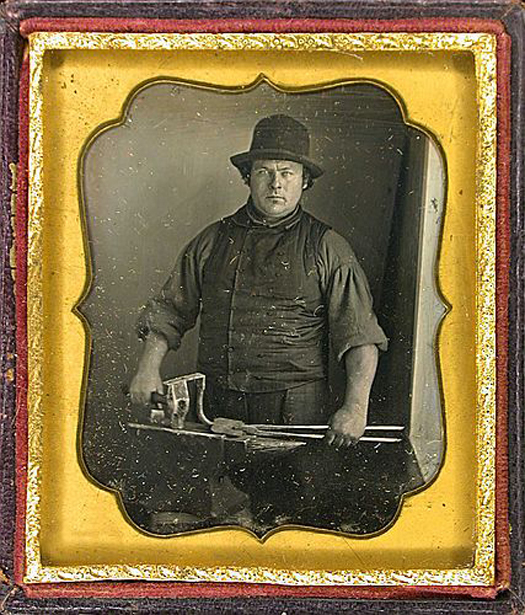
What's Your Job?

Blacksmith with tools, c. 1852.
Note the vest, scarf and rolled sleeves.
Image from The Design Observer Group.
Wondering about civilian professions in the 1860s?  Unsure what to wear? Curious about the 'tools of one's trade'?  Here are some resources for occupational images (either staged daguerreotypes/tintypes/CDVs showing 'types' of workers with their tools, or actual documentary pictures).  Many of these are loosely dated, or slightly/rather pre-war, but they still have useful background information.  Even the professional soldiers of the '60s would have interacted with tradesmen (and perhaps trained for an occupation at some point), while wartime volunteers all would have some sort of job before enlisting.


These Dated Images from the 1840s and 50s show a diverse range of trades and professions.

There are also slideshows of occupational images from the1840s/50s On Youtube.

The American Daguerreotype Society has fewer images, but with more commentary on them.

And there are more pictures here, but without useful contextual information.

These 1860s Russian CDVs show a great diversity of jobs and tools, with a mixture of traditional Russian and modern European dress--look to other sources for collaborating stylistic choices, unless you're portraying a very recent immigrant.

Women's occupational images. (For more about jobs open to women, check out Virginia Penny's 1863 book "The Employments of Women").

Illustrations of poor Londoners, 1851.  These include working people and the indigent.

The Library of Congress's Daguerretype collection: enter the occupation of interest, and voila!

Tuesday, August 11, 2015

Beginning First Person Interpretation

For those interested in trying it out, a few thoughts on first person living history:


First person interpretation is pretending to be a person from the past—and not alluding to the fact that you are a twenty-first century person in funny clothes talking about the past.

We call it "first person" because you are using the grammatical first person ("I/me/my, we/us/our") to convey your information. For example:

First person: "I fear prices will keep rising as long as the blockade lasts."
"We are making a quilt for the hospital."

Second person: "If you lived here in 1855, you'd be sharing this one room with all of your siblings."

Third person: "He wrote most of his letters at this desk."
"The soldiers often complained of inadequate rations."
"They didn't have electricity."

In first person, the speaker is placing himself or herself in the past. In second, the person being spoken to is placed in the past. In third person, the person(s) being spoken about is(are) placed in the past.

How to do it

In short, start using "I" statements. Everything you already know and share about the period is still relevant—you're merely changing how you present the information.

There are two main groups of people you'll interact with in first person: other reenactors (in first person), and the public (people not in first person).  Most of the techniques are relevant to both, though the later group in particular may need some prompting to understand that you are from the past--in first person rather than in third.  You'll also get the occasional corny attempt at humor ("Where's the TV?"; Waves cell phone--"Have you ever seen one of these?"); I prefer to handle these with a polite smile, "I am unfamiliar with that term", and getting back on topic.

It's fun to do first-person with other reenactors, and you don't need to plan out elaborate scenarios and scripts. At the bare minimum, all you need to have worked out is that you're in the same place—knowing where and when you are.

When are you? Where are you? 
Some events make this clear in advance: the event and everyone at it is in Gettyburg, PA July 1-3, 1863, for example. Others events are less well-defined, in which case you need to either work out your location/date or avoid using specific (time-sensitive) details that might not fit. Discussing the upcoming presidential election is an excellent topic for the summer of 1864, but makes less sense if your conversation partner thinks its the spring of 1861 and was just about to bring up their thoughts on the recently-past election. Complaining about blockade-caused shortages as a Georgian in 1863 is great...that is, if you're not talking to a northern shop-keeper who's noticed no such hardships, or to your southern neighbor of '61, who's still anticipating a quick war after First Manassas.

Dropping the year into your conversation can also help orient the public to your first-person conversation.  Ie, "Look at our new cook stove. Poor Thornhill was actually cooking over an open hearth until it arrived last year--imagine cooking on a hearth in 1854! But then, with the expense of shipping it around Cape Horn, we're quite lucky to have it at all."

Who are you?
Unless you're at a planned event where you share a backstory with other people--who are portraying your close friends, family and neighbors--this sort of background information is largely for your own benefit. It's both very important (your persona's social, political and geographical background informs everything you say/think/do in character), and not very important (unless you bring it up, no one will ever ask about your character's childhood home, or deceased relatives, or favorite food). To start, work out the very basic concepts such as your name, your relationships to other people present at the event (if any), and what you're doing there. You can build a more elaborate persona as you feel comfortable with it.

Introduce yourself!
Use a period form of introduction to do so, and you're already in first person.
(I've put forms of introduction and address in a separate post).

Keep Talking, Keep Trying
Venture an opinion: on the weather, on the shop-keeper's prices, on that bonnet you saw in Godey's, on the President's recent proclamation, on the war, on a patent medicine you tried. Ask a question, How's your health? Where's a good place to buy shoes? Have you seen my husband pass this way? What do you think of the military occupation/weather/recent political event/lastest fashion fad? Have you seen the latest edition of Harper's? Tell an amusing anecdote. Offer advice. Anticipate a coming event: the ball tonight, the end of the war, your sweetheart's next letter. Discuss your day/the children/that new Dickens novel you're reading. Attempt to recruit your conversation partner into some future project: planning a charity ball, supporting a political candidate, investing in your land speculation scheme.

I find first-person opportunities provide excellent fodder for your next first-person encounter: discussing the last ball over dinner, or recounting the time that the maid tripped and invented "flying aspic".  If you interact with the same people, you'll also start to develop shared stories and backgrounds which can be referenced on future occasions.

Period literature can make a pleasant topic of discussion. Incidents and opinions found in period diaries, letters, and travelogues can also be adapted for personal use: for example, one lady at Nisqually last year portrayed a character who had crossed Panama by mule, and regaled us with stories of the trip. Avoid taking well-known incidents and putting yourself into them—unless you actually are portraying one of the Pinkerton agents who thwarted the first assassination attempt against Lincoln (or whatever the particular situation is).

Do Something/ Start Conversations
This applies to in-character interactions as well, but it's vital to conversations with the "public". Visitors don't always know that you're in character, and might not know how to approach you. even if they do.  Doing something provides one way to break the ice—the public can ask questions about it, or you can greet them and volunteer information about your activity.

This is also great for you, as it focuses the sort of questions you'll be getting. Even if you don't feel like you know everything a person from you period would know, you can research a narrow topic until you feel comfortable with it (most people aren't looking for a dissertation). So, read up on period laundry methods if you're washing clothes. Consider where you bought/procured the food you're cooking with. Know who you're writing that letter to, and be able to name the equipment you're using to write it.  Someone who sees you cooking is more likely to ask you a question or two about your menu/tools/where you acquired your ingredients--ie, the questions you're prepared for--than to grill you for minutiae on politics, or transportation, or fashion.  

Then, when a visitor comes up to you, start talking to them. I like to start with a "good morning", or "good afternoon" ("hello" seems to be uncommon in 1860s, and "hi" is right out). The visitor will often ask when I'm making/doing, and I can explain that I'm tatting/rolling gingerbread/sewing a skirt. If they don't ask another question, I can offer a few more details (tatting is a sort of lace-making; I'm using it to make a decorative trim for a chemise, which is a sort of undershirt that keeps my other clothing nice). Eventually, the visitor will either start helping carry the conversation, or they will take their leave. Either way, you've just taught them something. And you did it in first person!

Admit That You Don't Know
This where I most often end up breaking character. Someone asks a question, and you don't know the answer. The cardinal rule of living history and museum interpretation is do not make it up.* So, don't. Own up to your ignorance. Offer what relevant information you do have. If it's something that can be handled in character, great—after all, there are things your character wouldn't know. If that's not the case, ie, the question is one that your character should be able to answer, then you need make it clear that you're breaking character when you say no. And later, you can try to find the correct answer for next time.

Some ways to answer in character:

"I've no idea what the clerks are paid, but it's surely more than I earn picking potatoes. Are you looking for a position?"

"My maid handles the laundry. I don't know how she gets those ink spots out, but my undersleeves always come back neat and clean. Nevertheless, I've started wearing sleeve protectors when handling a large correspondence."

"How old's the wheat? Well, I planted it late spring, and it's ready to harvest now, and that's my main concern." [If the questioner persists in asking about the dates for the wheat variety, I'd break character to say that I don't know.]

To gracefully demur: "Actually, I don't know how much the seasonal workers were paid, but we're continuing to research the topic.  I do know that servants in this area earned around $X per month, and expect that unskilled labor was paid at a similar level."

Keep Learning
The more you know, the more... Questions you can answer. Conversations you can enjoy. Interesting scenarios you can devise. Different personas you can try.

The more accurately you can present the past to others.

Some resources for developing more advanced personas and research:
Resources from the Atlantic Guard Soldiers' Aid Society
Linda Trent's "Creating Believable and Sustainable Characters"
First Person Character Worksheet
Discussion: Staying in First Person
In the Right Mind part I
In the Right Mind part II

To Re-Cap

First person interpretation is pretending to be someone from the past—using "I" and "we" in your conversations.

When doing first person with other reenactors:
  1. Know who, where and when you are
  2. Introduce yourself
  3. Keep trying
  4. Continue to learn

When doing first person interactions with the public:
  1. Know who, where and when you are
  2. Do something
  3. Start conversations
  4. Admit when you don't know the answer (stay in character if you can)
  5. Continue to learn

*To clarify, yes, you are lying: first person is a mutually-agreed-upon-fantasy, in which everyone knows that you were not actually born in 18XX, but both you and the visitors are pretending otherwise. All liberties need to be confined to this 'mutual fantasy' dressing and not get mixed into the history itself. We're here to educate, and inventing 'facts' does a disservice to everyone (including future generations of interpreters who get to keep disabusing returning visitors and their grandchildren of stories—that have no basis in fact—invented by previous living historians). The public is are trusting you to tell them what the past was like, and are granting you license in the presentation. So, go ahead and relate the funny privy story you read (in a period source) as though it happened to you, or use your own experience with the horsehair sofa as a warning about sitting carefully (happened while using period items in the prescribed way), but don't invent something out of wholecloth and pass it off as history.

Wednesday, April 1, 2015

Rounding Out Your Impression: Primary Sources

Glamour: 1865 (from Peterson's Magazine, January)
One benefit of reenacting 150(+) years in the past, is that the books, magazine, pamphlets, and newspapers of the time are in the public domain.  Yes, you can actually read the same papers that your ancestors got their news, humor, and fashion advice from.  Why not pick up a copy of Harper's and find some truly dreadful Victorian jokes to share around the next campfire?  Or regale your comrades with Mr. Foster's hit new song?

Here are some of the resources I've found useful for tracking down written primary sources from the 1850s-1860s.

The Library of Congress: It's not always the easiest to navigate when looking for a particular title, but they have tons of resources which are fun to browse.

Google Books (Advanced Search): One of the easiest ways to search for a particular topic is using this advanced search.  Enter your subject or title in the "all the words" bar ("leather work", "etiquette", "Godey's", "agriculture", "housework", etc.), check "full view only" (to get things you can read for free on-line) and set the year range (say 1855-1870).  Advanced tips: the "more editions" button can get you from the 1861 set of a magazine, to all the available years; compound words are sometimes spelled differently in the period: ie, "sunbonnet", "sun-bonnet", "sun bonnet"--if one search yields no hits, try varying the spelling.

Internet Archive: Less useful for subject-browsing that Google or LOC, Internet Archive can track down specific titles which the others may not have.  It's particularly nice for finding a whole year's worth of a magazine or newspaper (many period periodicals were published in bound volumes after the initial run of issues, and these are often what have survived in libraries and ended up posted on-line).

Project Gutenberg: If you know the title or author of a period book, you can search here: e-books, all public domain, and all free.  Unfortunately, I've never found a 'sort/exclude by date' option, so it's not easy to browse for specifically 1860s titles.

Harper's Weekly (and here): Probably the most famous of the national newspapers in the 1860s. Don't have time to read it all?  Check out the Cartoon of the Day.

And some of my specific favorites:

Links to Etiquette, Advice, and Household Books

Links to Literature and Sheet Music including the excellent Levy Sheet Music Collection from Johns Hopkins (allows you to search by title, subject, or instrumentation, and to limit the year range).

Links to Textbooks

Added 8/4/15: The British Library has an extensive collection of historic images from the 17th-19th centuries on their flicker account.  And they're all public domain!

Luminous-Lint has historic photographs (and information on the history of photography).

Friday, February 27, 2015

Introductions

"Allow me to introduce you."
New to first-person conversation?  There's no better place to start than at the beginning. The preferred period method for introductions features a person presenting one friend to another--you meet people largely on the recommendation of your existing acquaintances.  
"Mrs. Jones, have you met my sister, Mrs. Smith?"

"Mrs. Denny, allow me to present M. Hugo, from Paris."

"Miss Thomas, may I present Dr. Adams?"

When making an introduction, you always present one person to the other; the higher ranking person is addressed first. To determine precedence in this and most other social situations, some guidelines:
  1. Ladies outrank gentlemen (this is the most important rule)
  2. Married ladies outrank unmarried ladies (also universal)
  3. Older persons outrank young ones
  4. Accord higher precedence to people with whom you are less familiar, and lower to your close family and friends
  5. Social status—this is bit nebulous, unless you're dealing with actual aristocrats—but could come up if you're introducing two people of the similar age, gender, marital status, and proximity to yourself, in which case the one of greater social prominence goes first
Dropping in additional information (relationship to you, recent travel abroad, a visitor's hometown) is appropriate. The idea is to get people acquainted with each other, after all, and those details may help start a conversation.

Miss Leslie (The Behavior Book, 1853) writes that it is acceptable for ladies who are travelling alone to introduce themselves to genteel (female) strangers, when there is no one available to make an introduction. Similarly, persons meeting a the house of a mutual friend (according to Charles Day in Hints on Etiquette and the Usages of Society, 1844) may introduce themselves, as the host's invitation indicates that they are both respectable. Another period option is to present a letter of introduction from a mutual associate.  In certain situations (public balls),  a designated 'floor manager' or 'master of ceremonies' is delegated to introduce potential partners for the dance only; these introductions are different from normal social introductions and do not allow for future social interaction.

In any case, make sure to use social titles and surnames, when speaking to adults. Avoid reenactorisms, such as calling a middle-aged woman "Miss Betty"*, or addressing the postmaster as "George"**.  Use of first names, in period writing and address, is limited to family members, children, servants, and some intimate correspondence between friends. The exception is to differentiate between people with the same title and last name, in which case the first name is added for the junior parties.

Example: The Smith family has four daughters and three sons. Both the eldest son and the eldest daughter are married. The middle son and daughters are grown-up, but unmarried. The youngest son and daughter are still children, and not brought into adult society.

The family is addressed as:

Mr. Smith (dad)
Mrs. Smith (mom)

Mr. John Smith (eldest son)
Mrs. John Smith (daughter-in-law)
Mr. Robert Smith (younger adult son)
(Master) Michael Smith (child)

Mrs. Brown (married daughter)
Mr. Brown (son-in-law)
Miss Smith (eldest unmarried daughter)
Miss Deborah Smith (other unmarried daughter)
(Miss) Liza Smith (child)

In public, Mr. Smith refers to his wife as Mrs. Smith; she calls her husband Mr. Smith (what they say privately is their own business). They call their children by their given names. [Note: Mr. Day's book condemns the practice of calling one's own children Mr._ or Miss_, which means some people did it.]

When Master Smith grows up, he will be styled "Mr. Michael Smith" (unless/until he attains a professional distinction styling him as "Dr.", "Professor", or "Reverend", or assumes a notable military rank). The younger men will continue to use their first names in any situation where multiple "Mr. Smith"s create ambiguity.

Similarly, Mrs. Brown uses her husband's first name when more than one Brown is around. When Miss Smith marries, her sister Deborah will stop using her first name and simply be "Miss Smith". When little Liza is old enough to enter society, if any of her older sisters are still unmarried, she'll be styled Miss Elizabeth Smith. If Deborah never marries, she'll continue to hold the title of "Miss Smith"; in that case, Liza could pass right from "Miss Elizabeth Smith" to "Mrs. MarriedLastName" without ever being the sole "Miss Smith".

Women can attain professional titles, but they are very, very rare. The Rev. Miss Antoinette Brown (later Rev. Mrs. Blackwell) and her future sister-in-law, Dr. Elizabeth Blackwell, are quite exceptional--as is their shared sister-in-law, Lucy Stone.  [In order, they are the first woman ordained by a mainstream protestant sect in America, the first woman to receive a medical degree in America, and the the first prominent woman in America to keep her own name after marriage.]

References
Leslie, Eliza. The Behavior Book. Philadelphia: Willis P. Hazard, 1853. Available here. 
Day, Charles William. Hints on Etiquette and the Usages of Society. Boston: William Ticknor & Co, 1844 Available here.
Thornwell, Emily. The Ladies' Guide to Perfect Gentility. New York: Derny & Jackson,1856 Available here.


*That's "Miss Betty Thompson" if she's a spinster, with an elder sister who is also a spinster ("Miss Thompson"); exceptions if you can document a local custom appropriate to your impression

**It's only appropriate if he's your son or brother.

Friday, January 30, 2015

Getting Started: Impressions and Attire

Welcome to 1860!

There's lots to see and do, and no time like the present (or rather, the past).

Who Am I?/ What am I doing?/What should I wear?

There's more to reenacting/living history than clothing, but it is a highly visible part of the hobby.  In addition to being accurate (the 1860s were a long time ago, but not all 'olde tyme' things suit the 1860s), your clothing should also be suitable to the activities you'll be doing and and character/persona you may be presenting.

No one outfit is appropriate for all activities, so make sure that your first outfit suits the activities you will be pursuing, and at the time of year you will be doing them. You don't wear the same clothing for Christmas caroling that you would for working in your garden in the summer, nor does a nurse wear the same outfit as a society hostess.

Even if you really don't want to make a persona, give some thought to what you intend to do at the reenactment.  Are you fighting in a skirmish? Cooking over an open fire?  Minding children? Just hanging out in funny clothes? Demonstrating a craft or profession?  Lecturing?

The soldier has a uniform.  The crafter will want serviceable garments with accessories which suit his/her occupation, such a blacksmith's leather apron, or a clerk's sleeve protectors.  The lecturer will want neat, respectable garments in styles suitable to his/her class background.  Washable cottons and water/dirt/flame-resistant wools are a boon for laborers, servants, nurses and cooks. Hoops are a simultaneously ubiquitous for women in the period and hazardous in certain situations (factories, open fires, crowded hospital wards); let your activities dictate whether you wear one.  For example, when I'm cooking in a period kitchen, my complete outfit looks like this:
  • basic underwear: drawers/chemise/corset (keeps my other clothing clean, provides back/bust/torso support, allows easy use of the necessary)
  • shoes
  • a corded petticoat (keeps the skirts from wrapping around one's legs)
  • a second petticoat (for the period shape and to keep my skirts from drooping--this is a weak imitation of the fashionable ideal); for dirty work, the outermost petticoat can be made of printed material, with the dress skirt tied up above it
  • a basic cotton print dress (bodice and skirt joined as one piece, washable material) with sleeves that can be rolled up
  • a neckerchief or basted collar (keeps the dress cleaner during sweaty work)
  • pinner apron (protects the front of the dress); I have several cotton stripe and print aprons which can be washed; wool ones are also useful for putting out fires
  • wool shawl (not worn while cooking; kept on hand to haul supplies and smother small fires)
  • hair dressed up, with no decoration (center part, back bun, side hair varies with year portrayed)
  • plain handkerchief
  • sunbonnet (worn when going outside)
Contrast with a more genteel lady:
  • basic underwear: drawers/chemise/corset (as before)
  • shoes
  • a cage or hoop (for the fashionable silhouette)
  • additional petticoats (smooth the hoop line, add additional 'loft' for a fashionable look)
  • a well-fitted dress of wool, fine cotton, or silk, with tasteful trimming (may be conservative or follow the fashionable fads)
  • white collar and cuffs/undersleeves (these keep the neck and wrists of the dress tidy)
  • brooch or neck ribbon, and other tasteful accessories such as a pocket watch, fashion belt, jewelry, etc.
  • wool or silk shawl/wrap/mantel
  • gloves
  • hair dressed (as before), may add combs, a decorative net, a fine cap, or other accessories
  • handkerchief (plain or decorated)
  • fashionable bonnet or hood (worn in public spaces)
  • parasol (when going outside)
Most WCWA events take place during the summer, in outdoor settings and camps.  You'll want to start with clothing that is washable, cool for summer wear, and able to be layered against rain or cold weather. Medium, lightweight, or sheer cottons and tropical or sheer wools are good to start with. Additional (wool) layers, like shawls, paletotes, hoods, sontags, muffatees, and warm stockings will help you stay comfortable in cool evenings and morning.  These can also be employed for our few cold-weather events (Christmas at Fort Steilacoom, the Auburn Veterans' Day Parade).  I've also found rubber overshoes very useful for reenacting in wet weather.

Recommended articles: Mrs. Clark's Assembling Your Best Bet Wardrobe, and Defining the Work Dress cover the basics of selecting garments.  Anna Worden Bauer's Beginning Guidelines for Women are also very informative (as are her other articles).

Next Time: Where do you find this stuff?