Thursday, March 31, 2016

Quilt Resources

Bedcover/Bride's Quilt, 1861, Chicago Art Institute
Appliqued Bedcover, 1861, in the
Art Institute of Chicago.
Let's explore some of the lovely options for early 1860s quilts! I'm far from an expert on the subject, but I've gathered some period examples and links for further research.

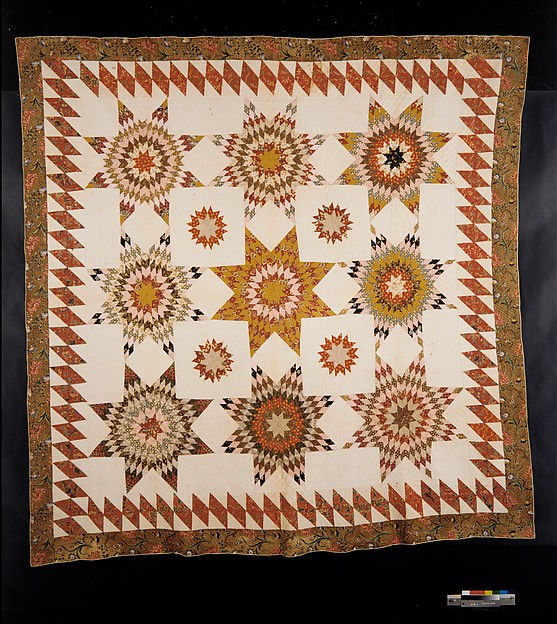
1840-1850 Star of Bethlehem Quilt in the Met Museum
Star of Bethlehem pieced quilt, c. 1840-1850
in The Metropolitan Museum of Art

Patchwork, applique, strip, whole cloth, and mixed technique quilts all can be appropriate for the early to mid-1860s.  Patchwork designs in use during and just before the American Civil War include Nine Patch, Mill Wheel, Star of Bethlehem, Star of Lemoyne (and another example), Flying Geese, Feathered Star, Wild Goose Chase, Tumbling Blocks, Chimney Sweep/Album/Friendship Chain, Crown, Mariner's Compass, and even simple squares. Log Cabin quilts seem to gain popularity during and after the war. Hexagon or Honeycomb patterns are frequently mentioned in period sources; today this design/technique is also known as "Grandmother's Flower Garden" and "English Paper Piecing". The talented Miss Dories sometimes demonstrates sewing this pattern at events.
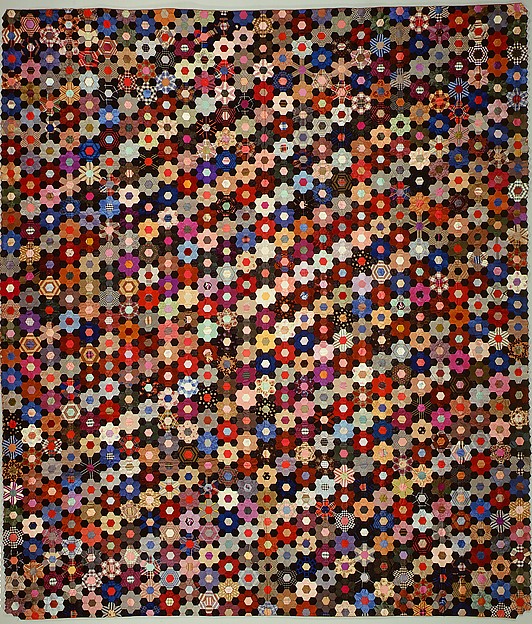
Hexagon Quilt, c. 1864, in the Metropolitan Museum of Art.
Silk hexagon quilt, started 1864,
in the Metropolitan Museum of Art.
Appliqued examples include the ubiquitous-yet-charming album quilts, as well as Rose of Sharon, Prarie Flower, Patriotic Eagle and Stars, Oakleaves, Triple Tulip, and Pineapple designs,  Pieced basket patterns with appliqued handles and/or flowers and fruits are fairly common; likewise patchwork quilts with appliqued borders.  An older technique ("Broderie Perse") involved cutting out chintz print motifs and appliqueing them onto the quilt top. I've used the museums' titles for the linked quilts; period names may differ.

1862 album quilt from the Art Institute of Chicago
"Circuit Rider's Quilt", 1862 album quilt,
in the Art Institute of Chicago.

In primary documents, quilts and patchwork are named among the prize categories of agricultural fairs and in exhibitions.  The second link includes a separate category for girls under twelve, with a four year-old, a seven year-old, and a five-year-old taking first, second and third place, respectively. A favorite period story of mine, "My Patchwork Quilt" (published in the 1840s), follows the development of a quilt, from the narrator first learning to sew until the work is completed; family anecdotes are tied in by the garment scraps used in the quilt--and a fair amount of social information comes through about the desirability of patchwork quilts, attitudes towards sewing them, how fabrics are acquired, and the process of making and quilting it.  Miss Leslie's Lady's House Book (11th ed./1850) has a more matter-of-fact discussion of popular bedcovers, and the different options available.  Patchwork designs and projects show up in period magazines.  Quilting was even addressed by sewing machine manufacturers.

Patchwork Cushion, Godey's 1852
Patchwork Cushion project in Godey's, 1852
1864 Patchwork from The Lady's Friend
Patchwork Pattern from The Lady's Friend, 1864

Quilts played their distinctive role in the war; the U.S. Sanitary Commission collected and distributed quilts, blankets, coverlets and comfortables to army hospitals.   Quilts might also be gifted to individual soldiers by their friends and relations.
1864 Sanitary Commission album quilt, in the Smithsonian
Sanitary Commission album quilt, 1864,
by The Ladies of the Fort Hill Sewing Circle
in the Smithsonian Museum of American History.
Sanitary Commission Quilt 1863 Susannah Pullen, Smithsonian
Star pattern quilt made for the U.S. Sanitary
Commission, 1863, by Susannah Pullen's
Sunday School class. Now in the Smithsonian.
For original quilts, you can't beat the International Quilt Study Center and Museum. They also have some articles specifically on Quilts of the Civil War. The Metropolitan Museum of Art, The Museum of Fine Arts Boston, and The Chicago Institute of Art also have a variety of nineteenth century quilts in their collections (and The Quilt Index has links to even more).  The Smithsonian's National Quilt Collection is also worth viewing.

Additionally, Barbara Brackman, noted quilt historian and author, blogs about 1860s quilts at the aptly-named Civil War Quilts; she also writes about antique quilts and reproduction fabric prints at Material Culture. I would particularly recommend her books Quilts from the Civil War, America's Printed Fabrics, and Facts and Fabrications.  Elaine Trestain's extensive collection of period quilts provides many of the fabric samples seen in Dating Fabrics: A Color Guide (which also has useful information on period fabric printing methods).

Monday, March 21, 2016

First Names

Illustration from The Ladies' Repository, 1852

This is not a post about when/who should use first names, but rather some interesting references to popular ones.  So, next time you're developing a persona, inventing a pseudonym, or devising names for your imaginary relatives and correspondents, here are some suggestions:

Most Popular Given Names.  Lists of the most common names for men and women, arranged by decade (calculated from U.S. Census returns).

The Ladies' Repository (1852) describes the histories of several common female names, including ones still used today (Mary, Sarah, Caroline), and some which have fallen out of favor (Mabel, Blanch).

Godey's lists some "Pretty Names for Girls" in 1855, as an antidote to having 'four Marys, three Anns, three Elizabeths, 1 Sarah, and 1 something else' for every dozen women.

Wednesday, March 2, 2016

Fans

The Fan Association of North America has a video showing fans from the 18th to 20th centuries; the mid-19th century portion starts around 7:34.  The Hand Fan Museum is another resource.  As the following examples bear out, The Met and UK National Trust collections have huge selections of fans on their websites (the latter has an especially large number of pieced ivory and fixed fans).

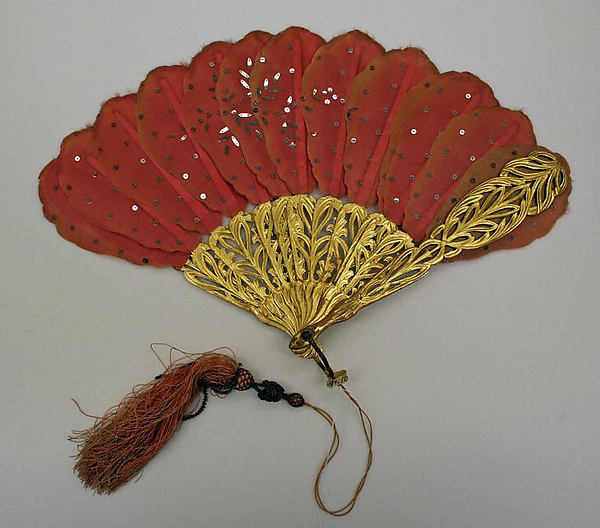
There are different shapes of fan available in the 1860s, with the traditional half-or-semi-circle folding "fan" shape apparently most popular. These tend to range between 8.5"and 11" long when closed, with the "skirt" or "leaf" taking up approximately 1/2 to 2/3 of this length (the size and proportion both change over time--late 19th century fans are often closer to 14"). Sticks and guards can be made of various materials including wood, bone, mother of pearl, tortoise shell, or ivory--even paper mache and whalebone are sometimes used. Lace, feathers, and metal sequins or "paillettes" sometimes appear as adornments (though the lace and feathers become more popular later in the century). Paper leaves with printed (lithograph) designs are common.  Cheap fans may have monochromatic prints, while more expensive versions could be hand-colored, or even all hand-painted. Silk leaves were also used: some painted, others left plain.
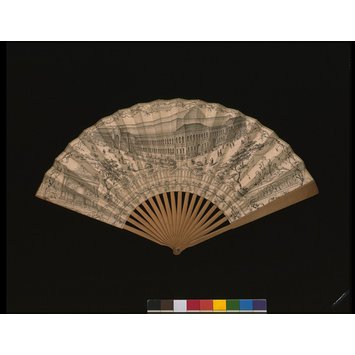
Inexpensive souvenir fan of the 1862 Paris Exhibition;
printed paper and wood. From the VAM.
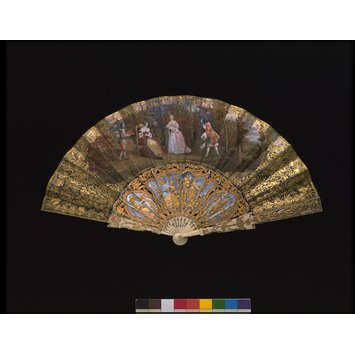
More expensive fan: hand painted paper with gilt, carved mother of pearl
sticks, ivory guards. c. 1840-60. From the VAM.
A similar-shape fan, sometimes called a "Jenny Lind" fan (after the singer) or a "palmette", has separate feather-shaped leaves on each stick.
Ivory and bone fan with individual silk leaves, c. 1830-1870.
From the UK National Trust.
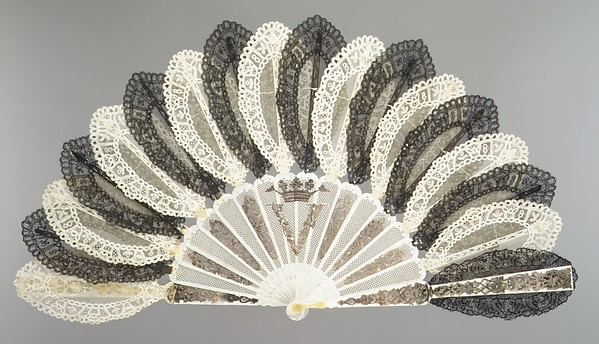
Mid-19th century mother-of-pearl fan with lace leaves. From The Met.
Fans with many painted or spangled silk leaves were popular in the 1860s.
This example, c. 1868, is from The Met.
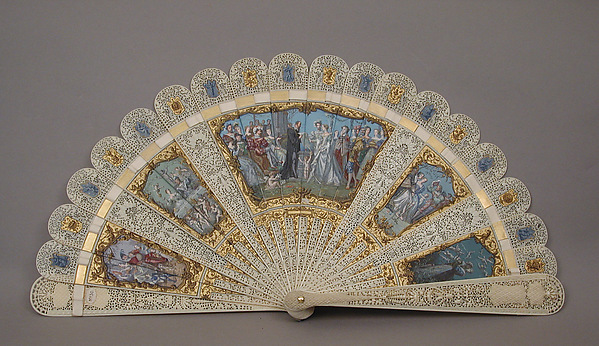
Brise fans are the same general shape, but without silk/paper leaves; instead, the blades themselves comprise the whole fan.  The examples I've seen tend to be ivory (one was horn, one wood), with ribbon joining the blades.  Most are elaborately carved and some are also painted, though there is the odd plain one.  Where I can find dimensions, these skirt-less fans run 6"-9" closed length.
Ivory fan, c. 1860. From The Met.
While these first three types of fan had approximately the same shape, other radically different styles were also used.

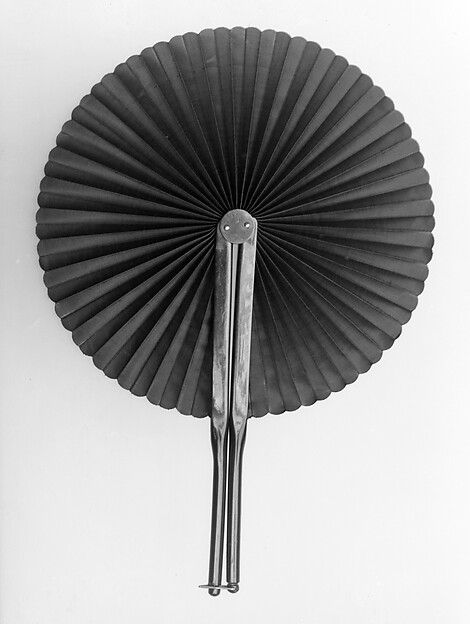
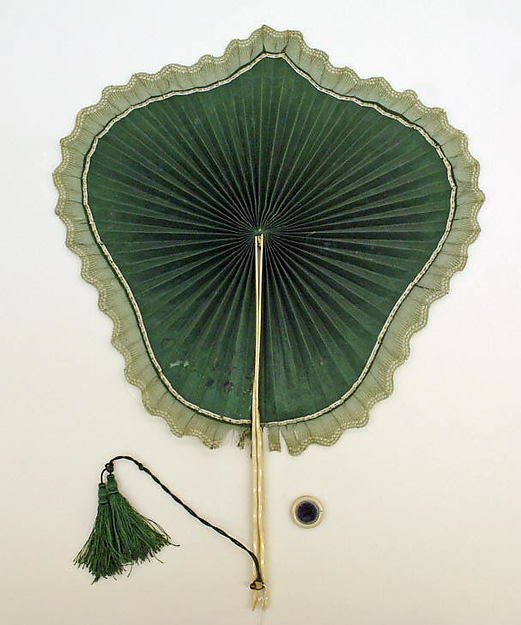
One of these is a circular shape (cockade), with the handle forming a case when closed.  The handle may be wood, metal or leather; the "cockade" of paper, straw, silk or cotton.  The only dimensions I've found are 11" (closed) on the straw example.
Silk and wood "cockade" fan, 19th century. From The Met.
Silk and bone fan, c. 1850. From The Met.
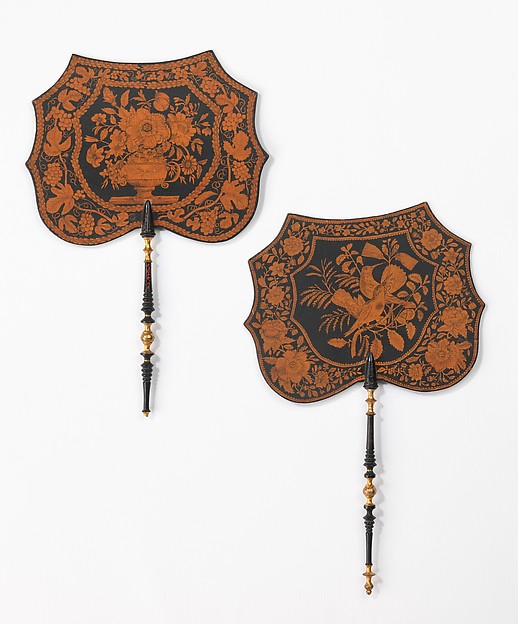
Solid "fixed" fans or hand screens are another option.  Usually 12"-14" in length, they often have a wooden handle attached to a piece of decorated wood, cardboard, or canvas.
Painted wood fans, c. 1837, from The Met.
Canvas and wood fan, c. 1850-60, from UK National Trust.
Similar fixed fans appear in other interesting materials, such as guinea fowl or turkey feathers, and the ubiquitous palmetto or palm-leaf fan.  This consisted of a palm frond, which had been woven into a distinctive spade shape (Abraham's Lady sells reproductions).  Miss Leslie (p. 33) advises buying palm-leaf fans with self-handles, as the attached bamboo ones tend to come loose.  Though frequently mentioned in period literature as commonly-used, inexpensive articles, I've found no images of original ones from the period.

Tuesday, March 1, 2016

Low Society

On the Brink (1865) by Alfred Elmore
Bad society then may be divided into three classes: 1. That in which both morals and manners are bad; 2. That in which the manners are bad, be the morals what they will; 3. That in which the manners appear to be good, but the morals are detestable. The first is low, the second vulgar, the third dangerous society. 
Few people but undergraduates, young ensigns, and aspiring clerks and shop-boys, will need to be warned against low society. Where vice wears no veil, and decency forever blushes, the man of any self-respect, to say nothing of taste and education, will speedily be disgusted. The first proof of lowness is seen at once in undue familiarity. If there are women in company, you will at once discover their character from the manner in which they allow themselves to be addressed; but if not you will doubtless ere long be yourself subjected to a freedom of treatment, which you will readily distinguish from ease of manner, and know to be beyond the proper limits. Familiarity on first introduction, is always of bad style, often even vulgar, and, when used by the openly immoral, is low and revolting. A man of self respect will not be pleased with it even when it comes from the most respectable, or his superiors; he will despise it in his equals, and will take it almost as an insult from those who do not respect themselves... 
--The Habits of Good Society (1863), page 37

Monday, February 22, 2016

Ladies' Belts

Building on the separates post (though you can also wear them with dresses): belts, girdles, corslets, corsages*, sashes, waists, waistbands, ceintures... there are a number of different decorative over-garments worn at the waist in the 1860s, and an even larger number of names for them.  For added confusion, many of the names are used interchangeably.  Nonetheless, let's check out a few.

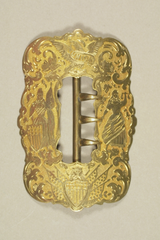
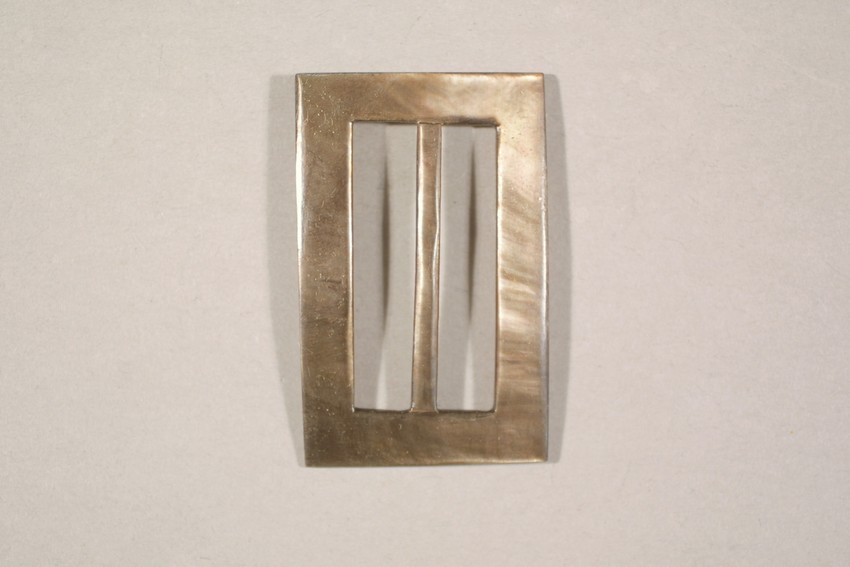
First, the narrow belt.  At it's simplest, this is a plain band of ribbon worn around the waist, possibly fastening with a buckle or clasp.  The examples below are all around 2.5" wide, except for the mother of pearl one, which is 1.5".  Notice the different types of buckles: there are two-piece versions which hook together, pronged buckles, and solid "slide" styles available.  
Ribbon belt with two piece clasp, Museum of Fine Arts, Boston
Belt clasp, c. 1850-70.
From Historic New England.
Buckle with 3 prongs, c. 1861-5
From Historic New England.
Mother of pearl belt slide, c. 1830-50. Historic New England
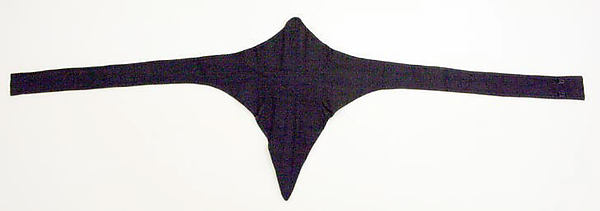
A more structured "belt" (also styled as a "waistband"/"waist" or "corselet") consists of silk or velvet over a stiff fabric such as buckram.  These belts may also have boning to help the points lie flat. Various styles are possible, including one, two, or three points up or down at the front; the "waist"may also have back points.  It can fasten with hooks and eyes or laces at the side or at the back (or even lace up the front).
Silk belt, 1860s, from the Met
Peterson's, May 1862
"Mauve silk corselet trimmed with lace",
worn over a white muslin body and a muslin tunic.
Le Follet, 1863
"Swiss Waists", "Medici girdles" and "Medici Belts" are more names for this garment (or similar ones).  A Swiss waist, corselet or corsage may also be substantially larger: while a 'belt' or 'girdle' is usually entirely below the bust, some of these latter garments may reach up to or over that point--closer to a low-cut second bodice than a 'belt'.
Waistband and diagram, Godey's, 1862.
An original "Swiss Waist" with front and back points (and close-up images of construction details!) is posted on The Fashionable Past. The Graceful Lady also has various original corslets, not to mention CDVs showing them worn: over dresses, with matching skirts over white waists, or with contrasting skirts and bodies.
"The Russian, Swiss, and Medici Waistbands are worn more than ever. Some are plain, some stitched in colored silk, others embroidered with silk, braid, etc. The long sashes, tied at the side, and generally black, are also embroidered with a design to match the dress they accompany. These sashes, edged with a fluting or a row of lace, with braces and pocket trimmings to match, are in great vogue, and, especially when adopted to muslin chemisettes, are extremely pretty for very young ladies." --Peterson's, March 1862
"Medici girdle or waistband" and braces in black velvet
and lace; matching cuffs and a bow are also given. The
girdle may be laced up the back or hooked at the sides.
Peterson's, March 1862
The braces or bretelles mentioned above are the shoulder straps.  They're especially common on children's and young women's accessories.
The Lesson (1861) by Jules Trayer
Girdles are another name for the pointed belts discussed above, though the term seems to be applied to a wider variety of shapes, such as this rounded one:
Girdle, The Lady's Friend, 1864
Back View
Sashes and scarves are distinguished by their long, trailing tails.  In addition to naming the flowing ribbons sometimes affixed to girdles/waistbands, a sash could also be a garment in its own right. These typically have very long, rounded tails, and may have a bow at the waist.  Scarves, likewise, can also refer to various cloths worn at the neck.
Mauve silk sash worn over a sheer white dress.
Mrs. Margaret Hicks (1861) by Sir Francis Grant
Sash with bow, Peterson's, February 1862
Scarf ceinture or 'girdle' with velvet applique  and runched ribbon trim (left);
plaid tafetta sash with Greek fringe (matching cover comb in hair).
Both worn with evening dresses. Godey's, February 1861.
Though perhaps less common in the period than in current reenacting circles, some functional ornaments could be hung from the belt.  The chatelaine or necessaire is a set of chains or ribbons from which useful and decorative tools could be hung: scissors, keys, small pencils, sewing supplies, etc.
Cut steel chatelaine, c. 1850. VAM.
Lady's Necessaire, Peterson's 1862
There was also a fad around 1861 for "girdle pockets" or "waist-pouches"--often elaborately embroidered or appliqued, and decorated with tassels--which could hold one's porte monaie and handkerchief.
Waist-pouches, Peterson's, September 1861

*Corsage can also just mean "bodice".

Sunday, February 14, 2016

The Language of Flowers

Bored with roses? Want to make a more complicated statement?

The Illustrated Language of Flowers (1856), contains all the Victorian lore needed to design a bouquet which exactly expresses your feelings.  Try four-leaved clovers ("be mine"), white dittany of Crete ("passion"), glory flower ("glorious beauty"), and red tulip ("declaration of love").

Or perhaps a combination of common almond, yellow carnation, fuller's teasel, and basil is more appropriate (stupidity, disdain, misanthropy, and hatred).

And for those set on roses, there are 34 different types named, conveying meanings from "I am worthy of you" (white rose) to "war" (York-and-Lancaster rose).

Shorter works on the subject include The Language of Flowers: An Alphabet of Floral Emblems (1858) and The Flower Vase (1850). If you need fuller explanations of the meanings, and poetry to accompany, try The Language of Flowers: The Floral Offering (1851).

Saturday, February 13, 2016

Events: Valentine's Tea, and Cupid's Ball

Double events on the Saturday before Valentine's.  In the afternoon, Fort Steilacoom held their annual "Mrs. Casey's Tea" fundraiser, which featured an auction of fancy goods, delicious tea and cakes, a display of antique quilts, and costumed reenactors portraying fort residents and visitors.

Tea tables in Quarters 2, just before the slide show of Victorian valentines.
Several members of the 4th proceeded to spend the evening dancing at Cupid's Ball, a period dinner and dance event hosted by Mrs. Keller-Scholz.  Mr., Mrs. and Miss Talbot danced much of the evening, as did Mr. Evans, and even Captain Jones joined in the terpsichorean exercises.