Thursday, June 11, 2015

Mourning Attire

In Memoriam  by Alfred Émile Léopold Stevens, c. 1861
"The chief use of mourning attire is to express our grief and humiliation, and to remind us of our bereavement on those occasions, when we are liable to be gay and thoughtless. It is also a caution to others, not to converse on light or mirthful topics in our presence; yet we should not speak of death to one who wears a weed." 
-George W. Hervey, The Principles of Courtesy (1856)

Victorian mourning, with its reputation as a morbid and baroque social institution, piques the interest of public and reenactor alike.  Living historians may chose to adopt mourning impressions as a teaching tool, to commemorate their own losses, or for any number of other reasons.  For those not mourning in modern life, I would recommend reading Miss Connolly On Mourning Impressions before assuming period mourning attire.
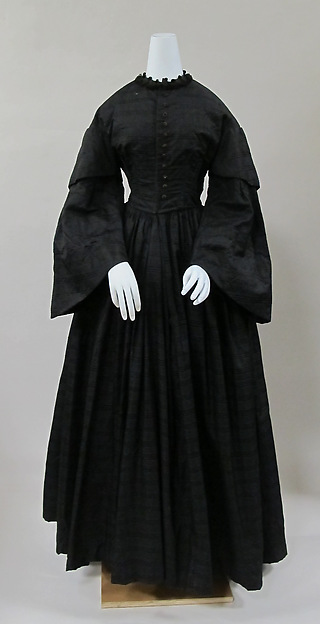
Mourning Dress, 1850s, from the Met
There are numerous terms and gradations used to describe nineteenth century mourning attire. Carolann Schmidt gives a good overview of the different types of mourning: "full", "second", "half", and so on. Generally speaking, one starts by wearing matte black fabrics (especially crepe/crape and bombazine), and slowly adds in white, more lustrous blacks, black and white ornaments, then shades of purple and grey, easing back into full color over time.
"Among all civilized modem nations there is a great similarity in mourning customs, and black is universally considered the proper color to be worn, although in the fashions for ladies' dresses modern refinement has gone so far as to symbolize the gradual change from the depth of affliction to a normal state of cheerfulness by a gradual return from black to the gay colors through the intermediate hues of purple and violet, which are recognized as 'second mourning.' The material of a mourning dress is also prescribed by fashion, being for ladies generally crape. The time varies, according to the degree of relationship of the deceased, from a week to a year, the latter being the period fixed by custom for a widow." -The New American Cyclopedia (1861)

Crepe/crape is a matte fabric, generally silk, with a distinct diagonal texture

How long one wears the different degrees of mourning varies based on age, relationship to the deceased, means, place of residence, and personal sentiment.  The most comprehensive period reference I've found is in Godey's, 1854.  It emphasizes the need for one's own sentiments to dictate the terms of mourning apparel, and suggests that white be worn both to mourn children and by children in mourning.  Though condemning codified mourning, it give as an example "one year for a parent, husband, brother, sister, or child.  Six months for grandparents, uncles, or aunts.  Three months or six weeks as a token of respect to the memory of a cousin, friend, or remote relative, or anyone who leaves the wearer a legacy." For public figures, or classmates, or fellow members of clubs, or for soldiers attending officers' funerals, mourning badges, mourning rosettes, and/or crape armbands might be adopted. In other public instances, as for royalty, slight mourning may be worn ("court mourning", for those attending on the royal family, can be highly formalized).

Reproduction of an original mourning badge/cockade
honoring Abraham Lincoln.
The Art of Dressing Well (1870) advises that "Ladies invited to funeral ceremonies should always wear a black dress, even if they are not in mourning, and it is bad taste to appear with a gay bonnet or shawl, as if it were a festive occasion." While I've found no solid description of what women who are not otherwise wearing mourning wear to funerals before 1870, there are some clues. The Principles of Courtesy (1856) confirms that female relatives and non-relatives attended funerals; it also mentions visits of condolence being paid to the bereaved in the week after the death or funeral (The Young Lady's Friend also offers tips on these paying these visits, while The Habits of Good Society deplores them).  Etiquette, Social Ethics, and the Courtesies of Society (1854) recommends the visitor on such an occasion wear "black silk, or plain-coloured apparel" to show sympathy with the family. Contrary to the above references The Hand-Book of Etiquette (1860) claims that "according to modern etiquette, ladies do not attend funerals", before describing female relatives (gentry and working-class) wearing black hoods and capes when they do attend funerals.  This is also one of the books which explains how undertakers provide black gloves and hat-bands to male mourners (white if worn for children or unmarried persons).  An account of British nurses in the Crimea mentions them attending another nurse's funeral in their "black capes and hoods", some even acting as pall-bearers.  Taking all of that together--the wearing of black to show sympathy with mourners outside of the funeral, the wearing of black by female relatives (or co-workers) at funerals, the effort and expense undertaken to put all male mourners in appropriate black mourning accessories--I feel quite comfortable assuming that the 1870 advice is not inappropriate for the preceding decade.
Funeral of a Child (1863) by Albert Anker.  All of the adults wear black, excepting
the grave-digger's shirtsleeves and tan vest, and one man's beige jacket.  Some children
wear black, but most are dressed in plain normal colors.
The Workwoman's Guide (1840) is one of few sources I've found with actual concrete guidelines for the duration of wearing mourning clothing: 1-2 years for a spouse, 6 months to 1 year for a parent or a child over 10 (3-6 months for one younger, and 6 weeks or more for an infant), 6-8 months for a sibling, 3-6 months for an aunt or uncle, six weeks to 3 months for a cousin or an aunt/uncle by marriage, and three weeks or more for friends and more distant relatives; servants may be given mourning clothing to mark deaths in the employer's family. By 1870, the recommended duration will have doubled for widows, according to The Art of Dressing Well.  It specifies that widows should wear mourning for two years (one in deepest black, half a year in less severe black, and half a year in grays and purples). It's worn for one year for parents and children; six months for grandparents, siblings, and friends who left bequests; three months for aunts, uncles, nephews and nieces.  The last is done in second mourning (white, black, gray and purples), while the the longer durations start in deepest black and progressively lighten.

From Graham's Illustrated Magazine, 1857
"Full Mourning. --Bonnets for full mourning are in the usual full-dress shape--made of crape and grenadine, trimmed with black blonde and a crape veil, with transparent crape strings; it is relieved with jets and bugle ornaments on the outside, which also mix with the blonde underneath. 
Second Mourning.--Bonnets for second mourning are composed of quadrilles of black and gray ribbons with straw. Purple has been the fashion to mix with black in the composition of second mournings; but it is now considered too heavy, and more appropriate for winter--the colors of gray, straw and lilac being in better taste for the spring season. The flower ornaments are generally lilac and mignonnette, mixing with the white blonde underneath, and with the foliage and ribbons on the sides..."
-Graham's Illustrated Magazine, 1856
Godey's informed us earlier, of course, that "the plainest mourning is also the most ladylike", and most sources agree to this for the earliest periods of mourning--the fashionable twists comes later if at all. "It is absolutely necessary that it should be severely plain (emphasis original)", says The Courant (1862). Initially, one dons all dull black attire, including dress, bonnet, outwear, and even the "white accessories" (collar and cuffs/undersleeves); trims are kept to a minimum, and little or no jewelry is worn.  The Lady's Self-Instructor in Millinery and Mantua-making (1853) recommends making collars and cuffs of book muslin, and then covering them with black crape, while bonnets are to be made of black silk with crape trims (including the ties), or to be covered with crape for deepest mourning; white muslin, crape, or net are used for later mourning collars.  Whatever may be said of fashionable grades of mourning, the plain black attire, and the black trimmed in white are staples of period literature:

"She was dressed in the deepest and plainest mourning, totally without ornament..."
 Littel's Living Age, 1866


"... He admired the softening effect which the plain white collar and cuffs had upon Annie's dress. When he was home before, everything about her was black of the deepest dye; but now the sombreness of her attire was relieved somewhat..."
- Rose Mather, an 1868 novel about the war.

Arthur's Home Magazine, 1860

As mentioned before, this addition of white accessories to the plain black dress begins a transformation, in which the black is made more decorative and slowly superseded by other colors. "Fashions for Mourning" are outlined in Peterson's, May 1862, recommending different materials for the different stages of mourning (including barege, a sheer wool, for deep mourning in the summer). Black straw bonnets trimmed with crape or ribbon as also suggested; for lighter mourning, there are white straw bonnets with black, purple, or white trim, and purple pansies or violets.

This "comfortable and elegant wrapper" can be made up for mourning wear
in "black delaine, with a trimming of black silk quilted in white."
Peterson's, 1862

 In 1861, Godey's even mentions gold thread applique being used in  first mourning in England (but insists that the women of Philadephia will never adopt such a custom, even if the women in New York might do so).

While black is agreed to be the primary color of mourning, second mourning can get more ambiguous.  In 1858, for instance, a description of second mourning in Godey's admits only black and white for second mourning colors, insisting that purple and lilac are not and have not ever been real mourning colors "though admitted to general wear the past five years."  Two years earlier,  Graham's Illustrated Magazine mentions that "half mourning bonnets are made of black and purple crape, and trimmed with lace" and that "black and green is becoming the union of colors for second mourning."  The next year, 1857, Arthur's Illustrated Home Magazine names 'purple and mixtures of black and white', or 'black and purple' the colors of half-mourning; it also prescribes black gloves for mourning wear and purple or lilac for second mourning.  Frank Leslie's Monthly praises small "grey, lavender and lilac" prints on black, which are apparently popular in 1860, and discourages the mixing of second mourning colors in general; the example given is that a bonnet with gray ribbons (not lilac) should accompany a gray and black dress.  The July 1860 issue of Peterson's notes that lighter mourning changes with the fashions, and that "a lady may dress very much as her fancy dictates, provided she adheres to black, white, or the shades of purple and lilac, of lead-color and grey, or of pearl-color."

Two possible examples of "lighter mourning" show up the 1861 "In Memoriam" paintings by Alfred Stevens.  The first (above) features one woman all in white and bareheaded--perhaps in second mourning, wearing white on account of her youth, wearing lighter mourning on account of a distant relationship with the deceased, or simply wearing white without it being mourning attire. Her two companions, by contrast, are in full mourning: unadorned black gowns with black bonnets and veils.  In the other painting (below), we see another woman in deep black mourning with a long veil; intriguingly, the second woman wears a black dress and bonnet, but the bonnet has blue ties, and she wears a bright paisley shawl.  What exactly she's wearing is unclear: she might be a sympathetic friend who is not in mourning at all, but has worn her darkest dress and bonnet to show respect for the mourner; she might be wearing blue as a second mourning color, though I've seen no other mention of it; perhaps she is in mourning, but can't afford a full suit of new clothes, and is using a bonnet and shawl already owned (though I wonder at the paisley in that case, as they could get very expensive).

In Memoriam by Alfred Émile Léopold Stevens, 1861

On the subject of already-owned black dresses and bonnets, it is good to remember that not all black attire meant for mourning.  "We must promise that the combination of black and white is not at all confined to mourning, but, on the contrary, is one of the most fashionable of costumes." -Peterson's, April 1862  In 1867, Godey's will also remind readers that "black is fashionable at all seasons, and particularly for street wear, even when not necessitated by bereavement."

The plain aesthetic of mourning clothing carries over into mourning jewelry. In 1862, Peterson's notes that "in mourning, the ornaments must be only of jet, or of black enamel, set very plainly. A pin to hold hair, and set in pearls, is admissible, however."  Additionally, in second mourning, "tortoiseshell, plain gold, or pearl ornaments, are allowable."  Two years before, Frank Leslie's mentions "vulcanized Indian rubber" set in gold as a new material for mourning jewelry, in addition to jet.  Hair jewelry, though not strictly for mourning use, can also be made and worn to remember the dead.
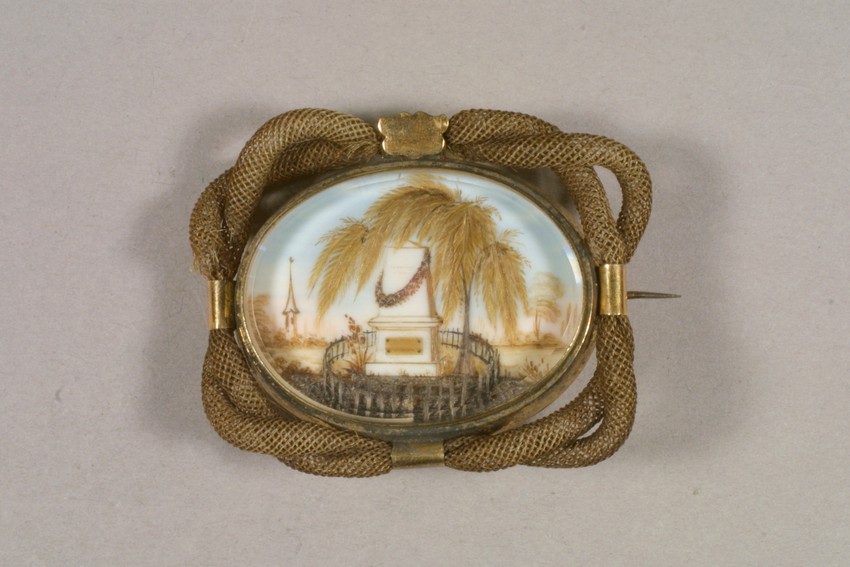
The funeral scene depicted in this c. 1850-80 hair brooch indicates that it is a
mourning piece. Hair jewelry could also be made and worn for sentimental reasons.

In 1862, Frank Leslie's Ladies' Magazine gives extensive descriptions of the different articles available for mourning wear; it contrasts rather sharply with the sentiment-focused tone of the Godey's article from eight years earlier. "The unfortunate war in which our country is now plunged, and the general mourning to which it has given rise, induces us to offer the following hints in relation to mourning fashions..."  These include the usual advice about keeping deep mourning attire plain or trimming it with crepe, but also describe white undersleeves and collars with black embroidery, and dinner, evening, ball dresses in black or white mourning.

Mourning collar and cuffs, 1862; to be made of white 'book muslin'
with black and white embroidery and white braid.

These highly fashionable approaches to mourning attire seem to be the stuff which draws hostility to mourning clothing in general.  An 1857 article in The Religious Monthly Magazine makes such complaints in moderate terms, finding fault in the excessive execution of a noble intent. Other sources will be less circumspect in mocking formalized mourning periods or fashionable mourning clothing.  Even books addressed to the grieving remark upon the more extreme mourning worn by fashionable city-dwellers than simple country folk, much in the same vein as Godey's earlier remarks on "half mourning" really being "fashionable mourning."  Nor is this the only strange (to me) juxtaposition of serious mourning sentiment with condemnation of mourning fashions:  in 1864, The Family Friend runs a joke about "Gradations in Mourning" right next to a "Rhyme for The Children" about the death of "Little Jane".

Arthur's Home Magazine published an article on "Going Into Mourning" in 1855 (originally excerpted from Susannah Moodie's 1853 Life in the Clearings Versus the Bush), which condemned the practice of wearing mourning at all. More specifically, it reiterates the idea that sentiment and fashion should not be conflated in the public eye, and in doing so offers examples of poor, sincere people either not being able to don mourning, or wasting their little means trying to do so, while richer, shallow people wear fashionable mourning garments for vanity rather than honest emotion.  For instance:
"We once heard a very beautiful volatile young lady exclaim, with something very like glee in her look and tone, after reading a letter she had received by the post, with its ominous black bordering and seal--'Grandmamma is dead! We shall have to go into deep mourning. I am so glad, for black is so becoming to me!'" 
Another example in that piece describes (and condemns) a man attending a ball within a week of burying a child. Apparently this wasn't a singular case: some people in mourning (and even in mourning attire!) apparently attended balls.  In addition to the 1862 fashion notes previously mentioned in Frank Leslie's, The Fashionable Dancer's Casket (1856) states that:
"Mourning in any stage--full mourning or half mourning--has always a somber appearance, and is, therefore, unbecoming in a ballroom; but since the custom of decorating it with scarlet has come into vogue, an air of cheerfulness has been imparted to its melancholy appearance."
Even people who are truly mourning might not wear mourning.  In addition to the cost factor addressed above, some people eschewed mourning clothing at the request of the dying, on account of age, for religious or patriotic reasons, or because they did not care for the custom. The Society of Friends (Quakers) did not wear mourning in the mid-nineteenth century, and some other individuals also found mourning for the righteous dead incompatible with Christian theology.  Mourning attire was curtailed during the American Revolution, forbidden during the Crimean War, and abandoned by some during the Civil War, for various reasons of morale, patriotism, and later scarcity of material. At least one (fictitious) woman who lost a son in the war forbore wearing mourning, instead spending the money to aid soldiers.

Not that everyone stopped wearing mourning due to the war; Frank Leslie's (1862) mentions that "the disastrous war now raging...make[s] black, white, violet, and mauve the prevailing colors".  In the south, particularly, such things could be difficult to come by:
"I gave $375 for my mourning, which consists of a black alpaca dress and a crape veil. With bonnet gloves and all it came to $500. Before the blockade such things as I have would not have been thought fit for a chamber maid." 
-Mary Chestnut, A Diary from Dixie, March 15, 1864

This is the current extent of my research into mourning clothing of the mid-19th century, which I hope may prove useful to the reader in his or her own.

The Soldier's Memorial, c. 1863

Friday, June 5, 2015

Research Resources: Period Paintings

Another tool to train the eye: contemporary paintings.  These can be a fascinating resource for material culture and clothing in context--as well as activities and attitudes of the time.

For our military men, what fun details can you spot in this 1863 painting?
"Home Sweet Home", c. 1863, Winslow Homer
"The War Spirit at Home: Celebrating the Battle of Vicksburg", Lilly Martin Spencer, 1866
Children playing, mom in her wrapper with a newspaper and the baby, an apron-wearing servant wiping the dishes.  Note the children's headgear as they play soldiers: a folded paper hat, an actual kepi, and I-don't-know-what on the youngest's head.  In the background, a draped table and what may be breakfast dishes.
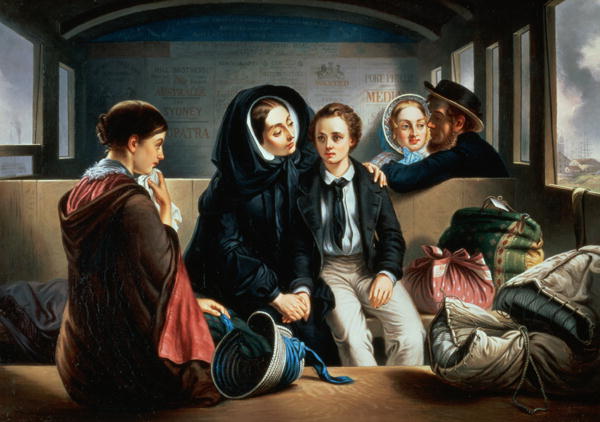
"Second Class: The Parting", revised version 1855, by A. Solomon
There's all sorts of fun material culture details here.  The hand luggage includes a carpet bag with a card on the handle, some red patterned cloth (a shawl?) tied into a bundle, and a stouter cloth pack tied with cords.  The young woman has taken off her straw bonnet (unlined, no frill, straw curtain), but still wears her cloak, with the hood off; the mother wears an attached hood drawn over her bonnet, while the third lady has kept her bonnet on.  The young man wears no head covering, while the older one in the background seems to have a two-toned hat--a trick of the light? a straw hat with a very broad black hatband? a black hat with some sort of facing on the underside of the brim? a hat with brim and crown of different materials?  There's also the characteristics of the train itself--the wooden benches, the open car, advertisements on the wall (contrast to the "First Class", by the same artist, whose occupants enjoy separated, upholstered seats in a private carriage).

"Changing Homes" by G. E. Hicks, 1862 (British)
So much detail! Blinds and layered curtains on the windows, the identical chandeliers in the two parlors, which are divided by curtains  The men have removed their hats, while the women (including the bride!) continue to wear bonnets, save for an old woman in a cap and a young woman bare-headed.  Three young girls (bridesmaids?) wear identical striped white dresses with cloaks--on one, you can see a pink waist sash with scalloped edges.

Some Artists to Look Out For
William Powell Frith, British genre painter, 19th century
William Hemsley, British genre painter, 19th century, many paintings of rural children
Winslow Homer, American, 1860s-1900s, slice of life images, include soldiers and leisure activities
Abraham Solomon, a British painter active in the 1840s-1860s; historic and contemporary subjects
Lily Martin Spencer, American genre painter, 1850s-1860s, focused on women and children.
Francis Xavier Winterhalter, German, 1830s-1870s, famous for portraits of royalty.

Other Collections
The Atheneum (you can search by year as well as artist!)
19th Century Genre Paintings on Wikipedia
The Victorian and Albert Museum (use advanced search to find paintings and narrow the year range)
The Metropolitan Museum of Art (ditto)

Monday, June 1, 2015

Concerning Hoopskirts

This 1858 illustrator has apparently confused
the crinoline with the lightning rod.

"The circles were all changed to polygons, and at every angle was a neat splice of white cord, or a bandage galloon, or a delicate suture of linen thread, and in one place where the break was particularly bad--a regular compound fracture as the doctors would say--and the steel protruded through the skin, the dear little woman had put it into splints of whalebone, and wound it round and round with bonnet-wire! I felt the tears come into my eyes as I looked at Mrs. Lambswool's hoops. 

When did she get that set? I counted on my fingers, and calculated that it must have been at least six months ago. It was the regular old-fashioned Champagne-glass figure and I reflected that had Mrs. Lambswool married somebody besides a poor book-keeper she would have had at least two new sets since that was bought."

--"My Velvet Shoes" in Harper's New Monthly Magazine (1860), hat tip to Jessamyn

Fiction though it may be, this internal monologue by a cash-strapped husband gives some useful insight into hoops in the year 1860.  We see how a set may be repaired and made to last by an economically-minded woman; we learn that shapes were changing rapidly enough for six-month-old hoops to be "old-fashioned" (it is later revealed that Mrs. Lambswool turned down a stylish friend's invitation because she was ashamed of her outmoded hoops); we learn that replacing hoops every two months or so is normal for someone who is not struggling financially; we later learn that purchasing hoops is embarrassing for a man, and that many different brands of hoops are available.  The new set bought to replace the above has 30-springs and cost $3 (for a top brand); in comparison, $5 was expected to buy a quality pair of men's boots, $0.50-$1 gets a cheap pair of shoes, and $0.50 is paid for a good clothes basket with a lid.

1858 Hoop skirt illustration from Peterson's Magazine
Hoop in Peterson's, 1858
This story indicated that even people in financially precarious situations made a point of wearing hoops.  Other sources confirm that hoops were ubiquitous, rich and poor:

"Hoop skirts--Have become, if possible, still a more confirmed and indispensable article of dress..." - Hesperian (1861)

"Five years ago when hooped skirts were first introduced, every one predicted for them a speedy decline, and fall; but after encountering the shafts of ridicule and opposition in every conceivable form, they still not only remain a fixed fact, but have become a permanent institution, which no caprice of fashion will be like to wholly destroy." -Peterson's, November 1861 (page 384).  Current prices at that time for "Demorest's Prize Medal Hoop Skirts" range from $0.50 for a 12 spring skirt to $2.00 for a 40 spring one.  Children's sizes are also available, from $0.19 to $1.00.  The skirts are noted for their quality construction and cheap cost.

As early as March 1857, Frank Leslie's New York Journal ran instructions for a "hoop petticoat": make a 2.5 yard (90" circumference) petticoat with six tucks, and then insert cane, steel, or whalebone into each.  The author finds these petticoats to be more durable than crinoline (the original "crinoline" being a petticoat made of the stiff linen/horsehair material called by that name), as well as cheap and easy to make at home.

A writer for The Saturday Review (1862) had hoped that fashionable women would abandon hoops once their servants started wearing them.  He is disappointed that this is not the case.

Servants' crinolines ridiculed in Punch, November 21, 1863

In occupied New Orleans, Miss Clara Solomon writes on Sunday, June 22nd, 1862:  “A. is by me grumbling as she is “devoting her whole energy to her hoop”; but these indispensable articles have become much reduced in price, as there had been an influx from Yankee Land, & it is useless to say you will not purchase Yankee importations when the majority of individuals do.”"

A defense of hoops in Ballou's Dollar Monthly (1863) appeals to both the convenience of wearing hoops and to the public stigma of appearing without them.  It includes this advice to complaining husbands:
"Now let me advise thee don that coatapet minus the wires, also thy wife's wrapper, just to see how nice thee will feel with thy feet hampered and muffled in the tangling skirts of heavy gowns. I think, too, thee might take a stroll on the shore, where the winds can have a fling at the cumbersome drapery. I trust thee will by that time be quite cured of anti-hoopopathy, and perfectly ready to enthrone Queen Crinoline." (The statement was attributed to a quaker woman, thus the 'thee's.)

Many different designs in hoop skirts were available in the 1850s-60s, and they were constantly changing; in 1858 alone, 16 different patents were issued in the US for hoop skirts, skeleton skirts, improved fasteners, buckles, etc.

While most (I daresay all) of us won't be acquiring dozens of hoops with minute styling differences for each of the years 1861-1865, an over-view of the popular shape will help train the eye.  To a small degree, changes in the fashionable form can be imitated by adding a bustle-pad ('tournure' or 'dress improver') to change the back-fullness and adopting petticoats and skirts of varying fullness and set.
"'The Crystal' hoop-skirt from Sherwood & Douglas; made of boiled bone,
this skirt has an 'adjustable tournour' and is superior to last season's 'skeleton hoops'."
July, 1856, Mrs. Stephens' Illustrated Magazine.
The dome-shaped "Princess Royal" Skirt, 
Frank Leslie's, 1858.
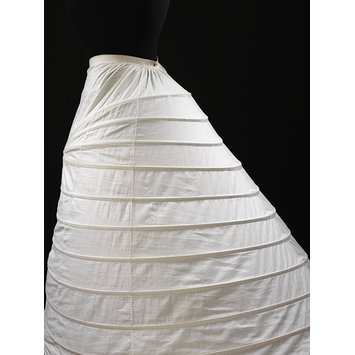
Covered Cage Crinoline, 1858, from VAM
Godey's, 1859; This arrangment promises more convenient wearing than the
"skeleton skirt", with removable steels for easy laundering
Crinoline Ad in La Follet, 1863, the round "dome" has become more conical
The "Patent Ondina or Waved Jupon" skirts in this 1864 advertisement
show the development of a more elliptical-shaped hoop. 
1865 Crinoline from Der Bazar: narrow upper, flat front, and long back
Egg-shaped foot-print of the 1865 crinoline
Although no picture is included, there's a very optimistic description of an 'inflatable' hoop found in Godey's in 1856:
I can think of a few things more charming, and would expect to see this write-up in Punch rather than Godey's!

[Edited to add: Punch did oblige with a cartoon on this topic, January 17, 1857:]

A final note on nomenclature: how did they name their skirt-supports?  Searching through Google Books, 1855-1865, "crinoline" is one of the most commonly used general terms, with "hoop" and "cage" being used casually (by fans and detractors alike). "Skeleton skirt" shows up in patent and advertising materials, as does "expansion skirt"; both get rather less usage in fiction, perhaps due to their specificity.  "Hoop-skirt" and "hoop petticoat" are also period terms. "Covered crinoline" is used rarely, and only late in the war.  The french "jupon" also is used in some publications.

I've found no period uses of the terms "cage crinoline" and "covered cage" in reference to skirt-supports.

Tuesday, May 26, 2015

Event: Deep Creek (Spokane)

The WCWA reenactment season began this last weekend, and a few hardy souls from the 4th made the cross-state journey to participate.


Our correspondent informs us that President Lincoln and General Grant were in attendance and well-received by the crowds.  Mr. Strand, a private with the 4th US, managed to have his image struck with both illustrious gentlemen.  Captain Jones, our stalwart leader, was also seen in the company General Grant, who must surely have recognized in his subordinate a kindred spirit of honor and martial merit.

Thursday, May 21, 2015

Quick-Start Civilian Reenacting: Secondary Sources

Deep Creek is this weekend; in honor of the new season, here are some secondary sources that I find informative and enjoyable.

There's a lot to learn about the 19th century, and we don't all have the time or inclination to become experts in every sub-field.  Well-researched secondary sources can make interesting, and very readable introductions topics one hasn't previously considered.

For civilian women just starting out, Bonny Blue Historical Help has some straightforward "do's and don't's" for planning your first outfit.

Liz Clark's articles are well-researched and amusing.  In addition to the free patterns, her compendium has a lot of advice for progressive reenacting at all levels, especially with children (beginners, check out "Assembling Your Best-Bet Wardrobe" and "The True Cost of Accuracy"). A subject search or inquiry posted at the Sewing Academy will usually get you some friendly advice and links.

Virginia's Veranda & the archive: Mrs. Mescher has a host of fascinating articles on topics near the civilian ACW reenactor's heart.  Whether you're looking for resources for your laundress impression, trying to find an accurate basket, or want a succinct history of calling cards, there's a lot to read (and extensive bibliographies if you want to find more).

The Atlantic Guard Soldiers' Aid Society has a wide range of articles on reenacting, as well as period clothing & material culture, farming, crafts, society, and most other topics under the sun.

Anna Worden Bauersmith has several helpful "101 Articles" on civilian reenacting.  She also does lovely advanced research on straw bonnets, sewing accessories, shawls, and hair nets. (If you're having trouble with a fashion bonnet sliding around, see her blog post on bonnet stays).

Scroll through The Victorian Needle to learn about 19th century jewelry design and materials.

The Pragmatic Costumer explains corsets, for those still ambivalent about wearing them.

Time Traveling in Costume has a basic run-down of women's watches and watch chains. The authentic campaigner (a great military reenactor forum) also has a watch primer, as does Old Sacramento Living History.

A detailed guide to period glasses and spectacles from the Historic Eyewear Company.

An introduction to period parasols from Marta Vincent.

A fabric-choosing flow chart for women's dresses, courtesy of Heather Sheen.

The Citizen's Companion and Homefront Herald also regularly publish articles on civilian history and re-enactment.

[For the military side of things, The Authentic Campaigner is a good place to ask questions.]

Tuesday, May 19, 2015

Did Victorians Wear Make-Up?

Yes.  And no.

Various cosmetics were available in the 1850s and '60s: the most common skin preparations appear to be 'white powders' (some are liquid or paste), and red coloring agents (rouges, carmine, 'soaps'). 'Hair restoratives' (and/or dyes), pomades, and hair oils are also mentioned.  Scents were popular, even ubiquitous.  Victorians also had homemade wrinkle-cream, freckle-remover, cold cream, and sun burn remedies.

This gives us a fairly good idea of what (mid-)Victorians were looking for in their cosmetics: a delicate complexion with a healthy 'bloom'; pleasant smells; and soft, full, shiny hair.  I've found no period analogues to eye shadow, mascara, eye or lip liner, or lip stick.

One other thing they had, however, was a rather complicated relationship with these beauty-aids.

From The Lady's Guide to Perfect Gentility (1856):

"A fair skin and rosy cheek are calculated to excite admiration; but if it be discovered that they are entirely produced by paint, that admiration becomes disgust; or if owing to disease, it is changed to pity."

And:

"A good selection of cosmetics and kindred preparations is important for the completeness of a lady's toilette. As a general rule, to set off the complexion with all the advantage it can attain, nothing more is requisite than to wash the face with pure water; or if anything further be occasionally necessary, it is only the addition of a little nice soap. As to the use of paints, washes, &c, it is not for us to determine; but in giving the following receipts, we have endeavored to distinguish those which are most objectionable, on account of the deleterious articles which they contain. A knowledge of their manufacture will, therefore, prevent ill consequences, if it be productive of no other good. "


“We have already expressed our opinion respecting paints and cosmetics. The latter cannot, of course, be objected to when the name is only expressive of their quality; but very
many compositions which have this alluring title, prove after a while to be destroyers rather than beautifiers. … Paints, however, can be of no benefit further than to produce a false appearance of beauty, and to a certain extent they must be injurious ; if even no poisonous ingredient be in their composition...”

The Philosophy of Common Life (1857) by John Scoffern including instructions "cosmetic paints" including red-hued "soaps", white-hued "powders" and anti-pimple preparations. The author explicitly notes that the best-looking white powders are based on poisonous lead or bismuth; they are included anyway, as "for stage purposes at least, these poisonous cosmetics cannot be dispensed with", but come with a warning to use minimal amounts and to remove the powder completely after use

Rouge-wearers are warned that their paints "soil the handkerchief, thus not only marring the beauty the rouged skin, but what is far worse tell tales."


Similar recipes, and commentary, show up in the American Journal of Pharmacy (1856):
"The use of a white paint by actresses and dancers is absolutely necessary; great exertion produces a florid complexion, which is incompatible with certain scenic effects, and requires a cosmetic to subdue it."

Mrs. (Sarah Josepha) Hale, of Godey's Ladies' Book fame, writes in Mrs. Hale's Receipts for the Million (1857):

OF THE COMPLEXION 
531. Never Paint--The use of white paint as a cosmetic affects the eyes, which it renders painful and watery. It changes the texture of the skin, on which it produces pimples; attacks the teeth, destroys the enamel, and loosens them. It heats the mouth and throat, infecting and corrupting the saliva. Lastly, it penetrates the pores of the skin, acting by degrees on the spongy substance of the lungs, and inducing disease. Powdered magnesia, or violet powder, is no further injurious than by stopping the pores of the skin; but this is quite injury enough to preclude its use. The best cosmetics are early hours, exercise, and temperance.  

The Family Doctor (1858) defines 'Cosmetic':
An external application to the skin, applied for the purpose of removing spots and freckles and improving the complexion. It may be innoxious such as Elder flower, Rose or Hungary Water; but most of the cosmetics employed are of a deleterious nature and ultimately, if not immediately, prove injurious to the tissues of the skin, and by their absorption affect the general health. 

The 1858 Lady's Companion includes the short story "Beauties Without Paint".

The Miss Worsdells laughed immensely at what they termed Anna Kent's preaching; but, nevertheless she firmly refused all offers of the beauty-bestowing blanc perle. "If I were as ruddy as a milkmaid", she observed, "as brown as a gipsy,  I would not use such stuff. I thought, indeed, it might be a simple herbal preparation which made you so fair; but paint ! oh, fie, cousins ! is it not a reproach to a woman to use red and white on her face?" 

"I beg your pardon, Anna", said Clara Worsdell, much offended, "we never paint our cheeks with rouge."


"And pray", her cousin asked, "what is the difference, or distinction, between white paint or red? I think I know, Clara, without your answer--the one is shameful, the other baneful."


Of course, twenty years later, Anna is happily married and still looks "fresh and youthful".  One of her make-up-wearing cousins is married, but prematurely aged and in poor health; the other never married, and went blind.  They both greatly regret having worn 'white powders' in their youth.


“The Best Cosmetic”, a parable in Arthur's Home Magazine (1865) also champions the idea that clean living and a sweet disposition are more beautifying than chemicals.

Meanwhile, humorous publications like Punch (1863) also attack the use of 'paints':

"As for paint attracting lovers, I am sure it only serves to frighten them away. Who with lips that are by nature capable of kissing would ever dream of paying his addresses to a girl with 'touch me not' quite plainly painted on her face? The misletoe will soon be an extinct institution if girls persist in trying to make themselves unkissable by colouring their cheeks."

And in non-fiction, the 1858 Autobiography of Mary Anne Schimmelpenninck relates an incident:


"There was one lady, the Duchess of D-- whom he had recently been called to attend, who was perishing, he said, under the effect of the white enamel paint which some ladies were then very fond of applying. The doctor at once perceived the cause of her malady, but he knew it would be tender ground to touch upon, since her use of this cosmetic was kept a profound secret, even from her family..."

The Proceedings of the First Annual Meeting of the Homeopathic Medical Society of Ohio (1865) include a report from one Mrs. Dr. Chase on "Toilet Articles and Toxicology".


"The occasional use of powders for the skin, and artificial coloring, is common, and such being the case, however much we may disapprove of it, persons should know something about the materials from which these are prepared, and be placed on their guard against dangerous combinations."


Hair dyes seem to meet with less disapprobation than face-paint.  From How to Arrange the Hair (1857):
"As to Hair-dyes, their name is legion, and every coiffeur has his own favourite preparation. … Care should be taken to suit the dye to the complexion and age..." 

The author goes on to relate in anecdote in which a child gets into her mother's hair dye, causing embarrassment before their guests. 

Scents, on the other hand, appear quite respectable.  The fact that they are obvious (no one 'naturally' smells like roses, after all) may have something to do with it.

“In the United States, the use of perfumery is general.”

In this context, "perfumery" includes not only scents, but also pomades, oils, and select other cosmetic preparations.  Whole books of instructions are written on it, like The Art of Perfumery (1857), and mainstream publications also include recipes: Godey's prints multiple recipes for “odors for the handkerchief” in 1858, and The Whatnot or Ladies' Handy-book (1859) contains “toilet receipts” including hair dye, curling fluid, lip salve, cologne, dentrifice, and “a cure for warts”

In general, the Victorians abhor the use of rouge and other 'red paints', but knowledge of them is readily available.  'White paints' and face powders seem more widely used, but considerable objection to them exists (above their known dangers).  Hair dye occupies as similar in-between place: it is used, but not admitted.  Perfume meets with no known opposition; various skin remedies are remarked on, but the only censure seems directed at those seen as wasteful or foolish (washing in milk, sleeping with meat over the face) rather than the accusations of deception, immorality, and toxicity which condemn 'paints'. 

When choosing whether to use cosmetics in reenacting, keep in mind your persona, the beauty ideals of the time you are portraying, and the available technology to meet those ideals (by all means, stay away from the poisonous ones!).  A full face of 21st century make-up, after all, looks like 21st century make-up.  A little rice powder for the would-be coquette, a dash of florida water on the handkerchief, or even some rouge on the cheek of a more daring woman, could all be interesting and "appropriate" additions to one's presentation.  

"I weary of this subject of Cosmetics, as every woman of sense will at last weary of the use of them. "
--Lola Montez, "Beautiful Women" (Lecture, 1858)

Monday, May 18, 2015

Event: Armed Forces Day at Fort Lewis

On Saturday, May 16th, members of the 4th US participated in a military-themed living history day at Fort Lewis.  

Our recruiting sergeant, hard at work
Truly, this is a model field hospital
Credit to Mr. Strand for the photos, and finding this video of the proceedings (Hospital shows up around 8:23, WCWA display at 11:11):